Over the past decade, influencers—individuals or organizations with substantial social media reach—have evolved into one of the most influential forces in modern marketing. Their ability to shape consumer perceptions, drive trends, and directly influence purchasing decisions has made them a cornerstone of brand communication strategies.
The numbers tell the story. Back in 2017, the global influencer marketing industry was valued at around $2 billion. Just a few years later, projections suggested the sector could grow to between $50 and $100 billion by 2020 (source: KOTRA, Korea Trade-Investment Promotion Agency). While exact figures vary, there is no doubt that the industry has expanded exponentially—and continues to do so.
Brands have increasingly shifted their advertising budgets toward influencer-driven campaigns, seeing them not just as an alternative but as a primary sales and engagement channel. Yet, beneath this impressive growth lies a set of structural issues that, if left unaddressed, could undermine the trust and efficiency of the entire ecosystem.
The Hidden Challenges Behind Influencer Marketing
While the influencer economy is booming, it is far from perfect. In fact, its rapid expansion has exposed several key challenges:
1. Centralization & Excessive Intermediary Costs
Top-tier influencers are often represented by agencies or management companies. While these intermediaries may help secure large deals, they also add significant layers of cost. Brands end up paying inflated rates, and influencers often lose a substantial portion of their earnings to commissions and fees.
2. Lack of Transparency
The industry suffers from data manipulation and metric inflation. Fake followers, purchased engagement, and artificially boosted impressions are not uncommon. Without reliable verification systems, brands risk investing in campaigns that don’t deliver genuine results.
3. Inefficient Matching Between Brands and Influencers
Many brands find it challenging to identify the right influencers for their products or services. At the same time, talented smaller influencers often remain undiscovered, missing out on fair opportunities for collaboration and growth.
Introducing SPIN Protocol – A Decentralized Marketplace for Influencer Marketing
SPIN Protocol proposes a radical solution: use blockchain technology to rebuild the influencer marketing ecosystem from the ground up—making it transparent, fair, and efficient. By replacing traditional intermediaries with a decentralized network, SPIN Protocol aims to empower both brands and influencers while ensuring trust and accountability.
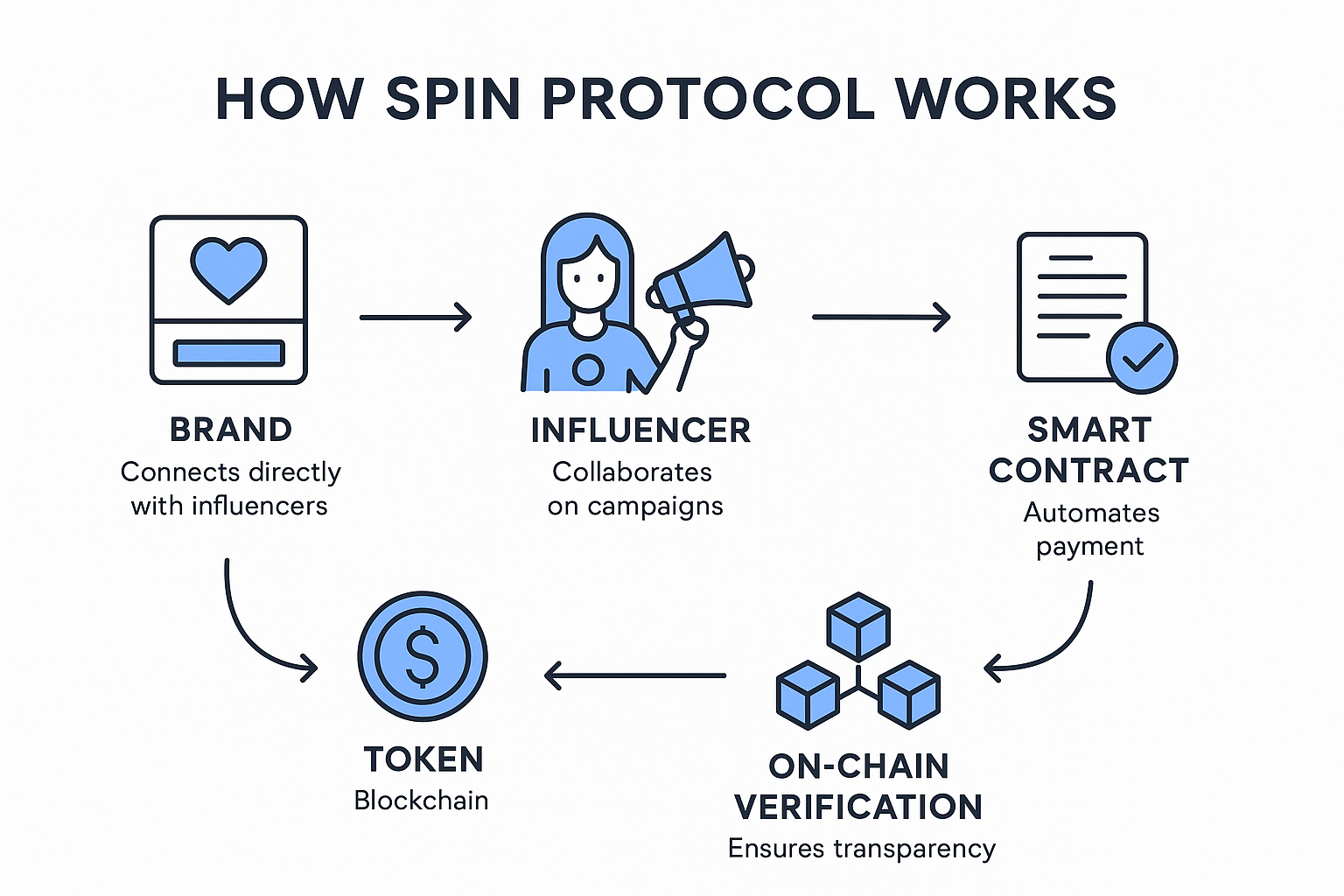
How It Works
SPIN Protocol leverages blockchain’s immutable ledger and smart contracts to create a self-sustaining marketplace where transactions are automated, data is verifiable, and partnerships are formed directly between brands and influencers.
Key Advantages of SPIN Protocol
✅ Lower Costs – By cutting out middlemen such as agencies, brands and influencers can connect directly. This reduces overhead, making campaigns more affordable for brands while allowing influencers to keep a larger share of earnings.
✅ Trustless Verification – SPIN uses on-chain analytics and blockchain-based identity verification to combat fake followers, inflated engagement metrics, and fraudulent activity.
✅ Smart Contract Payments – Campaign agreements are encoded in smart contracts, ensuring automatic and secure payments once agreed-upon deliverables are met. This eliminates disputes and delayed payments.
✅ Global Access – The decentralized nature of SPIN opens the door for cross-border collaborations. Brands can work with influencers anywhere in the world without the friction of traditional payment systems or contractual limitations.
Why Blockchain Changes the Game for Influencer Marketing
Blockchain’s impact goes far beyond just security and transparency. In influencer marketing, it can fundamentally reshape incentive structures, ensuring that:
- Influencers are rewarded fairly for authentic engagement.
- Brands receive guaranteed value for their investment.
- Audiences benefit from more genuine, relevant, and trustworthy content.
With SPIN Protocol, data integrity becomes non-negotiable. Every follower count, engagement rate, and campaign performance metric is stored in a tamper-proof ledger, providing brands with unprecedented confidence in their ROI calculations.
Real-World Applications of SPIN Protocol
Below is a detailed table showing how SPIN Protocol’s features can be applied across real-world influencer marketing scenarios:
| Feature | Description | Example Application |
|---|---|---|
| Direct Brand–Influencer Connections | Eliminates agencies and middlemen, enabling direct negotiation and collaboration. | A sustainable fashion brand partners directly with eco-conscious Instagram influencers without paying a 20% agency commission. |
| On-Chain Verification | Uses blockchain to validate follower authenticity and engagement. | A tech startup filters potential influencers, ensuring they have real audiences—not bots—before launching a product review campaign. |
| Smart Contract Payments | Automates payment upon campaign completion according to pre-set terms. | A beauty brand releases payment instantly after an influencer uploads the agreed tutorial video and reaches the specified engagement rate. |
| Cross-Border Transactions | Facilitates global influencer partnerships without currency conversion issues. | A U.S. beverage company works with a Japanese TikTok influencer, paying in stablecoins without delays or high bank fees. |
| Performance-Based Rewards | Rewards influencers based on actual campaign results rather than flat fees. | An e-commerce brand offers influencers a base payment plus a bonus tied to verified sales conversions tracked on-chain. |
| Decentralized Reputation Scores | Builds trust with a public record of past campaign performance and reliability. | A fitness influencer’s history of on-time deliverables and high engagement is visible to all brands before they sign a contract. |
The Road Ahead
The influencer marketing industry is too valuable—and too vulnerable—to rely on outdated systems of trust and manual verification. As advertising budgets continue to shift toward influencer-led strategies, the need for transparency, accountability, and efficiency will only intensify.
SPIN Protocol is not just another tool—it is a paradigm shift. By harnessing blockchain technology, it offers a future where influencer marketing is self-regulating, fraud-resistant, and globally accessible.
In this future, brands get genuine engagement, influencers are rewarded fairly, and audiences trust the content they consume. That’s not just innovation—it’s the foundation for a sustainable digital marketing ecosystem.
 Estrategias efectivas para tu negocio.
Deja un comentario