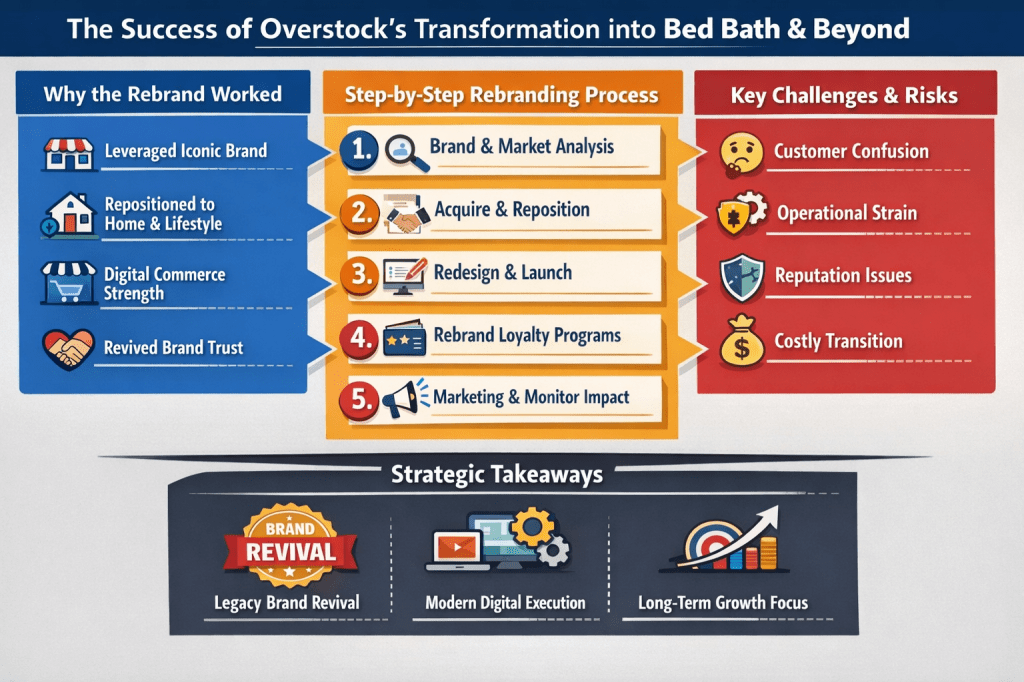
In a move that stunned both industry experts and consumers, Overstock’s bold transformation into Bed Bath & Beyond may go down as one of the most brilliant rebranding plays in retail history. What initially seemed like an unexpected pivot has revealed itself to be a stroke of strategic genius—one that merges digital agility with legacy brand power.
1. Why This Rebrand
- Leveraging an Iconic Brand
Bed Bath & Beyond, despite its financial struggles, remained a household name with deep customer loyalty. By acquiring its intellectual property, Overstock didn’t just buy a name—it inherited decades of brand equity, nostalgia, and trust. - From «Overstock» to «Beyond»
The Overstock brand, while successful, was often associated with liquidation and excess inventory. The shift to Bed Bath & Beyond reframes the company as a premier home goods destination, elevating its positioning from discount marketplace to a lifestyle brand. - Digital Meets Legacy
Bed Bath & Beyond’s brick-and-mortar struggles didn’t diminish its brand recognition—it simply needed a digital revival. Overstock, with its e-commerce expertise, was the perfect vehicle to resurrect BBB as an online powerhouse, blending the best of both worlds. - A Fresh Start with Familiar Trust
The rebrand allows the company to shed any lingering negative perceptions from Bed Bath & Beyond’s bankruptcy while retaining its emotional connection with shoppers. The relaunch as an online-only retailer gives it a clean slate with modern convenience.
2. A Rebrand for the Future
This isn’t just a name change—it’s a complete strategic realignment. Overstock (now Bed Bath & Beyond) has fully committed to being a home-focused e-commerce leader, capitalizing on shifting consumer habits while preserving the beloved aspects of a legacy brand.
Will It Succeed?
Early signs are promising. The buzz alone has reignited interest in Bed Bath & Beyond, and Overstock’s infrastructure ensures a seamless transition. If executed well, this could be a textbook case of how to breathe new life into a fading brand—without losing what made it special in the first place.
Here’s a synoptical table (side-by-side comparison) summarizing Overstock’s rebrand to Bed Bath & Beyond:
| Aspect | Overstock (Pre-Rebrand) | New Bed Bath & Beyond (Post-Rebrand) | Strategic Rationale |
|---|---|---|---|
| Brand Identity | Discount-focused online marketplace | Premium home lifestyle brand | Shed «liquidator» image; gain emotional appeal |
| Brand Equity | Limited nostalgia; transactional | Strong recognition & nostalgia (40+ years) | Leverage BBB’s legacy for instant trust |
| Business Model | Pure-play e-commerce | Online-first, but retains BBB’s brand essence | Modernize BBB while keeping its soul |
| Target Audience | Bargain hunters, deal-seekers | Home goods shoppers (mid-to-premium) | Attract higher-spending customers |
| Key Assets | E-commerce tech, logistics | BBB name, trademarks, customer data | Combine Overstock’s ops with BBB’s brand |
| Marketing Approach | Promoted deals, flash sales | Lifestyle branding (e.g., «Welcome Home») | Shift from price to quality/experience |
| Challenges | Perceived as «cheap» | Overcoming BBB’s bankruptcy stigma | Reassure customers of stability |
| Future Opportunities | Expand into new categories | Potential return to physical retail (pop-ups, partnerships) | Blend digital + tactile shopping |
Key Takeaways from the Table:
- From Discount to Premium: Overstock traded its liquidation reputation for BBB’s homemaker appeal.
- Digital Meets Legacy: BBB’s name + Overstock’s tech = a phoenix-like revival.
- Audience Upgrade: Targets more profitable home goods shoppers, not just bargain hunters.
- Long Game: Leaves door open for physical retail experiments later.
Would you like me to adjust any sections or highlight different aspects?
One thing’s for sure: This is rebranding done right. 🚀
What do you think—will the new Bed Bath & Beyond thrive?
3. Why This Rebrand Works: Strategic Rationale
Far from being a superficial marketing stunt, Overstock’s rebrand to Bed Bath & Beyond was rooted in powerful strategic logic — and it leveraged multiple core advantages:
A. Acquisition of a Legacy Brand With Emotional Equity
Although Bed Bath & Beyond the retailer shuttered its stores in 2023 after bankruptcy, the brand name itself carried decades of customer recognition, familiarity, and nostalgia. Rather than build brand awareness from scratch, Overstock paid roughly $21.5 million for trademarks, domains, customer data, and related intellectual property assets — instantly transporting itself into the top tier of the home goods category in consumer perception.
This is a textbook example of brand equity arbitrage: acquiring a well-known but financially struggling brand and pairing it with a capable operational engine to extract the latent value buried within. It’s a strategy usually reserved for private equity or brand investment firms — but Overstock executed it boldly as a core business pivot.
B. Reframing Market Positioning
Before the acquisition, Overstock was widely seen as a discount-focused online marketplace, often associated with liquidation inventory and price-driven deals. By adopting Bed Bath & Beyond, the company repositioned itself as a home and lifestyle brand with broader appeal — one that resonates emotionally with consumers looking to create home environments, not just score bargains.
This shift upgrades the company’s brand positioning from a niche discount identity to a broader lifestyle framework with higher lifetime customer potential.
C. Digital Meets Legacy
Bed Bath & Beyond’s physical stores struggled against competition and digital disruption (lagging ecommerce adoption, heavy fixed costs, supply-chain issues, and inventory mismatch), ultimately leading to bankruptcy. Overstock, by contrast, is an ecommerce native. Its infrastructure, logistics, and digital marketing capabilities made it the perfect vessel to resurrect the brand in a lean, scalable form — essentially turning old-world emotional trust into new-world digital customer acquisition.
D. Retaining Trust While Shedding Negative Associations
An effective rebrand must keep the positive associations of a legacy brand while distancing itself from any negatives. Overstock’s transformation accomplishes this — the Bed Bath & Beyond name evokes familiarity and trust for many consumers, while the company’s digital-first approach eliminates the burden of expensive brick-and-mortar stores that previously weighed down the brand’s profitability.
4. Strategic Lessons Every Business Can Apply
From this case, businesses of all sizes — from startups to corporates — can extract strategic lessons:
Lesson 1 — Brand Equity Never Dies, It Just Changes Form
Physical decline or bankruptcy does not necessarily erase customer memory or loyalty. A strong brand identity can live on through new ownership if it retains emotional significance. This is why established brands remain valuable even when operational models fail.
Lesson 2 — Operational Execution Matters More Than Brand Name Alone
A powerful brand without efficient operations will fail. Overstock’s ecommerce infrastructure was an essential piece enabling the Bed Bath & Beyond identity to live again — this alignment is critical.
Lesson 3 — Rebrands Are Long-Term Positioning Moves, Not Quick Fixes
A name change may generate buzz, but long-term success comes from sustained customer experience improvements, consistent messaging, and renewed operational investments.
Lesson 4 — Legacy Assets Can Be Strategic Levers
Brands can strategically acquire assets (like customer data, historical loyalty programs, and trademarks) not just for nostalgia but as foundations for future growth. This illustrates that brand portfolios themselves are investable and monetizable assets.
5. Step-by-Step Blueprint for a Successful Rebranding Process
To emulate success like Overstock’s, here’s a practical rebranding roadmap any company can follow:
Step 1 — Define Your Strategic Purpose
Ask: Why rebrand? What are the core business outcomes we hope to achieve?
Common strategic goals include:
- Reaching new customer segments
- Eliminating outdated brand perceptions
- Merging with or acquiring complementary brands
- Repositioning in a changing market
In Overstock’s case, the purpose was to leverage a historic brand’s equity to scale ecommerce market share quickly.
Step 2 — Conduct Brand Equity & Market Analysis
Assess:
- Brand awareness and perception among target audiences
- Strengths and weaknesses in the current positioning
- Opportunities in customer segments not yet captured
This should involve both qualitative and quantitative research.
Step 3 — Evaluate Acquisition or Partnership Options
Depending on goals, options may include:
- Purchasing intellectual property from a legacy brand
- Entering licensing or strategic alliance agreements
- Merging identities with compatible partners
For Overstock, acquiring Bed Bath & Beyond’s IP provided an instant lift in brand recognition.
Step 4 — Rename, Reposition, and Visual Identity
This includes:
- Brand naming and tagline
- Visual identity refresh (logos, design systems, color palettes)
- Messaging frameworks (value proposition, brand story)
If discontinuing a legacy name, plan for a gradual transition or dual-branding to ease audience acceptance.
Step 5 — Update Customer Touchpoints
Ensure your brand updates reach all channels:
- Website and app
- Social media and content platforms
- Marketing automation and customer communications
- Packaging and user experience flows
Overstock relaunched bedbathandbeyond.com as the central ecommerce destination while phasing out Overstock’s previous identity.
Step 6 — Reframe Loyalty Programs & Customer Data
Effective rebranding often goes beyond the name. Align existing loyalty or reward programs with the new identity — for instance, rebranding Overstock’s Club O as Welcome Rewards to reflect the new positioning.
Step 7 — Amplify Marketing & PR
A rebrand must be announced with strategic amplification:
- Press releases and investor communications
- Paid campaigns across search, social, and display
- Content marketing to educate audiences
- Influencer and community engagement programs
Overstock’s move generated surges in investor interest and stock valuation, illustrating the marketing impact a rebrand can have when executed with a compelling narrative.
Step 8 — Monitor Brand Health & Performance Metrics
Branding isn’t a one-off activity — track:
- Awareness and sentiment changes
- Customer acquisition costs
- Repeat purchase and loyalty metrics
- Revenue impact correlated to brand campaigns
Overstock’s transformation continues to be a work in progress with ongoing performance reviews and strategic investments.
4. Challenges and Strategic Risks to Mitigate
A rebranding of this magnitude carries inherent risks:
• Customer Confusion or Rejection
Long-standing fans of the original brand may resist change unless the new value proposition is clear.
• Operational Strain During Transition
Systems, supply chains, and customer support must align with the new identity simultaneously to avoid service gaps.
• Managing Legacy Brand Perceptions
Negative associations, such as bankruptcy stigma, require careful narrative framing to reestablish trust.
• Cost of Transition Execution
While brand acquisition may be inexpensive relative to building awareness from scratch, operational and marketing investments still require disciplined management.
5. Looking Ahead: The Future of This Transformation
The story continues beyond the initial rebrand. As of early 2026:
- Efforts are underway to reintroduce a standalone Overstock.com alongside Bed Bath & Beyond for differentiated positioning.
- Bed Bath & Beyond’s evolution now includes partnerships that may eventually return a scaled physical retail presence and hybrid omni-channel formats.
This evolution shows that strategic rebrand transformations are not endpoints — they are foundations for the next stage of innovation.
Key Strategic Takeaways
At its core, Overstock’s transition into Bed Bath & Beyond demonstrates:
✔ A legacy brand’s emotional power can be revived when paired with modern operational excellence.
✔ Thoughtful rebranding grounded in strategy can unlock growth opportunities rapidly.
✔ Successful brand transformations require deep alignment across operations, marketing, and customer experience.
✔ Rebrands should be measured continuously, not launched and forgotten.
 Estrategias efectivas para tu negocio.
Deja un comentario