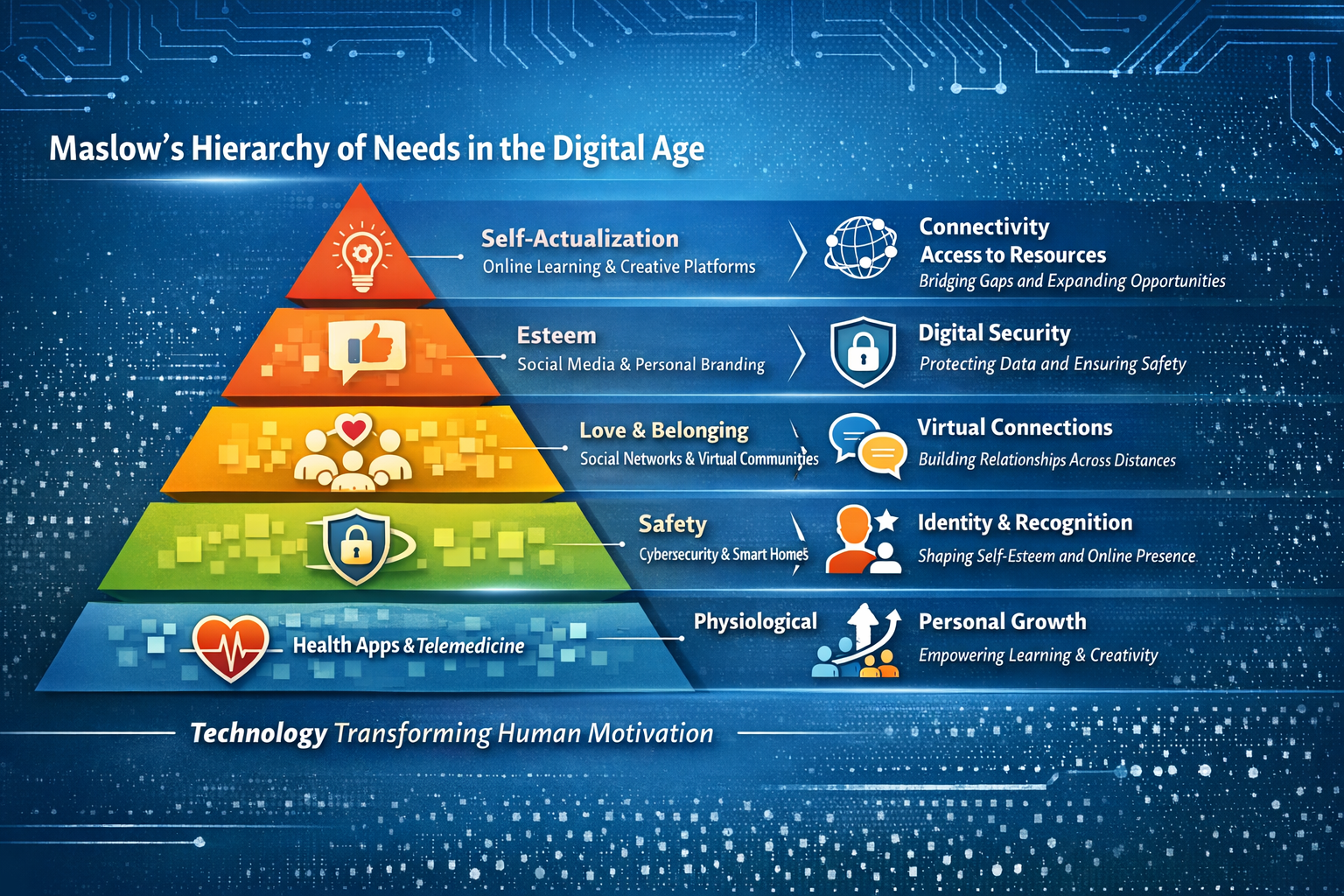
Abraham Maslow’s hierarchy of needs has long been one of the most influential models for understanding human motivation. His framework, commonly represented as a pyramid, describes the progression people follow from the satisfaction of basic survival needs to self-actualization, understood as the full realization of individual potential. However, the context in which we live today is radically different from the mid-twentieth century, when Maslow first introduced his theory. Digital technology has transformed the way we access resources, relate to others, build our identity, and pursue personal growth.
Today, every level of the pyramid is mediated—directly or indirectly—by technological systems that expand our possibilities while also creating new challenges. Understanding this interaction between human needs and the digital environment allows us to better interpret how our motivations are evolving in the twenty-first century.
In many parts of the world, access to a smartphone and an internet connection has become a gateway to food, work, healthcare, education, relationships, identity, and creativity. In this sense, digital access itself is increasingly being discussed as a foundational human enabler.
According to the International Telecommunication Union, around 6 billion people — roughly 75% of the world’s population — were using the internet in 2025, while 2.2 billion people still remained offline, highlighting a persistent digital divide.
This divide is not only technological — it is directly linked to economic development, education, health access, and opportunity.
In this post, we’ll explore how technology intersects with each level of Maslow’s pyramid, offering solutions that enhance quality of life and drive personal growth.
1. Physiological Needs: Technology as an Infrastructure for Survival
At the base of the pyramid, physiological needs are being transformed by smart systems, data, and global logistics.
Precision agriculture, powered by satellite imaging, IoT sensors, and AI-driven climate analysis, allows farmers to optimize water use and increase food production. Companies using vertical farming and hydroponics are producing food in urban environments with minimal land and water. This is particularly relevant as the global population moves toward 10 billion people.
Food access is also being reshaped by digital platforms. In many cities, a person can obtain a full meal in less than 30 minutes through delivery ecosystems such as Glovo, Uber Eats, or Deliveroo. For vulnerable populations, digital identity systems and mobile banking enable direct access to financial aid and food programs without intermediaries.
Healthcare provides one of the clearest examples of technological impact. During the COVID-19 pandemic, telemedicine became essential. Remote diagnostics, wearable health devices such as smartwatches, and AI-assisted imaging systems now allow early detection of heart conditions, sleep disorders, and metabolic risks. According to global health reports, remote monitoring reduces hospital readmissions and improves chronic disease management.
Sleep — a core physiological need — is now tracked by millions of people using quantified-self technologies. This data-driven self-awareness is changing how individuals understand their own bodies.
Technology is not only helping people survive — it is helping them optimize their biological functioning.
- Smart Agriculture: AI-powered farming tools and IoT-enabled devices optimize crop yields, ensuring food security for growing populations.
- Water Purification Systems: Advanced filtration technologies provide clean drinking water to underserved communities.
- Smart Homes: Automated systems regulate temperature, lighting, and energy use, creating comfortable and sustainable living spaces.
- Sleep Tech: Wearables and apps track sleep patterns, offering insights to improve rest and overall health.
By enhancing access to basic resources, technology is helping humanity meet its most fundamental needs more efficiently than ever before.
Today, 56.5% of internet users buy something online every week, and global e-commerce spending on consumer goods is expected to reach $3.66 trillion in 2025.
This means access to a smartphone and connectivity increasingly determines access to:
- food delivery
- medicine
- basic goods
- emergency services
Mobile access is therefore a survival enabler: 70.1% of the global population uses a mobile phone, with 5.78 billion unique users.
2. Safety Needs: Digital Stability, Financial Inclusion, and New Forms of Risk
Safety in the digital era is deeply connected to economic participation.
More than a billion people have gained access to financial systems through mobile banking platforms such as M-Pesa. This has reduced extreme poverty levels in several regions by enabling savings, credit access, and micro-entrepreneurship.
The rise of remote work has also transformed job security. Digital platforms allow people to work for global companies without migrating. During economic crises, freelancers often rely on online marketplaces to maintain income streams.
Smart cities are using predictive analytics to improve public safety, traffic flow, and emergency response times. Early warning systems for natural disasters now rely on real-time data and mobile alerts, saving thousands of lives.
However, this level also introduces new insecurities:
- cybersecurity threats
- algorithmic bias in hiring or credit scoring
- data privacy concerns
- digital exclusion
Today, feeling “safe” increasingly includes:
- having control over personal data
- maintaining a stable digital identity
- being protected from online fraud
Security has become both physical and digital.
Security in the 21st century is deeply tied to digital participation.
Mobile technology is a major economic driver. In 2023, mobile technologies and services generated 5.4% of global GDP, equivalent to $5.7 trillion.
Financial inclusion has accelerated through mobile systems:
- In developing economies, 84% of adults own a mobile phone, making digital financial services accessible at scale.
- Mobile money platforms such as M-Pesa have lifted households out of extreme poverty in multiple regions (widely documented by the World Bank and development research).
Digital labour markets also contribute to perceived security:
- An estimated 163 million freelancer profiles exist on online labour platforms, showing the global scale of digital work opportunities.
However, safety now includes:
- data protection
- cybersecurity
- control over digital identity
This reflects a shift from purely physical security to hybrid physical-digital security.
Technology is addressing these concerns through:
- Cybersecurity Tools: Protecting personal and financial data from cyber threats.
- Smart Security Systems: AI-driven cameras, alarms, and sensors safeguard homes and businesses.
- Health Tech: Wearables and telemedicine platforms provide real-time health monitoring and remote access to medical care.
- Financial Apps: Budgeting tools and digital banking platforms promote financial stability and planning.
These innovations empower individuals to feel secure in an increasingly complex world.
3. Love and Belonging: The Rise of Networked Communities
Belonging is one of the most dramatically transformed levels.
Globally:
The average person spends 18 hours and 36 minutes per week on social platforms.
Human connection has been radically expanded by digital platforms.
5.66 billion social media user identities exist, equal to 68.7% of the world’s population.
93.8% of internet users use social media every month.
Diasporas maintain daily contact with their families through video calls. Patients with rare diseases find global support groups. People with niche interests form communities that would never exist locally.
Online learning platforms create cohort-based communities where participants from different continents collaborate and build long-term professional relationships. Gaming environments and virtual worlds have become social spaces where millions interact in real time.
Research consistently shows that for younger generations, digital belonging is not a substitute for “real life” — it is part of real life.
At the same time, new challenges appear:
- loneliness despite hyperconnection
- parasocial relationships
- the pressure of constant availability
The key shift is that belonging is no longer geographically defined — it is interest-based and identity-based.
Humans crave social connections, and technology is bridging gaps like never before:
- Social Media Platforms: Facebook, Instagram, and LinkedIn foster relationships and community building.
- Communication Tools: Apps like Zoom and WhatsApp enable real-time connections across the globe.
- Online Communities: Forums and interest-based groups provide a sense of belonging for people with shared passions.
While technology can’t replace face-to-face interactions, it amplifies our ability to connect, especially in a globalized world.
Digital belonging is particularly relevant for younger generations:
82% of people aged 15–24 are online, compared with 72% of the rest of the population.
Belonging is no longer geographically defined — it is network-based.
4. Esteem Needs: The Attention Economy and the Construction of Digital Identity
Recognition in the digital age is measurable, visible, and scalable.
A creator can reach an audience of millions without traditional gatekeepers. A developer can build a global reputation through open-source contributions. A professional can gain credibility through thought leadership on LinkedIn or research shared on open platforms.
The creator economy has enabled individuals to turn expertise into income and social recognition. Millions of people now generate revenue through content, courses, digital products, or online communities.
Access to education has also changed self-esteem dynamics. Platforms such as Coursera, edX, and Khan Academy allow individuals from any background to obtain high-level training. Completing a course from a top university no longer requires physical presence.
However, the metrics of visibility — likes, followers, engagement — can create:
- comparison anxiety
- performance pressure
- validation dependency
Self-esteem in the digital world requires new forms of emotional literacy and critical thinking.
Technology supports these needs by:
- Professional Development Platforms: LinkedIn Learning, Coursera, and Udemy offer opportunities for skill-building and career advancement.
- Personal Branding Tools: Social media and websites enable individuals to showcase their achievements and expertise.
- Gamification: Apps and platforms use game-like elements to motivate users and celebrate milestones.
By providing tools for growth and recognition, technology helps individuals build confidence and achieve their goals.
At the same time, inequality persists:
- 94% of people in high-income countries use the internet, compared with only 23% in low-income countries.
This means access to digital visibility directly affects access to esteem and opportunity.
5. Self-Actualization: Creation, Purpose, and Global Impact
Technology has dramatically lowered the barriers to self-actualization.
A single individual can now:
- launch a business
- publish a book
- create a global movement
- develop an app
- teach thousands of students
—all from a laptop.
The scale of digital learning and content creation reflects this shift:
- The global population spends more than 1.2 billion years of combined human time online every year.
Artificial intelligence is accelerating this process by augmenting human creativity. Designers, writers, programmers, and researchers are using AI as a collaborative partner.
The open knowledge movement allows anyone with internet access to learn advanced topics — from neuroscience to philosophy to quantum computing.
Purpose-driven work is also increasing. Many people are using digital tools to:
- build social impact projects
- work in climate innovation
- promote mental health awareness
- support education in underserved communities
Self-actualization is no longer limi
Technology is enabling this through:
- Creative Platforms: Tools like Canva, Adobe Creative Cloud, and Medium empower individuals to express their creativity.
- Mindfulness Apps: Headspace and Calm promote mental well-being and self-reflection.
- AI-Powered Learning: Personalized learning platforms adapt to individual goals, fostering continuous growth.
- Virtual Reality (VR): Immersive experiences allow users to explore new perspectives and push boundaries.
Technology is unlocking new avenues for self-discovery and fulfillment, helping people reach their highest potential.
Beyond Self-Actualization: Collective Intelligence and Co-Creation
Maslow later spoke about self-transcendence — going beyond the self to serve something larger.
The digital era enables this at an unprecedented scale.
Key structural gaps:
- Only 58% of rural populations are online, compared with 85% in urban areas.
- Affordability remains a major obstacle in around 60% of low- and middle-income countries.
- Women are still less connected globally than men.
Open-source software, Wikipedia, citizen science projects, and decentralized communities are examples of collective intelligence. Thousands of people collaborate without ever meeting physically, driven by shared purpose rather than hierarchy.
This represents a shift from individual achievement to distributed creativity.
Here’s a table that summarizes how technology addresses each level of Maslow’s Hierarchy of Needs:
| Maslow’s Need | Technology Solutions | Impact |
|---|---|---|
| Physiological Needs | – Health tech (wearable devices, health apps) – Smart homes (climate control, energy efficiency) – Telemedicine and remote consultations | – Improves health monitoring and access to healthcare – Enhances comfort and accessibility in daily living |
| Safety Needs | – Cybersecurity (encryption, multi-factor authentication) – Smart security systems (cameras, alarms) – Fintech (digital banking, budgeting apps) | – Protects personal data and financial security – Increases physical safety and financial stability |
| Social Needs | – Social media platforms (Facebook, Instagram, LinkedIn) – Collaboration tools (Slack, Microsoft Teams) – Online communities and forums | – Fosters connections and emotional support – Enhances teamwork and professional relationships |
| Esteem Needs | – Gamification (fitness challenges, educational apps) – Professional growth platforms (LinkedIn, Coursera) – E-commerce and personal branding (Shopify, Etsy) | – Boosts motivation and recognition – Supports career advancement and personal achievement |
| Self-Actualization | – Personal development apps (Headspace, Calm) – Creative tools (Adobe Creative Cloud) – Artificial intelligence for personalized growth | – Promotes mental well-being and creativity – Enhances self-discovery and continuous personal growth |
This table captures how technology directly impacts and addresses each level of human need, from basic physiological requirements to achieving personal fulfillment.
6. Conclusion: A New Human Development Model
Maslow’s hierarchy still explains human motivation, but technology has changed:
- the speed of progression
- the accessibility of each level
- the definition of fulfillment
In the twenty-first century:
Connectivity enables survival.
Digital participation enables security.
Online communities enable belonging.
Visibility enables recognition.
Creation enables self-actualization.
The challenge is no longer access to tools — it is developing the wisdom to use them in ways that promote well-being, autonomy, and meaningful growth.
Human potential has not changed.
The environment in which it unfolds has.
And in that environment, technology is not the goal — it is the amplifier.
Deja un comentario