China as the Ultimate Retail Laboratory
For decades, retailers around the world looked at Europe and the United States as the benchmarks for innovation. Today, that reality has changed dramatically. If there is one country where the future of retail is being designed, tested, and perfected at breathtaking speed, it is China.
In 2018, Carrefour openly declared that China had become its testing ground for new retail concepts. At the time, many observers considered this a tactical move to recover market share in a difficult market. Looking back, it was much more than that: it was an early recognition that the retail industry was entering a new era where digital technology, physical stores, data, and customer experience would merge into a single ecosystem.
Today, every retailer, distributor, DIY chain, supermarket, and e-commerce company can learn valuable lessons from Carrefour’s Chinese experiment.
Why China Became the World’s Retail Innovation Hub
China offers a unique environment for retail innovation.
The country combines:
- More than one billion connected consumers.
- Extremely high smartphone adoption.
- Advanced digital payment systems.
- Powerful e-commerce ecosystems.
- Consumers willing to adopt new technologies quickly.
Unlike Western markets, where retail transformation often happens gradually, Chinese consumers embraced mobile-first shopping, digital wallets, QR codes, and omnichannel experiences at an unprecedented pace.
This created the perfect environment for retailers to experiment with entirely new shopping models.
Carrefour’s Challenge in China
Carrefour entered China in 1995 and initially became one of the country’s most successful foreign retailers.
However, the rise of local competitors and digital giants such as Alibaba and Tencent dramatically changed the competitive landscape.
Traditional hypermarkets started losing relevance as consumers increasingly preferred:
- Online shopping.
- Fast delivery services.
- Smaller convenience formats.
- Mobile-enabled purchasing journeys.
Carrefour’s sales in China began to decline, forcing the company to rethink its strategy.
Rather than abandoning the market, Carrefour chose a different path: innovation.
The Birth of Carrefour Le Marché
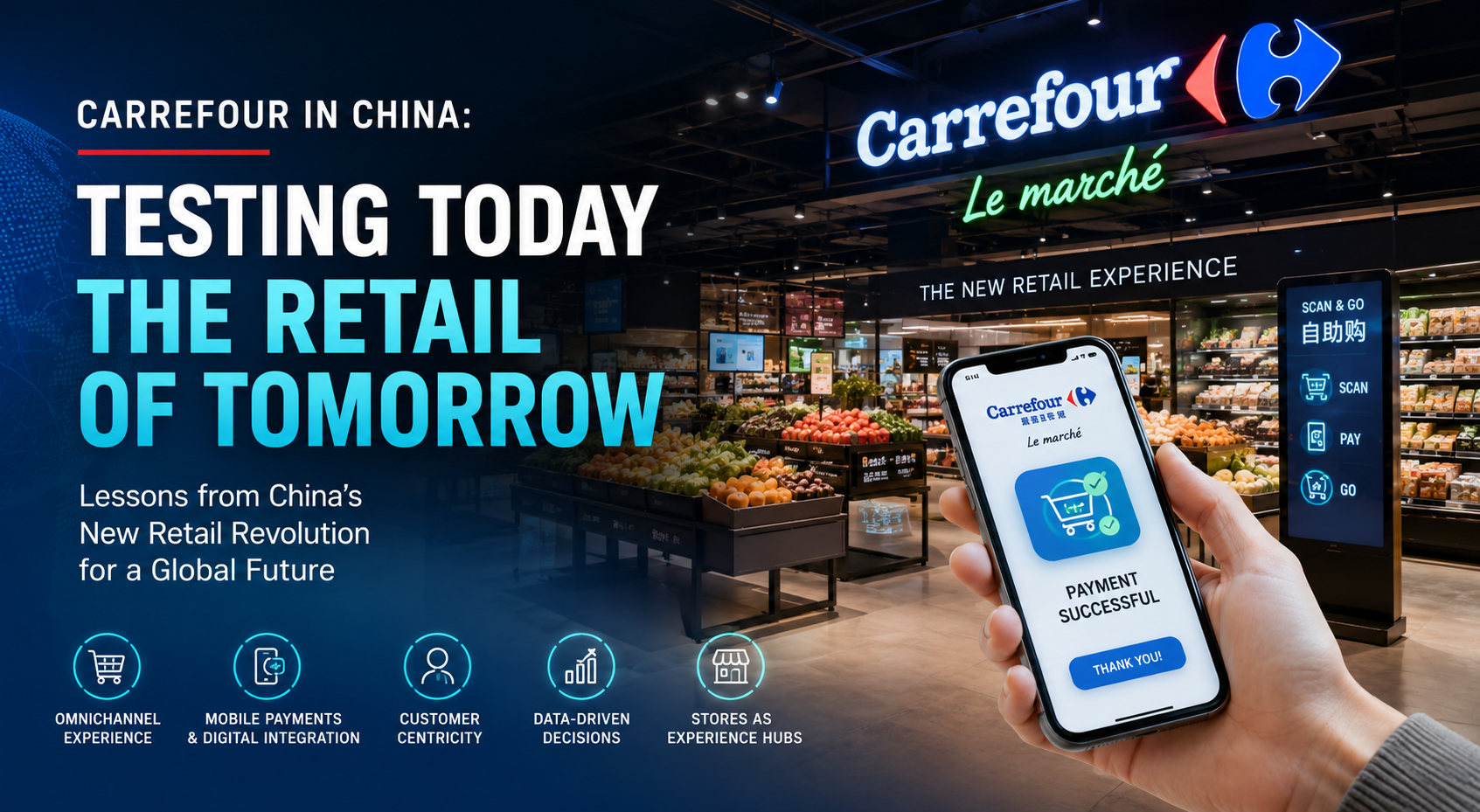
One of the most significant initiatives was the launch of Carrefour Le Marché in Shanghai.
Unlike traditional hypermarkets, this new format was designed around customer experience and digital integration.
The store included:
- Cashierless checkout systems.
- Mobile payments through WeChat.
- Personalized shopping experiences.
- Home delivery services.
- In-store dining experiences.
- Smart product information systems.
Customers could browse, scan, pay, and receive deliveries through their smartphones.
The store was only about half the size of a traditional Carrefour hypermarket, demonstrating a major shift away from the «bigger is better» philosophy that had dominated retail for decades.
The Rise of New Retail
The concept that inspired Carrefour’s transformation became known as «New Retail.»
Popularized by Alibaba, New Retail eliminates the distinction between online and offline commerce.
In the New Retail model:
- Physical stores become experience centers.
- Digital channels support every stage of the buying journey.
- Customer data drives personalization.
- Logistics become a competitive advantage.
- Shopping becomes frictionless.
Consumers no longer think in terms of online versus offline.
They simply shop.
Retailers that continue to manage channels separately risk becoming irrelevant.
The Most Important Lesson: Experience Beats Inventory
For many years, retailers believed success depended on carrying the largest assortment of products.
China proved otherwise.
Modern consumers increasingly value:
- Convenience.
- Speed.
- Personalization.
- Entertainment.
- Community.
- Experience.
Carrefour executives recognized that stores needed to become destinations rather than warehouses.
As Thierry Garnier explained, the role of the store is increasingly about spending quality time rather than simply purchasing products.
This idea is now visible worldwide through flagship stores, experiential retail, and interactive shopping environments.
What DIY, Home Improvement, and Hardware Retailers Can Learn
The lessons from Carrefour extend far beyond grocery retail.
For DIY retailers, hardware stores, craft chains, and home improvement businesses, the implications are profound.
Customers increasingly expect:
Demonstration Areas
People want to see products in action before buying.
Workshops and Events
Experiences create stronger customer relationships than promotions.
Digital Assistance
Mobile apps, QR codes, and video tutorials can support in-store purchases.
Click-and-Collect Services
Customers value flexibility and convenience.
Community Building
Retailers that build communities around hobbies and projects create loyalty that competitors struggle to replicate.
Brands such as Leroy Merlin, Home Depot, and many specialist DIY retailers have already embraced these principles.
Data Is the New Competitive Advantage
Perhaps the most powerful lesson from China’s retail revolution is the role of data.
Every interaction generates valuable information:
- Search behavior.
- Purchase history.
- Product preferences.
- Store visits.
- Customer feedback.
Retailers that successfully analyze and use this data can:
- Improve inventory management.
- Personalize recommendations.
- Optimize pricing.
- Increase customer retention.
- Predict future demand.
The future belongs not only to companies with the best products but also to those with the deepest understanding of their customers.
The Future Is Omnichannel
One of the biggest mistakes retailers still make is treating physical stores and digital channels as separate businesses.
Customers don’t see those distinctions.
They may:
- Discover a product on social media.
- Compare prices online.
- Visit a store.
- Buy through an app.
- Request home delivery.
For the customer, it is one journey.
For the retailer, it must be one strategy.
This omnichannel mindset is no longer optional—it is essential.
From Hypermarkets to Human-Centered Retail
The transformation of Carrefour in China highlights a broader shift occurring across the global retail industry.
Retail is moving away from a model centered on products and inventory toward one centered on people, experiences, convenience, and relationships.
The companies that thrive over the next decade will not necessarily be the largest retailers.
They will be the most adaptable.
They will understand that stores are no longer merely places to sell products.
They are platforms for engagement, education, entertainment, and community building.
Final Thoughts
Carrefour’s decision to use China as a testing ground for new retail methods was not simply an experiment. It was an early recognition that the future of retail would be digital, experiential, and customer-centric.
The lessons remain highly relevant today.
Whether you operate a supermarket, a DIY chain, a hardware store, a craft retailer, or an e-commerce business, the message is clear:
The future belongs to retailers that combine technology with human experience.
Products can be copied.
Prices can be matched.
Technology can be acquired.
But a remarkable customer experience remains one of the few sustainable competitive advantages left in modern retail.
And that future is already here.
Deja un comentario