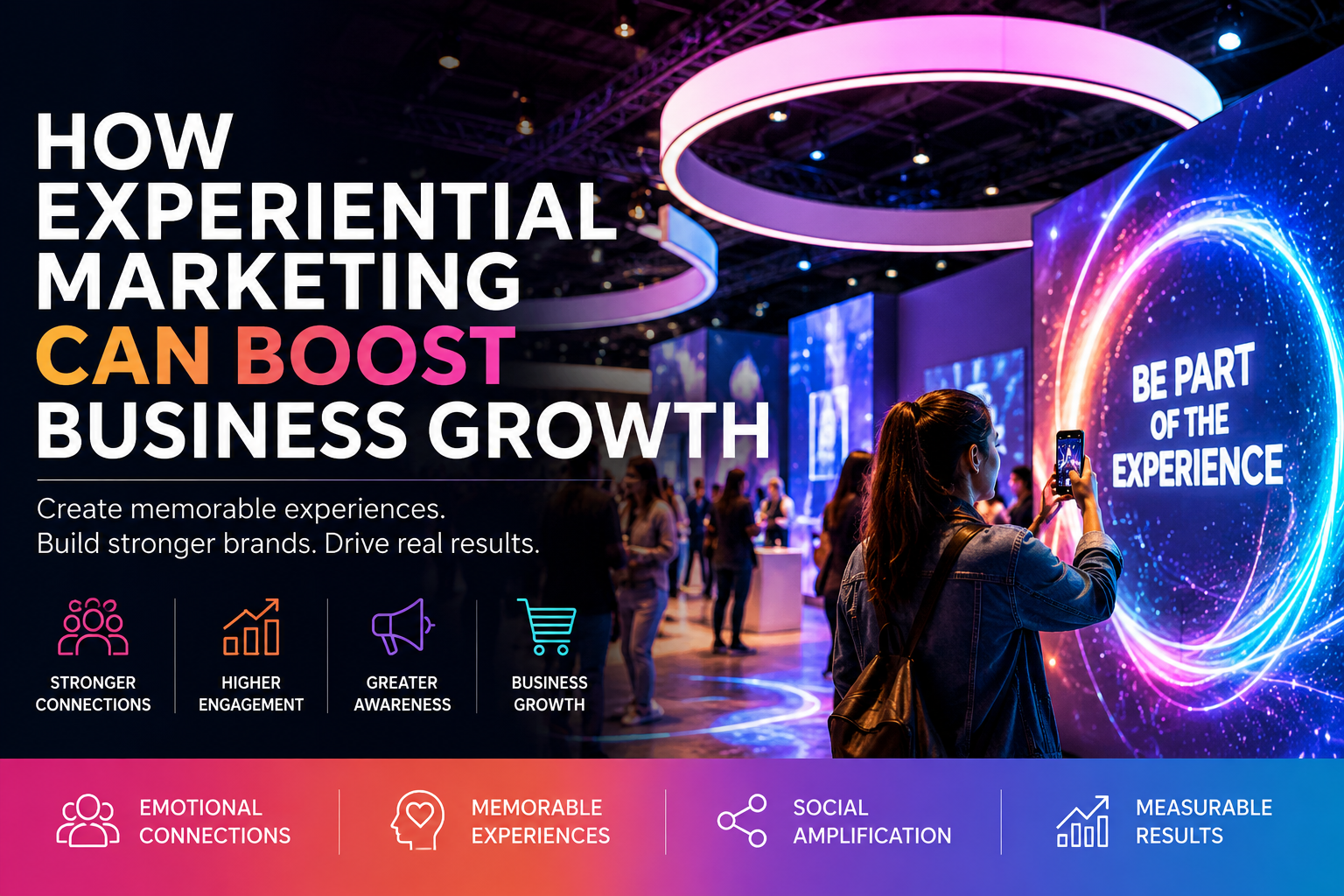
Why Experiences Have Become More Valuable Than Advertising
For decades, businesses relied on a simple formula: create a product, advertise it, and wait for customers to buy. Television, radio, newspapers, billboards, and later digital advertising became the primary channels for reaching audiences. While these methods still have value, the marketing landscape has changed dramatically.
Today’s consumers are exposed to thousands of marketing messages every day. Social media feeds are crowded, inboxes are overflowing, and digital advertising competes for attention in an environment where attention spans are increasingly limited. As a result, many brands struggle to create meaningful connections with their audiences.
This is where experiential marketing has emerged as one of the most powerful strategies available to modern businesses.
Experiential marketing focuses on creating memorable, immersive, and interactive experiences that allow consumers to engage directly with a brand. Instead of simply telling customers about a product or service, experiential marketing enables them to see it, touch it, test it, and feel it. The objective is not merely awareness but emotional connection. Research consistently shows that experiences create stronger memories and deeper brand relationships than traditional advertising alone. (corp.kaltura.com)
As businesses increasingly compete on customer experience rather than price alone, experiential marketing has become a critical tool for growth.
What Is Experiential Marketing?
Experiential marketing, often referred to as engagement marketing, is a strategy that encourages customers to actively participate in a brand experience rather than passively consume marketing messages.
Instead of watching a commercial, consumers interact.
Instead of reading an advertisement, they experience the brand.
Instead of being spectators, they become participants.
Examples include:
- Pop-up stores
- Product demonstrations
- Interactive retail installations
- Brand activations
- Workshops and classes
- Virtual reality experiences
- Augmented reality campaigns
- Festivals and sponsored events
- Immersive exhibitions
- Community-driven experiences
The purpose is to create moments that customers remember and share with others.
In many cases, the experience itself becomes the marketing.
Why Experiential Marketing Works
Human beings are emotional decision-makers.
Although consumers often justify purchases using logic, neuroscience and behavioral psychology suggest that emotions play a major role in buying decisions.
Traditional advertising communicates information.
Experiential marketing creates feelings.
When people interact directly with a brand, they engage multiple senses simultaneously. They build memories, create associations, and form emotional attachments.
This explains why experiential campaigns often generate higher engagement and stronger brand recall than conventional advertising. Studies and industry reports continue to show that immersive experiences improve brand favorability, customer engagement, and purchase intent. (snapbar.com)
The Shift from Ownership to Experience
One of the most important consumer trends of the last decade is the increasing value placed on experiences.
Consumers, especially Millennials and Generation Z, frequently prioritize memorable experiences over material possessions.
This trend has transformed entire industries:
- Tourism
- Hospitality
- Retail
- Entertainment
- Luxury goods
- Technology
Brands that understand this shift recognize that they are no longer simply selling products.
They are selling stories.
They are selling emotions.
They are selling memories.
The most successful companies today understand that every customer interaction contributes to the overall brand experience.
Key Benefits of Experiential Marketing
1. Increased Brand Awareness
Experiential campaigns generate attention naturally.
A creative activation can attract media coverage, social media engagement, influencer participation, and word-of-mouth recommendations.
Unlike traditional advertising, which disappears once the budget ends, memorable experiences often continue generating visibility through user-generated content.
When customers voluntarily share photos, videos, and testimonials, the brand’s reach expands organically.
2. Stronger Emotional Connections
People remember how brands make them feel.
Experiential marketing allows businesses to connect with consumers on a deeper level by creating moments that evoke emotions such as excitement, curiosity, joy, surprise, or inspiration.
Emotional connections lead to:
- Greater trust
- Higher loyalty
- Increased customer retention
- Stronger advocacy
These factors contribute directly to long-term profitability.
3. Improved Customer Loyalty
Customer acquisition is expensive.
Retaining existing customers is usually far more profitable.
Experiential marketing strengthens loyalty because customers who participate in positive brand experiences feel more connected to the company.
The relationship moves beyond transactions and becomes personal.
4. Better Product Understanding
Many products are difficult to explain through advertising alone.
Experiential marketing allows consumers to interact directly with products and services.
This is especially valuable for:
- Technology products
- Automotive brands
- Beauty products
- Food and beverage companies
- Educational services
- B2B solutions
Hands-on experiences reduce uncertainty and increase purchase confidence.
5. Higher Social Media Engagement
Experiential campaigns are naturally shareable.
Consumers love posting unique experiences online.
Brands that design Instagram-worthy moments, interactive installations, or immersive environments often benefit from significant social amplification.
Experiential marketing and social media form a powerful combination because physical experiences generate digital conversations.
6. Valuable Customer Insights
Experiential events provide direct access to customers.
Brands can observe behavior, gather feedback, conduct surveys, and identify customer preferences in real time.
This information can improve:
- Product development
- Customer service
- Marketing campaigns
- Sales strategies
The result is a more customer-centric organization.
Experiential Marketing in Retail
Retail has undergone dramatic transformation due to e-commerce.
Consumers can purchase almost anything online, often at lower prices and with greater convenience.
As a result, physical stores must offer something beyond products.
They must provide experiences.
Modern retail environments increasingly incorporate:
- Interactive displays
- Workshops
- Demonstrations
- Entertainment zones
- Personalization stations
- Community events
Successful retailers transform stores into destinations rather than points of sale.
This approach increases foot traffic, dwell time, and purchase likelihood.
Experiential Marketing in B2B
Many people associate experiential marketing with consumer brands, but it is equally effective in B2B environments.
Business buyers are still human beings.
They respond to experiences, emotions, and personal interactions.
B2B experiential strategies include:
- Industry conferences
- Executive roundtables
- Product demonstrations
- Innovation labs
- Interactive trade show booths
- Customer workshops
- Educational events
Recent trends show even technology and AI companies increasingly investing in pop-ups and live experiences to build trust and explain complex solutions. (Axios)
The Role of Technology
Technology has expanded the possibilities of experiential marketing.
Virtual Reality (VR)
VR allows consumers to immerse themselves in branded environments.
Applications include:
- Product demonstrations
- Real estate tours
- Training experiences
- Travel previews
Augmented Reality (AR)
AR blends digital content with the physical world.
Examples include:
- Virtual try-ons
- Interactive packaging
- Gamified experiences
- Product visualization
Artificial Intelligence
AI enables personalized experiences through:
- Smart recommendations
- Dynamic content
- Predictive personalization
- Interactive assistants
The future of experiential marketing will increasingly combine human interaction with intelligent technologies to create highly personalized experiences. (Vogue)
Measuring Experiential Marketing ROI
One common criticism of experiential marketing is that it can be difficult to measure.
However, modern analytics make ROI more visible than ever.
Key metrics include:
Brand Metrics
- Brand awareness
- Brand recall
- Brand sentiment
- Brand favorability
Engagement Metrics
- Event attendance
- Participation rates
- Time spent interacting
- Content creation
Digital Metrics
- Social media impressions
- Engagement rates
- User-generated content
- Website traffic
Sales Metrics
- Lead generation
- Conversion rates
- Customer acquisition
- Revenue growth
The most effective experiential campaigns combine emotional impact with measurable business outcomes. (Entire Productions, Inc.)
Real-World Examples of Experiential Marketing
Nike
Nike consistently creates immersive experiences that allow customers to test products and engage with the brand’s athletic identity.
Airbnb
Airbnb transformed hospitality marketing by focusing on unique experiences rather than accommodation alone.
Netflix
Netflix frequently launches immersive activations tied to popular shows, allowing fans to enter the worlds of their favorite characters.
Apple
Apple Stores are among the world’s most successful experiential retail environments, emphasizing learning, interaction, and community.
These companies understand that memorable experiences create stronger customer relationships than traditional advertising alone.
Common Mistakes to Avoid
Many experiential campaigns fail because they focus on spectacle rather than strategy.
Common mistakes include:
Lack of Clear Objectives
Every activation should support specific business goals.
Ignoring the Target Audience
Experiences must be designed around customer needs and interests.
Focusing Only on Social Media
An activation should create real value, not just photo opportunities.
Poor Follow-Up
Experiences should be integrated into broader marketing and sales processes.
Without follow-up, valuable opportunities are lost.
The Future of Experiential Marketing
Several trends are shaping the future:
Hyper-Personalization
Experiences tailored to individual preferences.
Hybrid Experiences
Combining physical and digital environments.
AI-Powered Interactions
Real-time customization based on customer behavior.
Sustainability
Consumers increasingly expect environmentally responsible experiences.
Community Building
Brands are shifting from selling products to creating communities.
The organizations that succeed will be those that understand how to create authentic, meaningful, and memorable interactions.
Conclusion
Experiential marketing is no longer a niche tactic reserved for large consumer brands.
It has become a strategic necessity for businesses seeking to stand out in crowded markets.
Consumers are overwhelmed by advertising but still crave meaningful human experiences. Brands that provide those experiences build stronger emotional connections, increase loyalty, generate advocacy, and ultimately drive growth.
Whether through live events, immersive retail environments, virtual experiences, or community-driven initiatives, experiential marketing enables companies to transform customers from passive observers into active participants.
The future belongs to brands that stop interrupting consumers and start engaging them.
In a world saturated with messages, experiences are what people remember.
And what people remember is ultimately what they buy.
Deja un comentario