Meetings are an essential part of modern work. They help teams coordinate, exchange information, and make decisions. Yet for many professionals, meetings are also one of the most frustrating parts of the workday. Endless discussions, too many participants, and unclear outcomes often make meetings feel like a waste of time.
One of the simplest and most powerful ways to improve meeting productivity is surprisingly straightforward: reduce the number of participants.
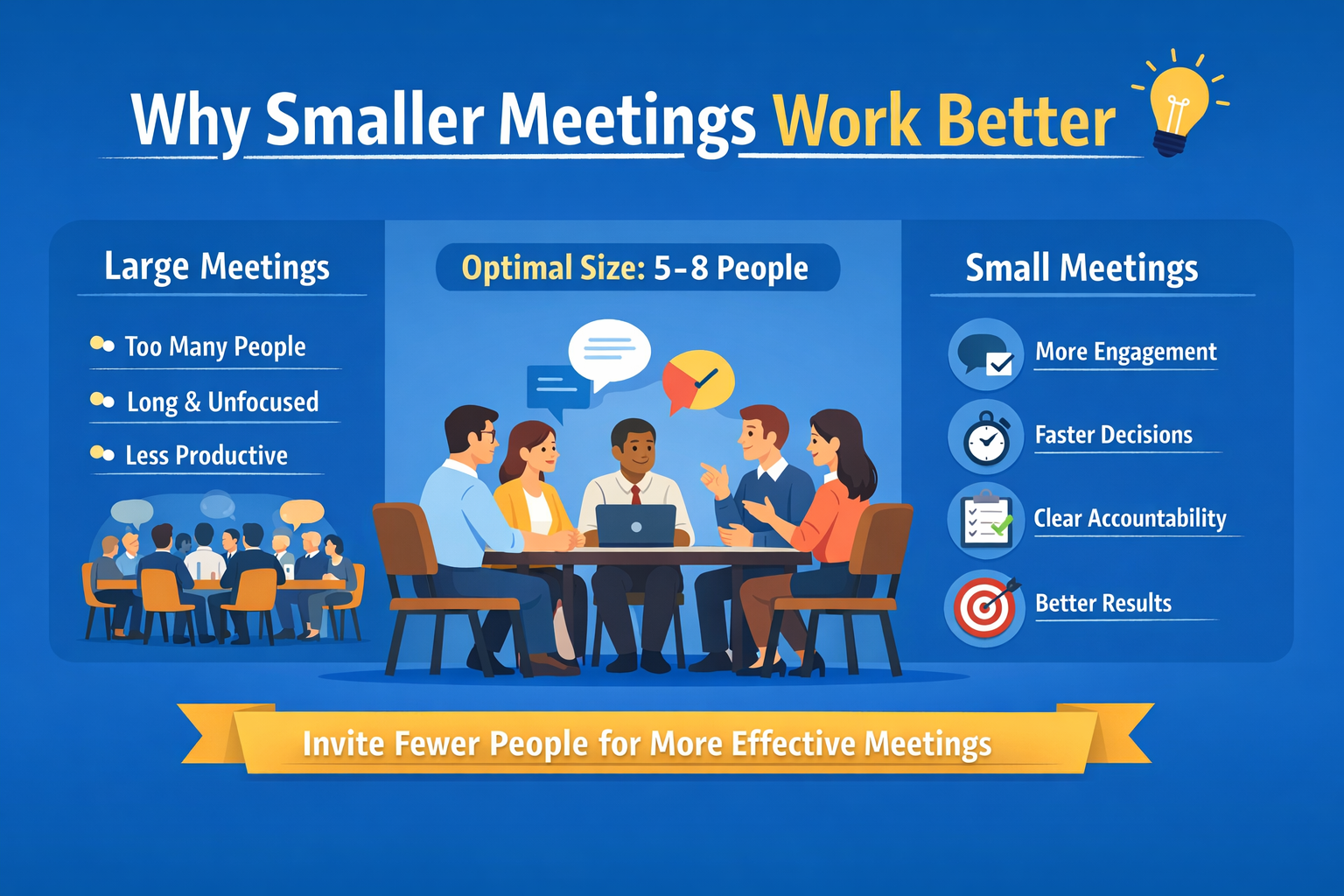
Research in organizational behavior suggests that the most effective meetings usually include between five and eight participants. Once the number of attendees exceeds this threshold, the quality of discussion and decision-making tends to decline. (hbr.org)
In other words, when it comes to meetings, smaller is usually better.
This principle might sound obvious, but it is rarely applied in practice. Many organizations continue to invite large groups of people to meetings—sometimes dozens—hoping to be inclusive or ensure everyone stays informed. Unfortunately, this well-intentioned habit often leads to the opposite result: less engagement, slower decisions, and reduced productivity.
Let’s explore why smaller meetings work better and how organizations can redesign their meeting culture to take advantage of this insight.
The Productivity Problem With Large Meetings
Many meetings become ineffective not because the topic is unimportant but because too many people are involved.
When the group becomes too large, several problems emerge:
1. Limited participation
The most obvious issue is that not everyone gets the chance to contribute.
If a meeting lasts one hour and there are 12 participants, each person theoretically has only five minutes of speaking time—assuming perfect distribution. In reality, some people dominate the conversation while others remain silent.
Smaller meetings allow participants to share ideas, ask questions, and challenge assumptions. Larger meetings often become passive listening sessions instead of collaborative discussions.
2. Decline in conversation quality
Research on group dynamics shows that conversation quality deteriorates when groups grow too large. Once the number of participants exceeds roughly eight people, the discussion tends to fragment and lose focus. (dangreer.com)
Instead of a coherent dialogue, the meeting turns into a sequence of disconnected comments. People repeat points, conversations overlap, and attention drifts.
The result is not just longer meetings—it is worse decisions.
3. Social loafing
Another well-documented psychological phenomenon that affects large meetings is social loafing.
Social loafing occurs when individuals exert less effort in a group because they feel their contribution is less noticeable or less important.
In large meetings, people may assume someone else will raise the key issue or offer the critical insight. As a result, many participants disengage mentally even if they remain physically present.
The larger the group, the stronger this effect tends to be.
4. Coordination problems
Large groups also create coordination challenges. Scheduling becomes more difficult, discussions take longer to organize, and reaching consensus becomes harder.
Psychologists have long observed that as group size increases, individual contributions decrease and coordination becomes more complex, a phenomenon related to the Ringelmann effect.
In meetings, this translates into slower progress and more confusion.
Why Smaller Meetings Work Better
Keeping meetings small improves productivity for several reasons.
More engagement
With fewer participants, everyone knows they are expected to contribute. There is no place to hide. This naturally increases participation and attentiveness.
People listen more carefully when they know they may be asked for their opinion.
Faster decision-making
Small groups make decisions faster. Communication flows more smoothly, misunderstandings are resolved quickly, and participants can move toward agreement without excessive bureaucracy.
Large meetings often struggle to reach conclusions because too many perspectives compete for attention.
Higher accountability
When a meeting has only six or seven participants, it is obvious who is responsible for which action items. Accountability becomes clearer.
In contrast, large meetings often produce vague outcomes such as “someone should look into this,” which rarely leads to real progress.
Stronger collaboration
Smaller meetings feel more like conversations and less like presentations.
Participants build on each other’s ideas, challenge assumptions, and explore alternatives. This dynamic exchange is difficult to achieve in large groups where many people remain silent.
The Real Reason Big Meetings Happen
If small meetings are so effective, why do organizations keep holding large ones?
The answer is often organizational culture rather than necessity.
Several common motivations drive large meetings:
Fear of excluding people
Managers often worry that leaving someone out of a meeting might cause frustration or miscommunication. As a result, they invite everyone who might be remotely relevant.
Ironically, this attempt to be inclusive can reduce the effectiveness of the meeting for everyone.
Information sharing
Many meetings exist primarily to distribute information rather than make decisions.
In such cases, a meeting might not be necessary at all. Email updates, internal documents, or recorded presentations often accomplish the same goal more efficiently.
Visibility and politics
In some organizations, meetings serve as a platform for visibility rather than productivity. Attending meetings signals involvement, importance, or authority.
While understandable, this dynamic often leads to unnecessarily large groups.
Habit
Sometimes meetings are large simply because they have always been that way. Recurring meetings continue without anyone questioning whether the participant list still makes sense.
Rethinking Meeting Invitations
One of the easiest ways to improve meeting effectiveness is to carefully evaluate the invitation list.
Before scheduling a meeting, ask a simple question:
Who absolutely needs to be in this conversation?
People who do not need to actively contribute may not need to attend.
Instead, they can receive a summary afterward.
A useful rule is to categorize participants into three groups:
- Decision makers – people responsible for approving outcomes
- Contributors – experts or stakeholders who provide input
- Observers – individuals who only need to stay informed
Only the first two groups typically need to attend.
Observers can often receive meeting notes instead.
The “Two-Pizza Rule”
Many organizations have independently discovered the benefits of small meetings.
Amazon popularized the famous “two-pizza rule”, which states that a meeting should be small enough that two pizzas could feed everyone in the room.
While not a scientific measurement, the idea reinforces the same principle: keep groups small enough for real interaction.
Small teams move faster, communicate better, and stay more focused.
Different Meetings Require Different Sizes
It is important to recognize that not all meetings serve the same purpose.
The optimal size depends on the type of meeting:
Decision-making meetings
These should be small—typically five to eight people. Too many participants make it difficult to reach agreement. (McKinsey & Company)
Brainstorming sessions
Creative sessions can sometimes benefit from slightly larger groups, but they still work best when structured and moderated carefully.
Information broadcasts
If the goal is simply to share updates, a large meeting may be acceptable. However, these sessions often work better as presentations, recorded briefings, or written reports.
Understanding the purpose of the meeting helps determine the appropriate size.
Practical Tips for Running Better Meetings
Reducing meeting size is powerful, but it works best when combined with other good practices.
Here are several strategies to make meetings more effective.
1. Define a clear objective
Every meeting should have a specific purpose:
- Make a decision
- Solve a problem
- Align on priorities
- Share updates
If the purpose is unclear, the meeting should probably not exist.
2. Share an agenda in advance
An agenda sets expectations and keeps the discussion focused.
Participants arrive prepared and discussions move more efficiently.
3. Limit meeting length
Shorter meetings encourage sharper thinking.
Many organizations are experimenting with 25-minute or 50-minute meetings instead of full hours to reduce wasted time.
4. Assign action items
Every meeting should end with clear next steps.
Who will do what? By when?
Without action items, meetings often become repetitive discussions rather than progress points.
5. Cancel unnecessary meetings
Perhaps the most powerful improvement is simply eliminating meetings that are no longer needed.
As organizations grow, meetings accumulate. Regularly reviewing and canceling unnecessary ones can dramatically improve productivity.
The Hidden Cost of Ineffective Meetings
The impact of inefficient meetings is enormous.
Professionals now spend a significant portion of their workweek in meetings, and many believe these sessions are one of the biggest obstacles to productivity. (hrdive.com)
Poorly run meetings cost organizations in several ways:
- Lost employee time
- Delayed decisions
- Reduced engagement
- Increased frustration
Small improvements in meeting structure can therefore produce large gains in efficiency.
A Simple Rule for Better Meetings
Improving meetings does not require complicated tools or elaborate management frameworks.
Often, it starts with one simple principle:
Invite fewer people.
When meetings stay small:
- Conversations are richer
- Decisions happen faster
- Accountability improves
- Participants remain engaged
The difference between six participants and twelve participants might seem small on paper, but in practice it completely changes the dynamics of a meeting.
Conclusion
Meetings will always be part of professional life. They are essential for coordination, collaboration, and decision-making.
However, the way many organizations conduct meetings today is far from optimal.
Research and experience consistently show that the most productive meetings involve small groups—typically five to eight people. (hbr.org)
By carefully managing meeting size, clarifying objectives, and respecting participants’ time, organizations can transform meetings from a productivity drain into a powerful tool for collaboration.
Sometimes, the key to better meetings is not adding more structure or more technology.
It is simply inviting fewer people.
Deja un comentario