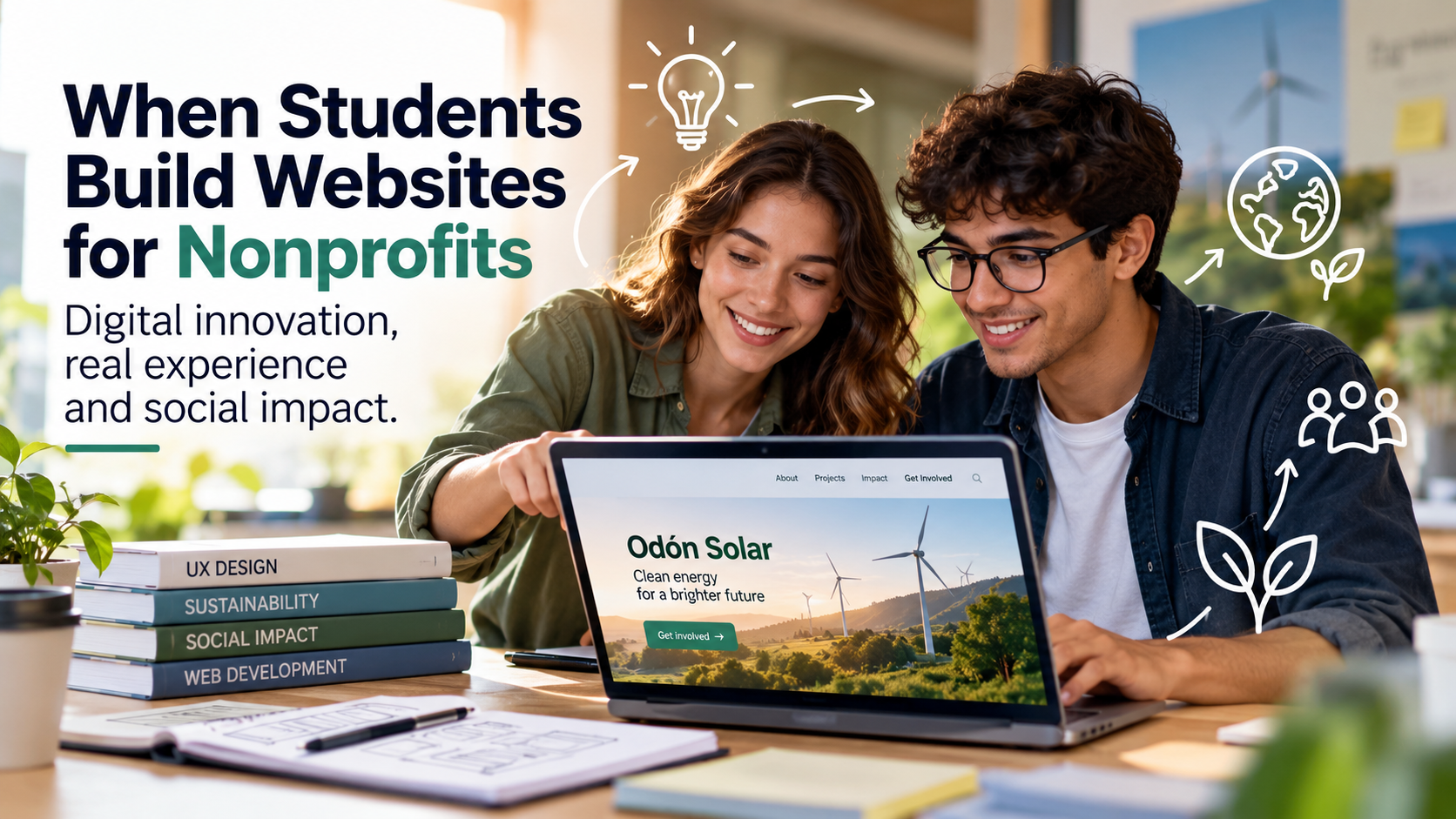
What happens when students, universities, technology platforms and nonprofit organizations work together? Sometimes, they create much more than a website. They create professional opportunities, strengthen social organizations and demonstrate how digital innovation can deliver real value to society.
I recently came across an interesting story published by WordPress.com: How Two Design Students Built a Nonprofit’s Website. It describes how two UX design students collaborated with Odón Solar, a Spanish nonprofit focused on clean energy, to develop a professional website while gaining practical experience.
The project caught my attention because it illustrates a powerful idea: digital transformation does not always require a large budget. Sometimes, it requires the right people, a shared purpose and a well-designed collaboration model.
1. The digital divide also affects nonprofit organizations
Having a professional website is no longer optional for organizations that want to communicate their mission, attract supporters, develop partnerships and demonstrate their impact.
However, many nonprofits face a familiar problem: they need digital capabilities but lack the financial resources to hire specialized agencies or build an experienced in-house team.
This creates a paradox. Organizations working to solve social and environmental problems often struggle to communicate their work effectively because they cannot afford the digital infrastructure that would help them grow.
A website is much more than an online brochure. It can become a strategic asset for:
- Communicating an organization’s mission and impact.
- Attracting donors, volunteers and strategic partners.
- Building trust and credibility.
- Increasing visibility through search engines.
- Supporting fundraising and community engagement.
- Explaining complex projects in a clear and accessible way.
For nonprofits, digital transformation should not be considered a luxury. It is part of their ability to fulfil their mission.
2. Turning student projects into real-world solutions
The WordPress.com initiative connects two needs that are rarely addressed together.
On one side, students need practical experience, real projects and professional portfolios. On the other, nonprofit organizations need digital solutions but may not have the budget to purchase them commercially.
In this case, students Constanza Diaz and Axcel Paucar Garcia worked with Odón Solar, spending 125 hours on research, information architecture, UX design, stakeholder discussions and website development.
The result was a live website for the nonprofit and a meaningful professional experience for the students.
This is an important distinction.
A university assignment is often evaluated by a teacher and may never leave the classroom. A real client project introduces different challenges: understanding actual needs, managing expectations, incorporating feedback, working within constraints and delivering something that people can use.
These are the experiences that help transform academic knowledge into professional competence.
For the nonprofit, the benefit is equally tangible: a digital tool designed around its needs, without having to finance a conventional agency engagement.
3. A new model of collaboration between education and business
The most interesting aspect of this story is not the technology itself. It is the collaboration model.
Universities, students, mentors, technology providers and nonprofit organizations each contribute something different.
- Students contribute time, creativity, technical skills and fresh perspectives.
- Educational institutions connect academic learning with professional practice.
- Mentors provide guidance, quality control and industry experience.
- Technology platforms make development tools more accessible.
- Nonprofits provide a real-world challenge and the opportunity to create meaningful impact.
When these contributions are coordinated effectively, the outcome can be more valuable than the sum of its parts.
This approach also creates an opportunity for companies and agencies to identify emerging talent through real projects, rather than relying exclusively on traditional recruitment processes.
It is a practical example of how collaboration can create shared value.
4. AI can make digital capabilities more accessible
Another interesting element of the project is the use of AI-assisted development tools within the WordPress ecosystem.
According to the original article, the students designed the website in Figma and used WordPress Studio’s AI agent to help implement and refine the site.
This illustrates a broader trend: AI is reducing some of the technical barriers involved in building digital products.
However, it is important to understand what this means — and what it does not mean.
AI does not automatically create a successful website. A useful digital experience still requires research, strategic thinking, content planning, usability testing and an understanding of the organization’s audience.
The real opportunity lies in combining human expertise with tools that accelerate execution.
For small nonprofits, this combination can make projects possible that previously seemed financially or technically out of reach.
The same principle applies to businesses. As I discussed in my article on digital marketing strategies to boost your business and increase sales, technology becomes valuable when it supports clear objectives rather than being adopted simply because it is available.
5. From a website to a measurable social impact strategy
A nonprofit website should not be judged exclusively by its appearance or technical performance.
The more important question is whether it helps the organization achieve its mission.
That requires defining clear objectives and measuring results.
For example:
Visibility
- Growth in organic website traffic.
- Visibility for relevant search terms.
- Visits to key project and impact pages.
Engagement
- Time spent on important pages.
- Downloads of reports and resources.
- Newsletter subscriptions.
- Volunteer enquiries.
Conversion
- Donations generated through the website.
- New partnerships and collaboration requests.
- Volunteer registrations.
- Qualified enquiries from potential supporters.
Organizational impact
- Reduced costs for digital services.
- Improved communication with stakeholders.
- Greater capacity to attract resources.
- Better access to information about the organization’s work.
Not every organization needs the same metrics. The right indicators depend on its mission, resources and stage of development.
The important point is to connect digital activity with meaningful outcomes.
For a deeper perspective on this relationship between business, purpose and social value, read my article on corporate social marketing and collaboration with NGOs.
6. Could this model be replicated by companies and other organizations?
Absolutely. The underlying idea can be applied to many different areas, including digital marketing, branding, market research, communication, data analysis and process improvement.
Imagine a company that needs to improve its digital presence but cannot justify a large consultancy project. A university could connect it with students working on a supervised, real-world assignment.
Or consider a nonprofit that needs a communications strategy, a new fundraising campaign or a better way to measure its social impact. A multidisciplinary student team could help develop an initial solution under professional supervision.
For this model to work well, however, several conditions are essential:
- A clearly defined problem. The project must address a genuine organizational need.
- Realistic expectations. The scope must match the students’ experience, available time and resources.
- Professional supervision. Mentoring and quality assurance are necessary to protect both the students and the organization.
- Clear responsibilities. Deliverables, deadlines, intellectual property and ongoing maintenance should be agreed in advance.
- Sustainability beyond the project. The organization must be able to maintain and use the solution after the students leave.
The last point is particularly important. A website that cannot be updated, secured or maintained may create more problems than it solves.
A successful project should therefore deliver not only a finished product but also documentation, training and a realistic plan for continuity.
7. Social impact should be built into the business model
There is a broader lesson here for companies, educational institutions and social organizations.
Social impact does not always require a donation or a traditional corporate social responsibility campaign. It can also emerge from the way we organize work, share knowledge and develop talent.
A company can contribute expertise. A university can open its professional networks. A technology provider can make tools accessible. A nonprofit can offer a meaningful challenge. Students can transform their learning into something useful for society.
Everyone contributes, and everyone can benefit.
This approach is closely connected to the idea of creating shared value: developing initiatives that address social needs while also generating value for the organizations involved.
It also challenges a narrow understanding of corporate responsibility as something separate from everyday business activity.
The question should not only be how much an organization donates, but also how its capabilities, knowledge and resources can help solve real problems.
Conclusion: Digital innovation works best when people collaborate
The story of Odón Solar and the two design students is a useful reminder that innovation is not exclusively about technology, investment or large transformation programmes.
Sometimes, innovation means connecting people who have complementary needs and capabilities.
A nonprofit gains a digital asset. Students gain professional experience. Mentors contribute to developing talent. Technology becomes more accessible. And the community gains an organization better equipped to communicate its mission.
The challenge is to turn these individual projects into sustainable models that can be replicated, evaluated and improved.
For me, that is the most valuable lesson: the future of digital transformation will depend not only on better tools, but also on better collaboration models.
Technology can make things possible. Strategy gives them direction. People make them meaningful.
Further reading on ComoSeVende
If you are interested in the relationship between digital innovation, marketing and social impact, I recommend exploring these related articles:
- Digital Marketing Strategies to Boost Your Business and Increase Your Sales
- Social Media Isn’t Dead: The New Marketing System for Businesses Wanting to Sell in 2026
- Corporate Social Marketing and Collaboration with NGOs: Strategies for Transformative Social Impact
What do you think? Could collaboration between universities, companies and nonprofits become a more common way to accelerate digital transformation and generate social impact?
I’d love to hear your thoughts in the comments.
Deja una respuesta