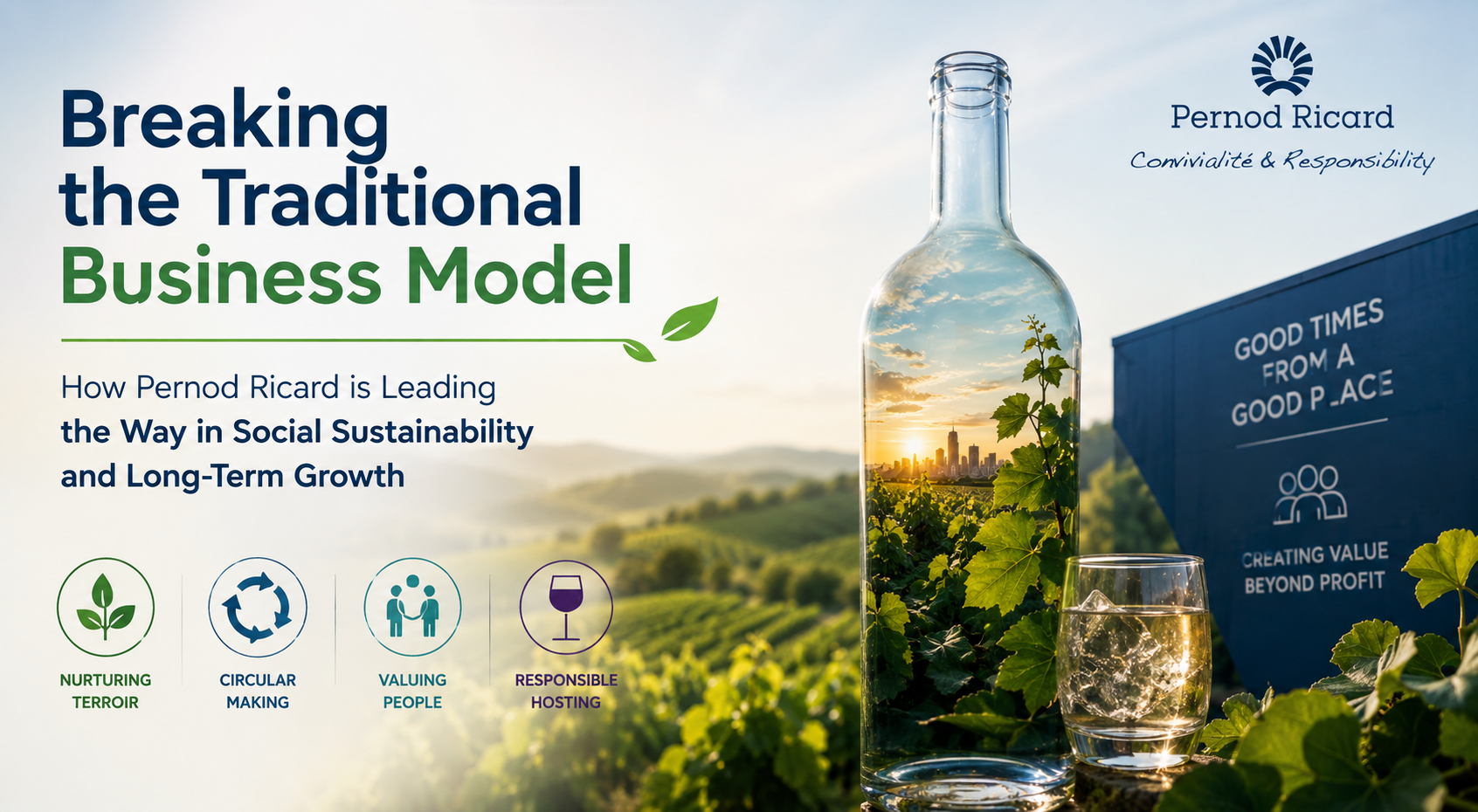
Why the Future of Business Is No Longer Just About Profit
For decades, the dominant business model was remarkably simple: maximize profits, increase shareholder value, and grow market share. Sustainability, social impact, and community engagement were often treated as secondary concerns or delegated to Corporate Social Responsibility (CSR) departments.
Today, that paradigm is rapidly changing.
Consumers, employees, investors, and regulators increasingly expect companies to generate value not only for shareholders but also for society and the environment. Businesses that fail to adapt risk losing relevance, reputation, and competitive advantage.
One company that understood this transformation early is Pernod Ricard, one of the world’s leading wine and spirits groups. Rather than viewing sustainability as a compliance obligation or marketing exercise, the company integrated it directly into its business model and long-term growth strategy.
The result is a powerful example of how social sustainability can become a source of innovation, differentiation, resilience, and profitability.
The End of the Traditional Business Model
Traditional business thinking focused on a straightforward equation:
Economic Value = Business Success
However, modern stakeholders demand something broader:
Economic Value + Social Value + Environmental Value = Sustainable Success
This shift has given rise to the concept of the Sustainable Business Model, where companies create, deliver, and capture value while simultaneously generating positive outcomes for society and the planet.
Research increasingly shows that sustainability is no longer an optional add-on. It must be embedded within the core value proposition of the organization. Companies that merely implement isolated CSR initiatives often struggle to create meaningful impact or competitive differentiation.
Pernod Ricard recognized this challenge and decided to rethink its role in society.
Pernod Ricard’s Transformation
Pernod Ricard is known globally for brands such as:
- Absolut Vodka
- Chivas Regal
- Jameson
- Ballantine’s
- Havana Club
- Beefeater
Yet behind these iconic brands lies a deeper strategic transformation.
The company developed a sustainability framework that moved beyond traditional philanthropy and integrated sustainability into every stage of its value chain. Its vision evolved from simply selling premium spirits to becoming a company that creates conviviality while contributing positively to society and the environment.
This strategic shift was not cosmetic.
It influenced sourcing, production, packaging, employee engagement, community relations, responsible consumption initiatives, and long-term investment decisions.
Sustainability as a Competitive Advantage
Many executives still see sustainability as a cost.
Leading organizations view it differently.
They understand that sustainability can drive:
- Stronger brand equity
- Greater customer loyalty
- Talent attraction and retention
- Innovation opportunities
- Operational efficiency
- Risk reduction
- Long-term profitability
Pernod Ricard positioned sustainability as a growth driver rather than an expense. Its Sustainability & Responsibility roadmap established clear commitments linked to business performance and stakeholder expectations.
This approach transformed sustainability from a reporting exercise into a strategic management tool.
The Four Pillars of Sustainable Growth
One of the most interesting aspects of Pernod Ricard’s model is the creation of a structured sustainability framework.
Its roadmap focuses on four interconnected pillars:
1. Nurturing Terroir
The company works closely with agricultural communities and suppliers to promote responsible sourcing practices and protect natural ecosystems.
This includes:
- Sustainable farming
- Water stewardship
- Biodiversity protection
- Regenerative agricultural practices
By supporting the long-term viability of agricultural resources, the company protects both the environment and its future supply chain.
2. Circular Making
The traditional «take-make-dispose» model is increasingly unsustainable.
Pernod Ricard embraced circular economy principles through:
- Reduced packaging materials
- Increased recyclability
- Waste reduction
- Resource efficiency
- Lower carbon emissions
Circularity not only reduces environmental impact but also generates operational savings and enhances brand reputation.
3. Valuing People
Social sustainability begins with people.
The company invests in:
- Employee well-being
- Diversity and inclusion
- Skills development
- Workplace safety
- Community engagement
Organizations that prioritize people create stronger cultures, higher engagement, and greater innovation capacity.
4. Responsible Hosting
As a global alcohol producer, Pernod Ricard faces unique responsibilities.
Rather than avoiding this issue, the company actively promotes responsible consumption and awareness programs.
This demonstrates an important lesson:
Sustainable companies do not ignore the negative externalities of their industries. They actively work to address them.
Why Purpose Matters More Than Ever
Modern consumers increasingly buy from brands that align with their values.
Research consistently shows that younger generations prefer organizations that demonstrate authenticity, responsibility, and social impact.
Purpose has become a strategic asset.
Pernod Ricard’s approach illustrates how purpose can guide decision-making across the organization while strengthening relationships with customers, employees, regulators, and communities.
The key difference is that purpose is not used as a marketing slogan.
It is embedded within the operating model.
From CSR to Sustainable Business Model Innovation
Perhaps the most important lesson is that sustainability cannot remain isolated within a CSR department.
True transformation requires redesigning the business model itself.
Academic research highlights that sustainable business models expand traditional value creation by incorporating environmental and social dimensions alongside financial returns. Companies that succeed make sustainability part of innovation, operations, governance, and stakeholder management.
This is exactly what Pernod Ricard achieved.
Instead of asking:
«How can sustainability support the business?»
The company asked:
«How can sustainability become the business?»
That change in perspective is transformative.
What Other Businesses Can Learn
Whether you run a multinational corporation, an SME, a retailer, or a family-owned business, several lessons emerge from Pernod Ricard’s experience:
Sustainability Must Be Strategic
Treating sustainability as a side project limits its impact.
It should influence decisions across the organization.
Stakeholders Matter
Long-term success depends on creating value for customers, employees, suppliers, communities, and shareholders alike.
Purpose Drives Differentiation
Products can be copied.
Purpose is much harder to replicate.
Innovation and Sustainability Go Together
Many sustainability challenges create opportunities for innovation, new products, and new revenue streams.
Long-Term Thinking Wins
Companies that balance financial performance with social and environmental responsibility are often better positioned for future market shifts.
Final Thoughts
Pernod Ricard’s sustainability journey demonstrates that the future of business is not about choosing between profit and purpose.
It is about understanding that profit and purpose can reinforce each other.
The most successful organizations of the coming decades will be those capable of creating economic value while simultaneously generating positive social and environmental impact.
Breaking the traditional business model does not mean abandoning profitability.
It means expanding the definition of value.
And that may be the most important competitive advantage of all.
In a world where trust, transparency, and responsibility increasingly shape purchasing decisions, companies that embrace sustainable business models will not simply survive—they will lead.
Leave a comment