For decades, workplace flexibility was considered an employee benefit reserved for a privileged minority. It was often associated with senior executives, working parents, freelancers, or specific industries where remote work was easier to implement. Today, however, flexibility has evolved from a desirable perk into a strategic necessity.
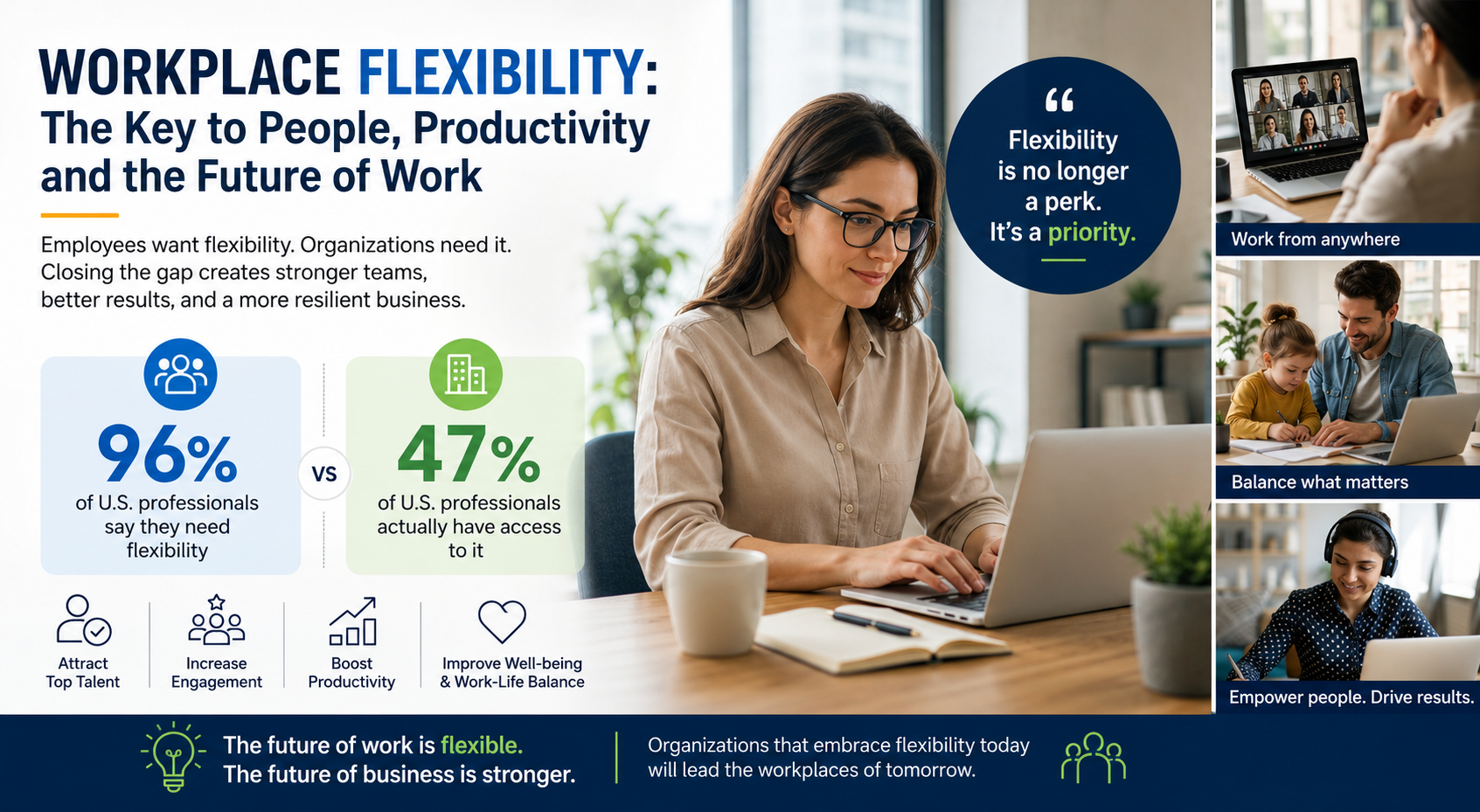
Back in 2018, a study highlighted a striking reality: 96% of U.S. professionals stated that they needed workplace flexibility, yet only 47% actually had access to it. The research revealed what became known as the «flexibility gap» — the difference between what employees require to perform effectively and what organizations are willing or able to provide.
Eight years later, despite the massive transformation triggered by digitalization, remote work technologies, and the pandemic, the debate remains highly relevant. While organizations have embraced hybrid work models and digital collaboration tools, many employees still feel that flexibility exists more in corporate communications than in everyday practice.
The question is no longer whether flexibility matters. The real question is whether companies can afford not to offer it.
Understanding Workplace Flexibility
Workplace flexibility refers to the degree of freedom employees have regarding where, when, and how they perform their work.
Flexibility can take multiple forms:
- Remote work
- Hybrid work arrangements
- Flexible schedules
- Compressed workweeks
- Results-oriented work environments
- Job sharing
- Part-time arrangements
- Asynchronous collaboration
True flexibility is not simply allowing employees to work from home one day a week. It involves redesigning work around outcomes rather than physical presence.
Many organizations mistakenly believe they offer flexibility because they provide isolated benefits. Employees, however, evaluate flexibility differently. They measure it based on their actual ability to manage professional responsibilities while maintaining personal well-being.
This difference in perception explains why many companies believe they are flexible while employees continue to report dissatisfaction.
The Origins of the Flexibility Gap
The flexibility gap exists because organizations often operate under assumptions that were created during the industrial era.
Traditional management systems were designed around visibility:
- If employees are present, they are productive.
- If managers can see employees, they can supervise them.
- If everyone works at the same time and place, coordination becomes easier.
These assumptions worked reasonably well in factories and highly standardized environments. However, knowledge work follows different rules.
Modern professionals create value through:
- Creativity
- Problem-solving
- Strategic thinking
- Communication
- Innovation
- Relationship building
None of these activities necessarily require physical presence.
Yet many organizations continue to evaluate performance through attendance rather than outcomes.
As a result, employees feel constrained while managers feel uncertain.
The gap grows wider.
The Pandemic Changed Everything
The COVID-19 pandemic became the largest workplace experiment in modern history.
Companies that previously argued remote work was impossible suddenly transitioned entire workforces online.
What many organizations discovered surprised them:
- Productivity remained stable.
- Employee engagement often improved.
- Digital collaboration accelerated.
- Operating costs decreased.
- Talent pools expanded geographically.
The experience shattered many myths about remote work and flexibility.
Employees discovered they could eliminate long commutes, improve work-life balance, and gain greater control over their schedules.
Organizations discovered that performance could be maintained without constant physical supervision.
However, new challenges emerged as well.
Many workers experienced burnout, digital fatigue, isolation, and blurred boundaries between work and personal life.
The lesson was not that remote work is perfect.
The lesson was that flexibility requires intentional design.
Why Employees Want Flexibility More Than Ever
Several forces are increasing the demand for flexible work arrangements.
1. Changing Workforce Expectations
Millennials and Generation Z have entered the workforce with different expectations than previous generations.
While salary remains important, younger professionals increasingly prioritize:
- Work-life balance
- Purpose
- Autonomy
- Mental health
- Personal development
For many employees, flexibility is now considered a basic requirement rather than an optional benefit.
Organizations that ignore this shift risk losing access to top talent.
2. Mental Health Awareness
Mental health has become a central workplace issue.
Research consistently shows that excessive commuting, rigid schedules, and lack of autonomy contribute to stress and burnout. Greater flexibility has been associated with improved well-being, reduced psychological distress, and higher job satisfaction.
Employees increasingly recognize that flexibility allows them to:
- Manage family responsibilities
- Exercise regularly
- Reduce stress
- Improve sleep quality
- Maintain healthier lifestyles
The connection between flexibility and well-being is no longer theoretical.
It is measurable.
3. Technological Evolution
Modern digital tools make flexibility more practical than ever before.
Cloud platforms, project management software, video conferencing, AI assistants, and collaborative workspaces have reduced the importance of physical location.
The question is no longer whether technology supports flexibility.
The question is whether management practices have evolved at the same speed.
The Business Case for Workplace Flexibility
Many executives still perceive flexibility primarily as an employee benefit.
This perspective overlooks its strategic value.
Talent Attraction
Organizations compete in a global talent market.
Candidates increasingly evaluate employers based on flexibility policies.
Companies that offer meaningful flexibility gain access to larger and more diverse talent pools.
Geography becomes less restrictive.
Recruitment becomes more efficient.
Employer branding improves.
Talent Retention
Replacing employees is expensive.
Recruitment costs, onboarding expenses, productivity losses, and knowledge transfer all create significant financial impacts.
Flexible work arrangements increase employee loyalty and reduce turnover.
When employees feel trusted, they are more likely to remain committed to the organization.
Productivity Improvements
Contrary to traditional assumptions, flexibility often increases productivity.
Employees can align work with their peak performance hours.
They experience fewer interruptions.
They spend less time commuting.
They gain greater control over their work environment.
The result is often higher-quality output rather than simply more hours worked.
Diversity and Inclusion
Flexibility creates opportunities for groups that have historically faced barriers in traditional workplaces.
These include:
- Parents
- Caregivers
- People with disabilities
- Older professionals
- Individuals living outside major urban centers
Flexible work expands participation in the labor market.
As a result, organizations benefit from broader perspectives and stronger innovation.
The Risks of Poorly Implemented Flexibility
Not all flexibility initiatives succeed.
Some organizations introduce flexible policies without redesigning management practices.
This creates new problems.
Always-On Culture
Employees may feel pressured to remain available around the clock.
Emails arrive late at night.
Messages continue during weekends.
Work-life boundaries disappear.
Flexibility without limits can become a source of burnout.
Inequality Between Roles
Not all jobs can be performed remotely.
Manufacturing, healthcare, logistics, and retail often require physical presence.
Organizations must carefully design policies to avoid creating perceptions of unfairness between different employee groups.
Collaboration Challenges
Innovation often emerges through spontaneous interaction.
Remote and hybrid teams must intentionally create opportunities for:
- Knowledge sharing
- Informal conversations
- Relationship building
- Creative collaboration
Without these efforts, organizational culture may weaken over time.
The Leadership Challenge
The biggest obstacle to workplace flexibility is often not technology.
It is leadership.
Traditional management relies heavily on control.
Flexible management relies on trust.
This shift requires leaders to develop new capabilities:
Outcome-Based Management
Instead of measuring attendance, leaders must evaluate results.
Success becomes defined by objectives achieved rather than hours observed.
Clear Communication
Flexible teams require stronger communication practices.
Expectations must be explicit.
Goals must be measurable.
Feedback must be frequent.
Trust Building
Trust becomes the foundation of flexible organizations.
Employees must trust leaders.
Leaders must trust employees.
Without trust, flexibility quickly collapses into micromanagement.
The Future of Workplace Flexibility
The future is unlikely to be fully remote or fully office-based.
Instead, organizations are moving toward hybrid ecosystems.
Employees will increasingly expect:
- Flexible schedules
- Location independence
- Personalized work arrangements
- Outcome-based evaluation
- Digital collaboration tools
Artificial intelligence will accelerate this trend.
AI systems can automate routine tasks, support asynchronous collaboration, and increase productivity regardless of location.
As AI becomes integrated into everyday work, physical presence will become even less relevant for many knowledge-based roles.
The organizations that succeed will be those that redesign work around human performance rather than historical habits.
Closing the Flexibility Gap
The flexibility gap identified years ago remains one of the most important challenges in modern management. While employee expectations continue to rise, many organizations still struggle to translate flexibility into practical reality. The original finding that 96% of professionals needed flexibility while only 47% had it highlighted a structural disconnect between workforce needs and organizational practices.
Today, flexibility is no longer simply about remote work.
It is about autonomy.
It is about trust.
It is about designing organizations that recognize employees as adults capable of managing their responsibilities.
Companies that embrace flexibility strategically will attract better talent, improve retention, strengthen innovation, and build more resilient organizations.
Those that resist may discover that the real cost is not offering flexibility.
The real cost is losing the people who expect it.
In the future of work, flexibility will not be the exception.
It will be the standard.
Leave a comment