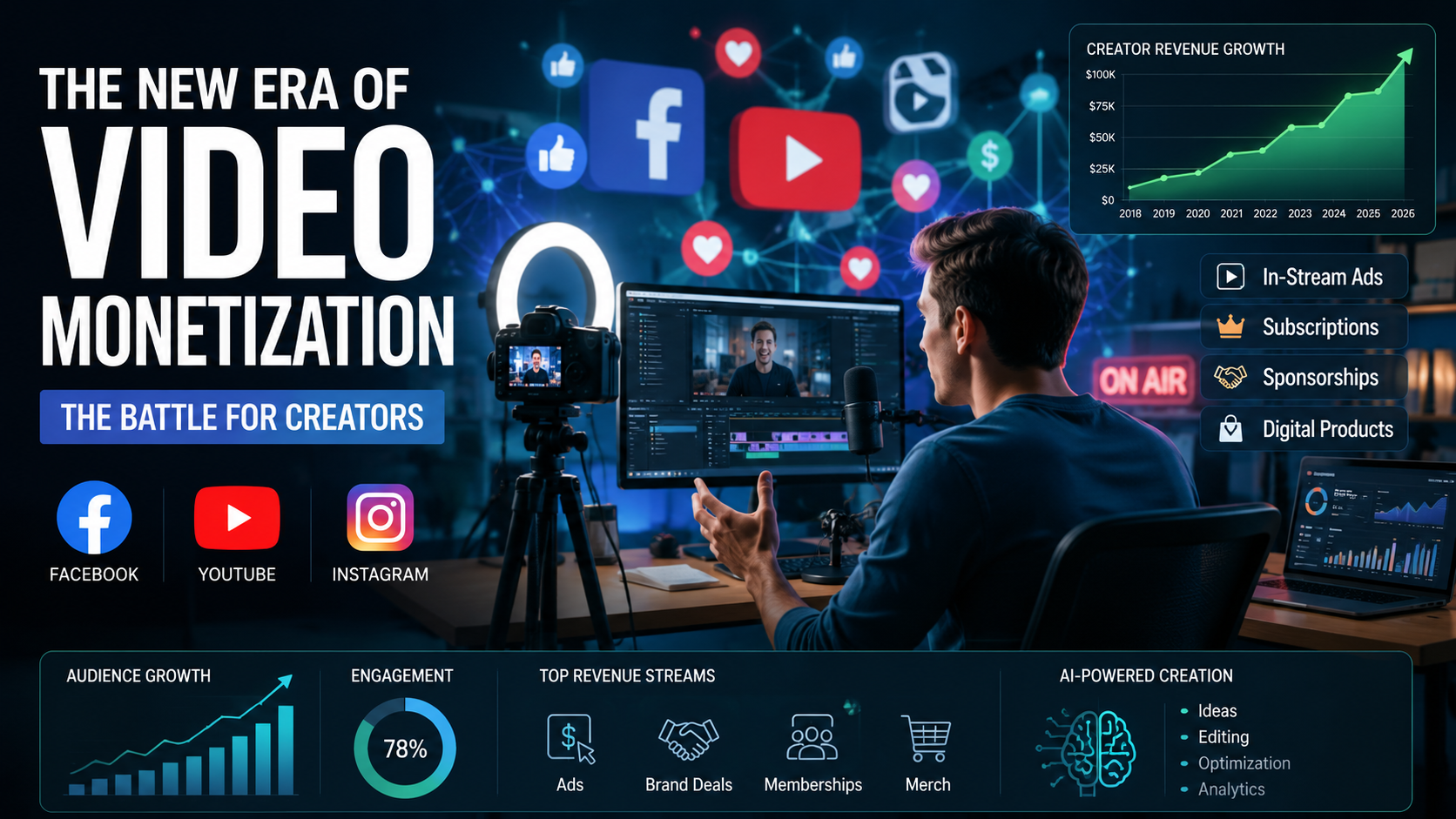
Introduction: The Beginning of a New Creator Economy
In June 2018, Facebook made a strategic move that would help reshape the digital content industry. The company introduced new video monetization tools designed to attract creators who were increasingly dependent on YouTube for their income.
At the time, YouTube dominated online video. It had a mature advertising ecosystem, an established creator community, and a proven monetization model. Facebook, despite having billions of users, struggled to convince professional creators that it could become a serious alternative.
The introduction of monetization tools was not simply a product update. It represented the beginning of an intense battle for the attention of creators, advertisers, and audiences.
Today, looking back from 2026, it is clear that Facebook’s initiative was part of a much larger transformation: the emergence of the creator economy as one of the most influential sectors of the digital world.
Why Facebook Needed Creators
Social platforms thrive on content.
While traditional media companies invest millions in production, digital platforms depend heavily on creators to generate content that keeps users engaged.
Facebook understood several realities:
- Users were consuming more video than ever.
- Video generated higher engagement than text or images.
- Advertisers were willing to pay premium rates for video placements.
- Professional creators influenced audience retention.
Without creators, Facebook risked losing engagement to competitors.
The challenge was simple: why would a successful YouTuber abandon or reduce activity on YouTube?
The answer had to be money.
The Rise of Video Advertising
During the late 2010s, digital advertising underwent a profound transformation.
Consumers increasingly ignored traditional banner ads. Video emerged as a more effective format because it captured attention, delivered emotional impact, and allowed brands to tell stories.
Advertisers quickly shifted budgets toward video campaigns.
This created a huge opportunity for platforms capable of attracting audiences and content creators.
Facebook wanted a larger share of this growing market.
To achieve that goal, it needed a monetization system capable of rewarding creators directly.
Facebook’s Initial Monetization Tools
The company introduced several mechanisms designed to help creators earn revenue.
In-Stream Ads
One of the most important innovations was the introduction of in-stream advertising.
Similar to YouTube’s model, creators could insert advertisements into their videos and receive a percentage of the revenue generated.
This was a crucial step because it provided creators with a familiar business model.
Ad Breaks
Facebook launched ad breaks that could be placed during longer videos.
These interruptions created additional inventory for advertisers while generating revenue opportunities for publishers.
Audience Development
Facebook also invested heavily in helping creators discover and grow audiences.
The platform’s recommendation algorithms promoted video content more aggressively, increasing organic reach.
Facebook Watch
The launch of Facebook Watch represented another significant investment.
Facebook hoped to create a dedicated video ecosystem that could compete directly with YouTube.
The platform offered exclusive programming, creator partnerships, and new monetization opportunities.
The Real Goal: Retention
Monetization was important, but Facebook’s ultimate objective was retention.
The longer users remained on the platform, the more advertisements they consumed.
Creators became a strategic asset because they encouraged users to spend additional time watching content.
This dynamic transformed creators into essential partners rather than simple content suppliers.
Platforms began competing aggressively for talent.
The Creator Economy Emerges
When Facebook introduced monetization tools in 2018, few people fully understood the scale of the transformation that was beginning.
The creator economy would eventually become a multi-billion-dollar ecosystem.
Today creators generate revenue through:
- Advertising
- Sponsorships
- Brand partnerships
- Merchandise
- Memberships
- Online courses
- Affiliate marketing
- Events
- Consulting services
- Digital products
Advertising is now only one piece of a much larger puzzle.
The most successful creators operate like media companies.
The YouTube Advantage
Despite Facebook’s efforts, YouTube maintained several competitive advantages.
Predictable Revenue
Creators appreciated YouTube’s established monetization structure.
Revenue models were transparent and relatively stable.
Searchability
Unlike Facebook, YouTube functioned as a search engine.
Videos could continue generating views years after publication.
This created long-term value.
Community
The platform had developed a strong creator culture.
Educational resources, networks, agencies, and support services revolved around YouTube.
Creator Identity
Many influencers built their personal brands around YouTube.
Switching platforms involved significant risk.
The Algorithm Wars
One of the defining features of the creator economy has been the increasing importance of algorithms.
Algorithms determine:
- Visibility
- Reach
- Engagement
- Revenue potential
Facebook’s strategy relied heavily on algorithmic distribution.
However, this created uncertainty.
Many creators discovered that algorithm changes could dramatically impact their performance overnight.
This lesson remains relevant today.
Building an audience on rented platforms always carries risk.
Lessons for Modern Creators
The experience of Facebook and YouTube offers several important lessons.
Never Depend on One Platform
Many creators learned the hard way that algorithms can change unexpectedly.
Diversification is essential.
Successful creators build audiences across:
- YouTube
- TikTok
- Podcasts
- Email newsletters
- Personal websites
Own Your Audience
Email databases remain one of the most valuable assets in digital marketing.
A creator who owns direct communication channels has greater independence.
Build a Brand, Not Just Content
Content can be copied.
Strong brands are more difficult to replicate.
Creators who focus on trust, expertise, and differentiation achieve greater sustainability.
How Monetization Evolved After 2018
The years following Facebook’s announcement saw an explosion of new monetization models.
Subscription Models
Platforms introduced subscription features allowing audiences to support creators directly.
Virtual Gifts
Live streaming generated new revenue streams through digital gifting systems.
Creator Funds
Several social networks launched creator funds to encourage content production.
Affiliate Commerce
Creators increasingly earned commissions from product recommendations.
Social Commerce
The integration of shopping features transformed creators into sales channels.
The TikTok Disruption
No analysis would be complete without discussing TikTok.
The platform fundamentally changed content distribution.
Unlike YouTube and Facebook, TikTok emphasized discovery over followers.
A creator with a small audience could suddenly reach millions.
This democratized visibility and intensified competition.
Facebook responded by launching Reels.
YouTube introduced Shorts.
The battle for creators expanded dramatically.
Artificial Intelligence and Content Creation
By 2026, artificial intelligence has become one of the most influential forces in content production.
Creators now use AI to:
- Generate ideas
- Edit videos
- Create thumbnails
- Produce voiceovers
- Translate content
- Analyze audience behavior
- Optimize publishing schedules
The barriers to entry have fallen significantly.
However, this creates new challenges.
As content becomes easier to produce, authenticity becomes more valuable.
Audiences increasingly reward creators who demonstrate genuine expertise and personality.
The Business Model of Modern Creators
The most successful creators no longer rely exclusively on advertising revenue.
Instead, they operate diversified business models.
Typical revenue sources include:
- Advertising (20-40%)
- Sponsorships (20-30%)
- Digital products (10-20%)
- Memberships (5-15%)
- Affiliate programs (5-15%)
- Services and consulting (variable)
This diversification reduces risk and increases profitability.
What Brands Can Learn
Brands can learn important lessons from the creator economy.
Authenticity Matters
Consumers increasingly trust individuals more than corporations.
Communities Create Value
Engaged communities generate stronger results than passive audiences.
Storytelling Wins
Video remains one of the most powerful storytelling formats available.
Attention Is the New Currency
Platforms compete for attention.
Brands must compete for relevance.
The Future of Video Monetization
Several trends are likely to shape the next decade.
AI-Powered Personalization
Content recommendations will become increasingly precise.
Interactive Video
Viewers will participate rather than simply consume.
Immersive Experiences
AR and VR technologies will create new forms of engagement.
Decentralized Creator Economies
Creators may increasingly seek ownership and independence from major platforms.
Community-Based Revenue
Memberships and direct support models will continue growing.
Conclusion
Facebook’s introduction of video monetization tools in 2018 represented far more than a feature update.
It marked a turning point in the battle for creators.
The initiative reflected a broader realization that creators were becoming the engine of the digital economy.
Although YouTube maintained significant advantages, Facebook’s move accelerated innovation across the industry and contributed to the emergence of today’s creator economy.
The lesson remains relevant for creators, marketers, and businesses alike: platforms may change, algorithms may evolve, and technologies may advance, but the ability to capture attention, create value, and build trust will always remain at the center of sustainable digital success.
The future belongs not to those who simply create content, but to those who build meaningful relationships with their audiences while adapting to an ever-changing technological landscape.
Leave a comment