The Relevance Crisis: Why Good Companies Become Invisible
History is full of successful companies that disappeared not because they lacked talent, resources, or customers, but because they lost relevance.
Markets evolve. Consumers change. Technologies disrupt entire industries. What worked yesterday may become obsolete tomorrow.
In an environment shaped by artificial intelligence, digital transformation, changing consumer expectations, and increasing competition, relevance has become one of the most valuable business assets.
The challenge is no longer simply being better than competitors. The challenge is remaining meaningful in the lives of customers.
Many organizations mistakenly focus on efficiency, cost reduction, or operational improvements while ignoring a critical question:
Are we still relevant to our audience?
The answer often determines whether a business grows, stagnates, or disappears.
Let’s explore three practical strategies that can help companies, entrepreneurs, marketers, and sales professionals increase their relevance and avoid extinction.
Understand That Relevance Is Dynamic
One of the biggest business mistakes is believing that relevance is permanent.
A successful product today may become irrelevant tomorrow.
Just ask companies that dominated their sectors before being disrupted by changing customer behavior:
- Kodak in photography
- Blockbuster in entertainment
- Nokia in mobile phones
- BlackBerry in business communication
None of these organizations lacked resources. They failed to recognize that customer expectations had changed.Listen Beyond Traditional Market Research
Today’s customers leave digital signals everywhere:
- Social media conversations
- Online reviews
- Search behavior
- Customer support interactions
- Community forums
- AI-powered sentiment analysis
Modern businesses must move beyond annual surveys and adopt continuous listening systems.
Artificial intelligence has dramatically improved the ability to identify emerging trends before competitors notice them.
Companies that detect changes early gain a significant advantage.
Practical Example
A retailer notices through AI analysis that customers are increasingly searching for sustainable packaging.
Instead of waiting for competitors to act, the company redesigns its packaging strategy and launches an eco-friendly communication campaign.
The result?
Increased relevance among environmentally conscious consumers.
Create Value Beyond the Product
Customers rarely buy products.
They buy solutions, experiences, emotions, and outcomes.
In highly competitive markets, product features alone are no longer enough to differentiate a brand.
The most relevant brands create ecosystems around their products.
Become Part of the Customer’s Journey
Think about the world’s most admired brands.
They don’t simply sell products.
They provide:
- Education
- Inspiration
- Community
- Support
- Entertainment
- Personalization
The objective is to occupy a larger space in the customer’s mind.
When a company becomes a trusted advisor rather than just a supplier, relevance increases dramatically.
Practical Example
A paint manufacturer could limit its role to selling paint.
Or it could offer:
- DIY tutorials
- Creative workshops
- Online communities
- Design inspiration
- Educational content
The second approach creates deeper customer engagement and stronger brand loyalty.
This is precisely why content marketing remains one of the most effective tools for long-term growth.
Embrace Continuous Reinvention
The most dangerous phrase in business is:
«We’ve always done it this way.»
Relevance requires constant evolution.
Organizations that survive long-term develop a culture of experimentation and adaptation.
Reinvention Is Not a One-Time Project
Many businesses approach innovation as an occasional initiative.
The most successful companies treat innovation as an ongoing process.
This includes:
- Testing new business models
- Exploring emerging technologies
- Adopting AI tools
- Experimenting with new channels
- Launching pilot projects
- Learning from failures
The objective is not to predict the future perfectly.
The objective is to remain flexible enough to adapt when the future arrives.
The Role of Artificial Intelligence
AI is accelerating the pace of change across every industry.
Organizations that integrate AI strategically can:
- Predict customer behavior
- Automate repetitive processes
- Improve personalization
- Generate market insights
- Enhance decision-making
However, technology alone is not enough.
Companies must combine technological capabilities with human creativity, empathy, and strategic thinking.
The winners of the next decade will not be the businesses with the most technology.
They will be the businesses that use technology to remain deeply relevant to people.
Signs Your Business May Be Losing Relevance
If you notice several of these warning signals, it may be time to rethink your strategy:
- Declining customer engagement
- Lower brand awareness
- Reduced organic traffic
- Falling repeat purchases
- Increasing price sensitivity
- Competitors attracting younger audiences
- Slower growth despite marketing investments
These indicators often appear long before financial problems become visible.
Addressing them early can prevent major challenges later.
A Framework for Staying Relevant
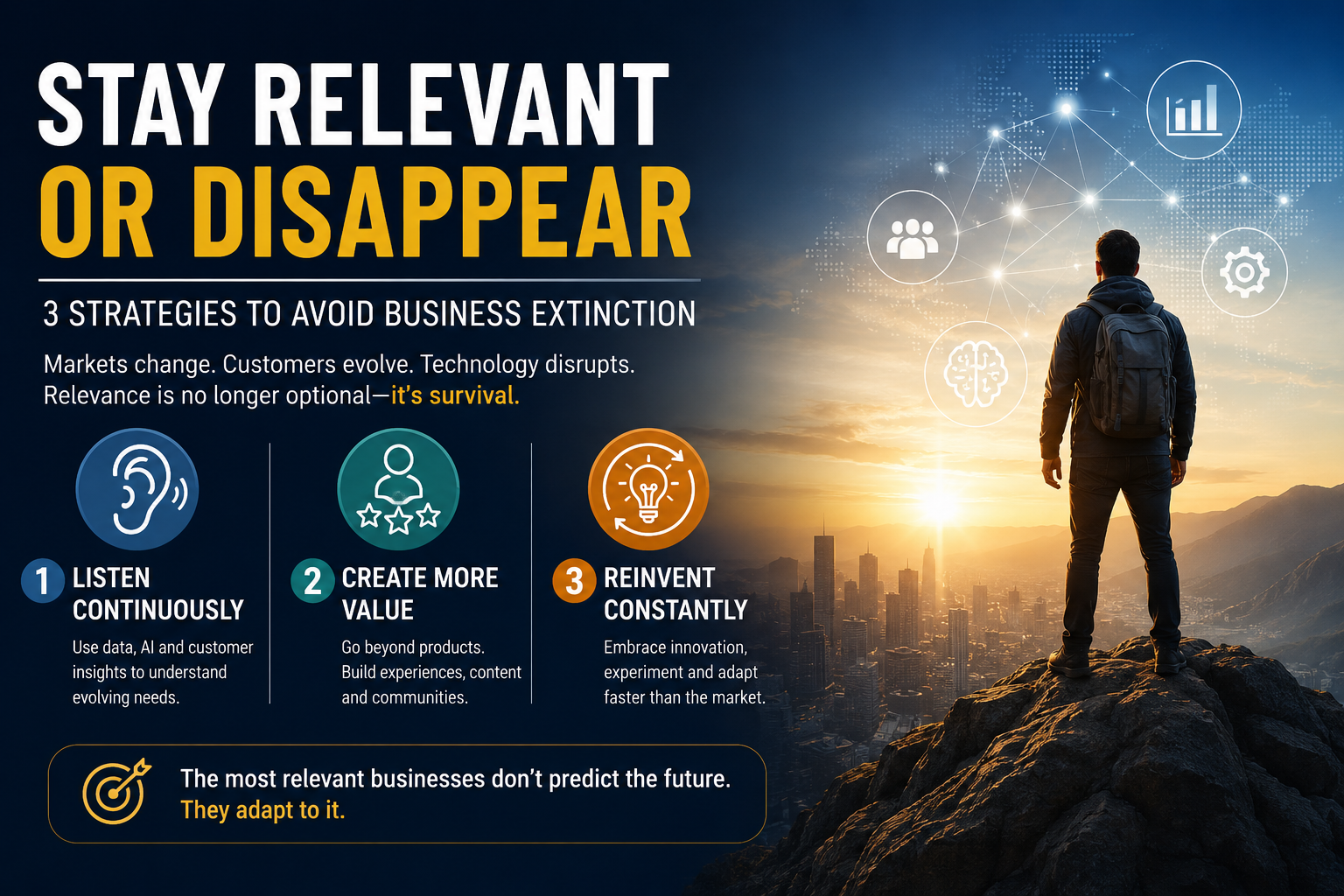
To maintain relevance in a rapidly changing world, focus on three priorities:
1. Listen Continuously
Use data, customer feedback, and AI-powered insights to understand evolving needs.
2. Deliver More Value
Build experiences, content, and communities around your products.
3. Reinvent Constantly
Create a culture that embraces experimentation, innovation, and adaptation.
Businesses that consistently execute these three principles significantly improve their chances of long-term success.
Conclusion: Relevance Is the New Competitive Advantage
The future does not belong to the biggest companies.
It belongs to the most relevant ones.
In an era where technology evolves faster than ever and customer expectations continuously shift, relevance has become the ultimate competitive advantage.
Organizations that listen carefully, create meaningful value, and embrace reinvention will continue to thrive.
Those that rely solely on past success risk becoming another cautionary tale of business extinction.
The question is no longer whether your industry will change.
The question is whether your organization will remain relevant when it does.
Start today: review your customer experience, analyze emerging trends, and identify one area where your business can become more relevant tomorrow than it is today.
Leave a comment