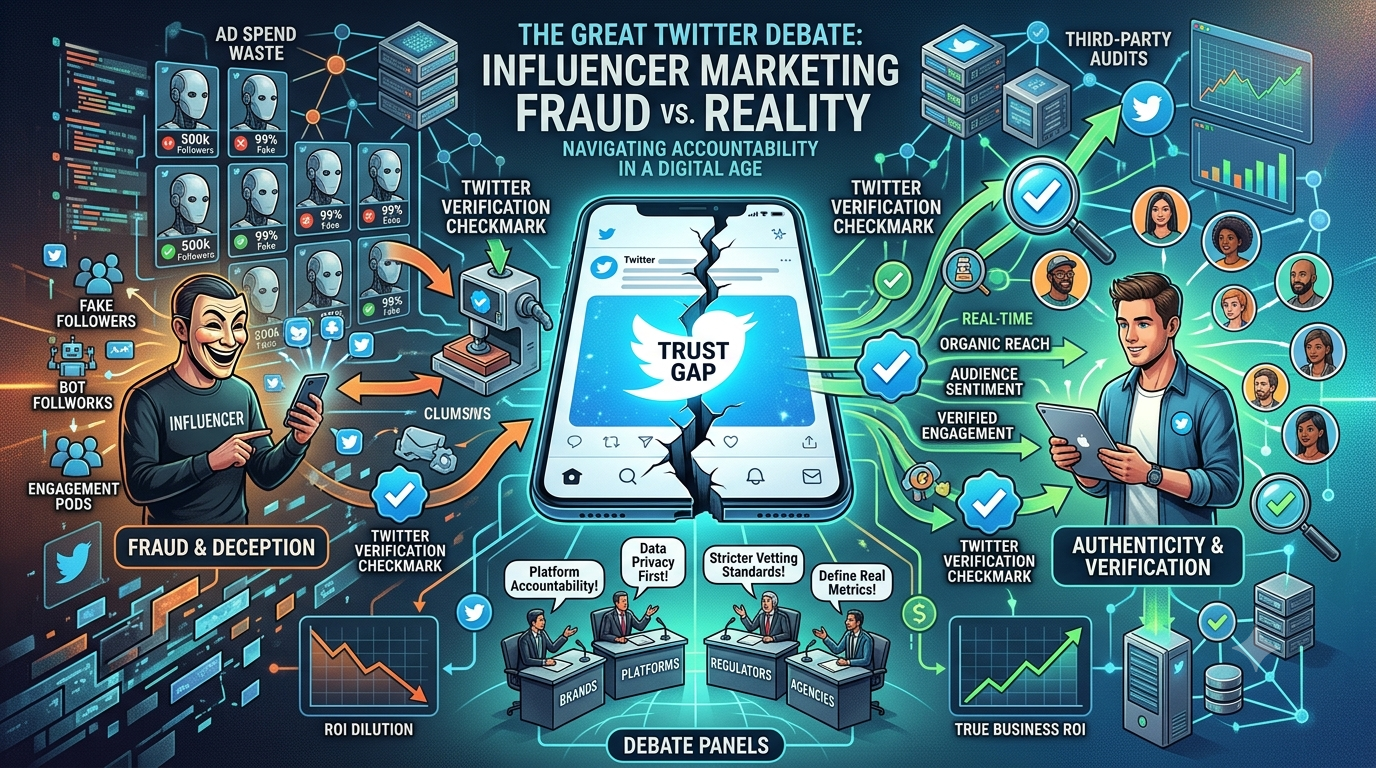
Introduction: When influence became a commodity
In the digital age, influence can be manufactured.
Followers can be bought.
Engagement can be faked.
Authority can be simulated.
And for years, this has created a fundamental problem in marketing:
👉 influence doesn’t always equal authenticity or value.
Back in 2018, Twitter made headlines by updating its user policies and purging millions of fake accounts in an attempt to restore trust in the platform.
But the real question was—and still is:
👉 Can platform policies actually stop influencer fraud?
In 2026, with more sophisticated technology, AI-generated content, and billions invested in influencer marketing, this question is more relevant than ever.
1. The origin of the problem: fake influence at scale
Influencer fraud didn’t appear overnight.
It emerged as a natural consequence of how social media platforms measure success:
- followers
- likes
- shares
These metrics became the currency of digital influence.
And where there’s currency…
👉 there’s manipulation.
1.1 The rise of fake followers
One of the most common forms of fraud is simple:
👉 buying followers
These followers are usually:
- bots
- inactive accounts
- or low-quality users
Their purpose: 👉 inflate perceived influence
1.2 Why fake influence matters
For brands, this creates serious problems:
- overpaying for campaigns
- targeting the wrong audience
- wasting marketing budgets
Recent data shows that a significant portion of influencer audiences can be inauthentic, costing brands billions globally every year
2. Twitter’s crackdown: what actually happened
In 2018, Twitter took a major step.
It removed millions of fake and suspicious accounts in a massive purge.
Impact:
- celebrities lost millions of followers
- overall follower counts dropped significantly
- credibility metrics were shaken
This move was intended to: 👉 increase trust
👉 improve platform integrity
Twitter explicitly stated that fake followers distort perceived influence and reduce trust in the system
2.1 Why Twitter acted
The platform recognized a critical issue:
👉 follower count had become a misleading metric
High follower numbers no longer guaranteed:
- engagement
- authenticity
- real influence
So the platform intervened.
3. The limits of platform policies
While these actions were important, they also exposed key limitations.
3.1 Fraud evolves faster than policy
As platforms improve detection:
👉 fraud adapts
New tactics include:
- engagement pods
- purchased comments
- AI-generated content
Even as platforms remove fake accounts, new ones appear.
3.2 The arms race between platforms and fraud
This creates a constant cycle:
- Platforms detect fraud
- Fraudsters adapt
- Platforms update policies
- Fraud evolves again
👉 A never-ending arms race
3.3 Visibility vs authenticity problem
Even with strict policies:
👉 audiences cannot always distinguish:
- real engagement
- fake engagement
4. The evolution of influencer fraud (2026 reality)
Today’s influencer fraud is far more sophisticated than in 2018.
4.1 Advanced fake engagement
Examples include:
- realistic bot comments
- automated engagement behavior
- coordinated interaction networks
4.2 AI-generated influence
AI has introduced:
- fake personas
- synthetic influencers
- deepfake content
These are harder to detect and more convincing.
4.3 Economic scale of the problem
Influencer fraud is no longer a niche issue.
It is now: 👉 a multi-billion-dollar problem
Studies estimate that billions in marketing budgets are wasted annually due to fraudulent influencer activity
5. Platform responses in 2026
Social media platforms have taken stronger measures.
5.1 Account purging
Platforms continue to remove fake accounts regularly.
5.2 AI detection systems
Machine learning identifies:
- bots
- anomalies
- suspicious patterns
5.3 Content labeling and transparency
Platforms increasingly require:
- disclosure of sponsored content
- labeling of AI-generated content
5.4 Regulatory pressure
Governments are stepping in.
In 2026:
- stricter disclosure rules
- increased legal accountability
- higher transparency standards
6. Why policies alone are not enough
Despite all these efforts:
👉 influencer fraud still exists
Why?
6.1 Incentives are still aligned with vanity metrics
Brands still often:
- prioritize reach
- focus on follower count
This creates demand for fake growth.
6.2 Lack of marketer awareness
Many companies:
- lack expertise
- rely on superficial metrics
6.3 Complexity of detection
Even advanced tools: 👉 cannot guarantee 100% accuracy
7. The shift from reach to performance
One of the most important changes in 2026:
👉 performance > popularity
Brands are moving toward:
- ROI-based influencer campaigns
- conversion tracking
- data-driven partnerships
Metrics are evolving from:
- followers
➡️ to outcomes
8. The rise of micro and nano influencers
Another shift:
👉 smaller influencers outperform larger ones
Why?
- higher engagement
- stronger trust
- more authentic relationships
9. The authenticity economy
We are entering a new phase:
👉 the trust economy
Consumers now demand:
- transparency
- authenticity
- honesty
Platforms and brands must adapt.
In 2026, authenticity is a critical factor in influencer success and campaign performance [capital.es]
10. The role of brands: where responsibility really lies
Here’s a key insight:
👉 platforms cannot solve this problem alone
Brands must:
✅ Vet influencers properly
Check audience quality, not just size
✅ Define clear KPIs
Focus on results, not vanity metrics
✅ Use analytics tools
Detect anomalies in engagement
✅ Build long-term relationships
Avoid one-off transactions
11. The future: AI, transparency and accountability
Looking forward:
11.1 AI-driven verification
Advanced tools will:
- audit influencers
- monitor campaigns
- predict fraud
11.2 Global regulation
New laws will enforce:
- disclosure
- accountability
- transparency
11.3 Platform accountability
Platforms will:
- be responsible for transparency
- provide better metrics
12. Lessons for marketers
Lesson 1: Don’t trust surface metrics
Followers ≠ influence
Lesson 2: Focus on outcomes
Measure:
- leads
- sales
- ROI
Lesson 3: Build strategy, not campaigns
Integrate influencer marketing into broader strategy
Lesson 4: Trust takes time
Authenticity cannot be faked long-term
Conclusion: Policies help, but strategy wins
Twitter’s crackdown was a wake-up call.
It showed:
- how widespread fake influence was
- how fragile trust can be
But it also proved something critical:
👉 platform policies are necessary—but not sufficient
The real solution lies in:
- better strategy
- smarter measurement
- stronger accountability
🚀 Want to build influencer campaigns that actually work (without fraud)?
If you want to:
- avoid fake influencers
- improve ROI
- build authentic campaigns
👉 We can help.
What we do
✅ Influencer audit and validation
✅ Data-driven strategy
✅ Campaign optimization
✅ ROI measurement
Leave a comment