Introduction: Reinventing Delivery at Scale
Amazon is not just an eCommerce company—it is one of the most sophisticated logistics organizations in the world. Its competitive advantage lies not only in product selection or pricing, but in its ability to move goods faster, more efficiently, and more reliably than almost any competitor.
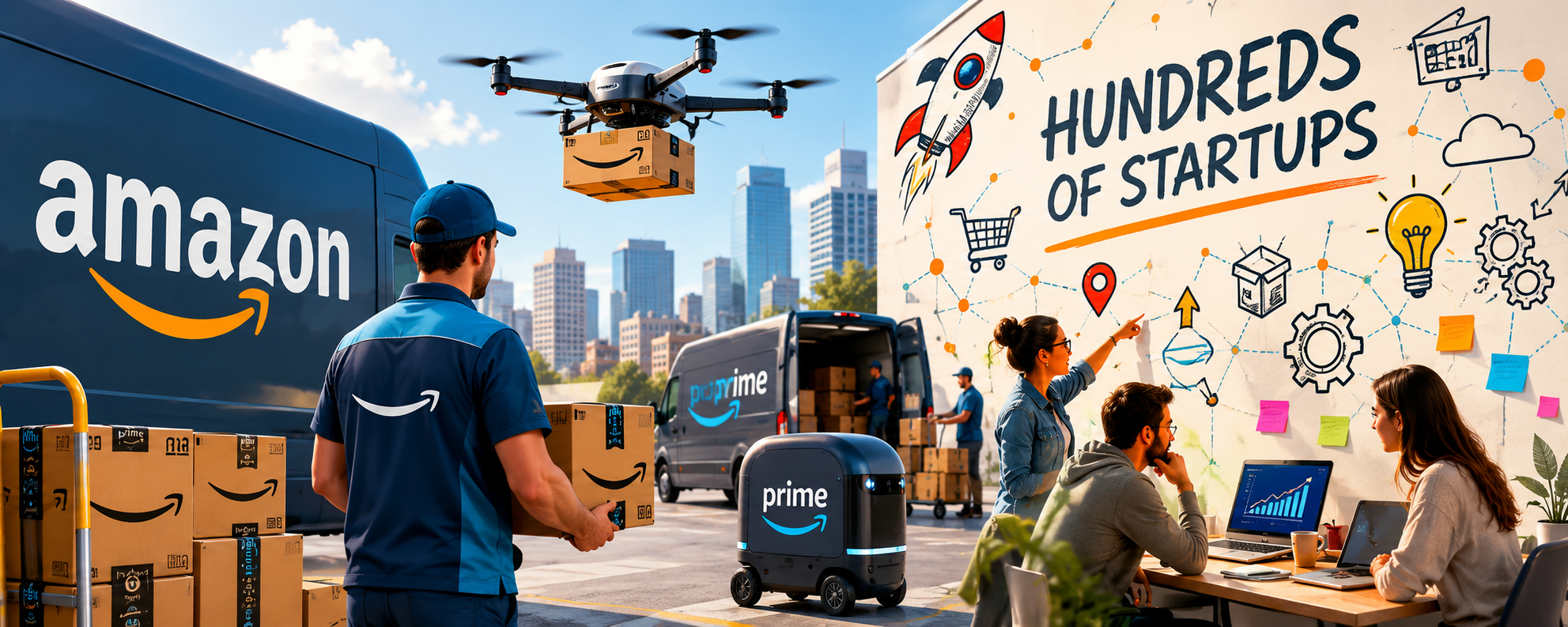
Over the past decade, Amazon has aggressively invested in warehouses, sorting centers, aircraft fleets, robotics, and last-mile delivery systems. Yet one of its most interesting and disruptive initiatives has been its decision to build a delivery network powered by hundreds of small, independent startups.
This strategy, formalized through programs like Delivery Service Partners (DSP), represents a structural shift in how logistics networks are built and scaled. Rather than relying exclusively on large carriers like UPS or FedEx, Amazon is creating a decentralized ecosystem of entrepreneurial operators.
This article explores why Amazon is embracing this model, how it works, its implications for the logistics industry, and what it reveals about the future of global commerce.
1. The Logistics Battlefield: Why Delivery Matters More Than Ever
1.1 Logistics as the Core of Competitive Advantage
In modern retail, logistics is no longer a back-office function—it is the core value proposition.
Consumers now judge brands based on:
- Delivery speed
- Reliability
- Transparency
- Convenience
Amazon has defined the standard with services like:
- Same-day delivery
- Next-day shipping
- Real-time tracking
This has reset customer expectations across industries.
1.2 The Challenge of the Last Mile
The «last mile»—the journey from the local distribution point to the customer’s doorstep—is the most expensive and complex part of the logistics chain.
Key challenges include:
- Urban congestion
- Failed deliveries
- High labor costs
- Variable demand
Despite technological advances, the last mile remains inefficient compared to earlier stages of the supply chain.
2. Amazon’s Strategic Shift: From Partnerships to Ownership
2.1 Breaking Away from Traditional Carriers
Historically, Amazon relied heavily on external logistics giants like UPS, FedEx, and USPS. However, over time, the company realized that:
- These carriers limited its ability to innovate
- They introduced dependencies
- They constrained scalability
This led Amazon to begin building its own logistics infrastructure.
2.2 Vertical Integration in Logistics
Amazon now controls a significant portion of its delivery ecosystem:
- Fulfillment centers
- Sorting facilities
- Delivery hubs
- Air cargo operations
The addition of startup-based delivery partners completes the final, critical link: the last mile.
3. The Delivery Service Partner (DSP) Model
3.1 What Is the DSP Program?
Amazon’s Delivery Service Partner program enables entrepreneurs to launch small delivery companies that operate exclusively within Amazon’s logistics ecosystem.
Participants typically:
- Operate fleets of branded vans
- Employ drivers
- Deliver Amazon packages within assigned territories
3.2 What Amazon Provides
Amazon supports these startups with:
- Logistics technology
- Route planning systems
- Training programs
- Operational guidelines
- Access to steady delivery volume
This significantly lowers the barriers to entry for new businesses.
3.3 What the Partner Handles
The startup operator is responsible for:
- Hiring and managing staff
- Maintaining vehicles
- Meeting performance metrics
- Ensuring delivery standards
This creates a hybrid model of outsourcing with tight central control.
4. Why Amazon Wants Hundreds of Startups
4.1 Flexibility at Scale
A network of small operators allows Amazon to adapt quickly:
- Increase capacity during peak seasons
- Adjust to local demand fluctuations
- Deploy resources more efficiently
Large logistics companies often struggle with this level of responsiveness.
4.2 Decentralization as Strength
Instead of a single rigid system, Amazon creates a distributed network:
- Many small delivery companies
- Multiple layers of operation
- Localized decision-making
This increases resilience and reduces system-wide risk.
4.3 Cost Efficiency
By outsourcing the last mile to startups:
- Amazon avoids fixed labor costs
- Operational risks shift to partners
- Capital investment requirements decrease
This makes the model financially attractive.
4.4 Entrepreneurial Ecosystem
Amazon frames the DSP program as an opportunity:
- Build a small business
- Create local jobs
- Participate in a global logistics network
This narrative aligns with broader economic goals while supporting Amazon’s growth.
5. The Power of Data and Technology
5.1 Route Optimization
Amazon uses advanced algorithms to:
- Optimize delivery routes
- Reduce travel time
- Improve efficiency
These systems continuously learn and adapt.
5.2 Real-Time Tracking
Customers can:
- Monitor package location
- Receive delivery updates
- Adjust delivery preferences
This transparency enhances the customer experience.
5.3 Performance Monitoring
Amazon tracks:
- Delivery times
- Success rates
- Customer feedback
Partners are evaluated constantly, ensuring high standards.
6. Impact on the Logistics Industry
6.1 Disruption of Traditional Carriers
Amazon’s model challenges established players:
- Reduces dependency on UPS, FedEx
- Introduces new competitive dynamics
- Forces innovation across the industry
6.2 Fragmentation of the Market
The rise of startup-based logistics leads to:
- More players
- Smaller operators
- New forms of collaboration
6.3 Innovation Acceleration
Competition drives innovation in:
- Delivery models
- Technology integration
- Customer experience
7. Opportunities for Entrepreneurs
7.1 Lower Barriers to Entry
Amazon provides:
- Tools
- Infrastructure
- Demand
This reduces the difficulty of launching a logistics business.
7.2 Predictable Revenue Streams
Partners benefit from:
- Consistent delivery volume
- Structured contracts
- Operational support
7.3 Rapid Scaling Potential
Successful operators can:
- Expand fleets
- Increase territory coverage
- Grow revenue
8. Challenges and Criticisms
8.1 Labor Concerns
Critics point to:
- High performance pressure
- Tight delivery schedules
- Working conditions for drivers
8.2 Dependency Risks
DSP operators rely heavily on Amazon:
- Single primary client
- Limited negotiation power
- Exposure to policy changes
8.3 Thin Margins
Despite revenue opportunities:
- Costs can be high
- Margins may be tight
- Profitability depends on efficiency
9. The Customer Experience Revolution
9.1 Faster Deliveries
The model enables:
- Same-day delivery
- More precise time windows
- Improved reliability
9.2 Increased Transparency
Customers expect:
- Real-time updates
- Delivery flexibility
- Seamless interactions
9.3 New Standards
Amazon has redefined expectations across:
- Retail
- Logistics
- Digital services
10. Future Innovations in Delivery
10.1 Autonomous Vehicles
Amazon is exploring:
- Self-driving delivery vans
- Robotics
10.2 Drone Delivery
Programs like Prime Air aim to:
- Deliver products within minutes
- Reduce delivery costs
- Bypass urban congestion
10.3 Micro-Fulfillment Centers
Placing inventory closer to customers:
- Speeds up delivery
- Reduces transportation time
11. Sustainability Challenges
11.1 Environmental Impact
Increased deliveries lead to:
- Higher emissions
- More traffic
11.2 Green Initiatives
Amazon is investing in:
- Electric delivery vehicles
- Sustainable packaging
- Carbon reduction strategies
12. Lessons for Business Leaders
12.1 Build Ecosystems, Not Just Companies
Amazon demonstrates:
- The power of networks
- The value of partnerships
12.2 Leverage Technology for Scale
Data-driven operations are essential for:
- Efficiency
- Growth
- Competitiveness
12.3 Think Beyond Traditional Models
Innovation often requires:
- Rethinking assumptions
- Experimenting with new structures
13. The Broader Economic Impact
13.1 Job Creation
The DSP model creates:
- Local employment
- Entrepreneurial opportunities
13.2 Changing Work Structures
It contributes to:
- Gig economy trends
- Independent business growth
13.3 Regional Development
Local delivery networks support:
- Urban economies
- Decentralized growth
14. Risks for the Future
14.1 Regulatory Pressure
Governments may intervene on:
- Labor practices
- Competition
- Market dominance
14.2 Over-Reliance on Amazon
Startups dependent on Amazon face:
- Strategic vulnerability
- Limited diversification
14.3 Economic Sustainability
Long-term viability depends on:
- Balanced margins
- Stable demand
- Efficient operations
15.Conclusion: A New Blueprint for Logistics
Amazon’s ambition to build a delivery network consisting of hundreds of startups represents a fundamental shift in logistics strategy. Rather than relying solely on centralized infrastructure or traditional partners, the company has embraced a hybrid model that combines technology, data, and distributed entrepreneurship.
This model offers clear advantages:
- Scalability
- Flexibility
- Cost efficiency
- Innovation
At the same time, it raises important questions about labor, sustainability, and dependency.
What is certain is that Amazon is not just improving logistics—it is redefining it. The combination of centralized intelligence and decentralized execution may become the blueprint for the next generation of supply chains.
In this future, the winners will not be those who simply move goods, but those who orchestrate complex ecosystems with precision, agility, and customer obsession.
Amazon is already showing what that future looks like—and it includes hundreds of startups at its core.
Leave a comment