Introduction to Digital Marketing for SMEs
In the race to achieve better market positioning and increase online visibility, social networks have become one of the most important channels for digital marketing for SMEs.
In their early years, platforms like Facebook, Twitter, Instagram, or LinkedIn offered an almost level playing field: a large budget was not necessary to obtain results. Creativity, consistency, and a good understanding of digital language were enough to reach thousands of people.
During this initial stage, Facebook for business became the jewel in the crown: a virtual shop window that allowed local businesses to showcase their products, interact with customers, and generate sales without the need for large investments.
The evolution of social networks as a sales channel
For over a decade, social networks have transformed the way companies interact with their customers. What began as a space for sharing personal experiences ended up becoming one of the main channels for customer acquisition, building awareness, and fostering loyalty.
For small and medium-sized enterprises, this transformation was especially important. Before Facebook arrived, promoting a local business relied heavily on traditional advertising, word-of-mouth, or physical presence. The advent of social networks allowed them to compete with much larger companies using reduced budgets.
However, the initial success generated an inevitable problem: more and more companies began to use the same platforms. As a consequence, the volume of content grew exponentially, and user attention became a scarce resource. This phenomenon led platforms to modify their algorithms to filter the information that appears in each user's feed.
The consequence for SMEs was clear: simply publishing content is no longer enough. Today, it is necessary to develop a comprehensive strategy based on objectives, segmentation, valuable content, advertising, and results analysis.
How Facebook for Business Worked in its Early Days
At the height of its popularity, Facebook for SMEs offered:
- High organic reach: posts seen by a large portion of followers.
- Moderate competition: few active pages compared to today.
- Direct connection with customers through comments and messages.
Examples:
- A restaurant posted a photo of the dish of the day and received instant bookings.
- A clothing store would upload an album with new arrivals and generate sales in hours.
- A consultant shared tips and secured meetings without advertising investment.
The golden age of organic reach
Between 2010 and 2014, Facebook represented an extraordinary opportunity for small businesses. The platform was not yet saturated, and the algorithm showed a large portion of posts to page followers.
A local business could reach thousands of people simply by posting attractive images, promotions, or business updates. This dissemination capability enabled the growth of thousands of companies that found Facebook to be a much more economical communication channel than traditional media.
Furthermore, interaction was more natural. Users were predisposed to comment, share, and recommend content posted by brands. Business pages benefited from an ecosystem where trust and visibility were closely related.
Many businesses built loyal communities during this period. However, excessive dependence on a third-party-controlled platform ended up becoming a strategic risk that many companies did not perceive in time.
The Changing Rules of the Game on Facebook
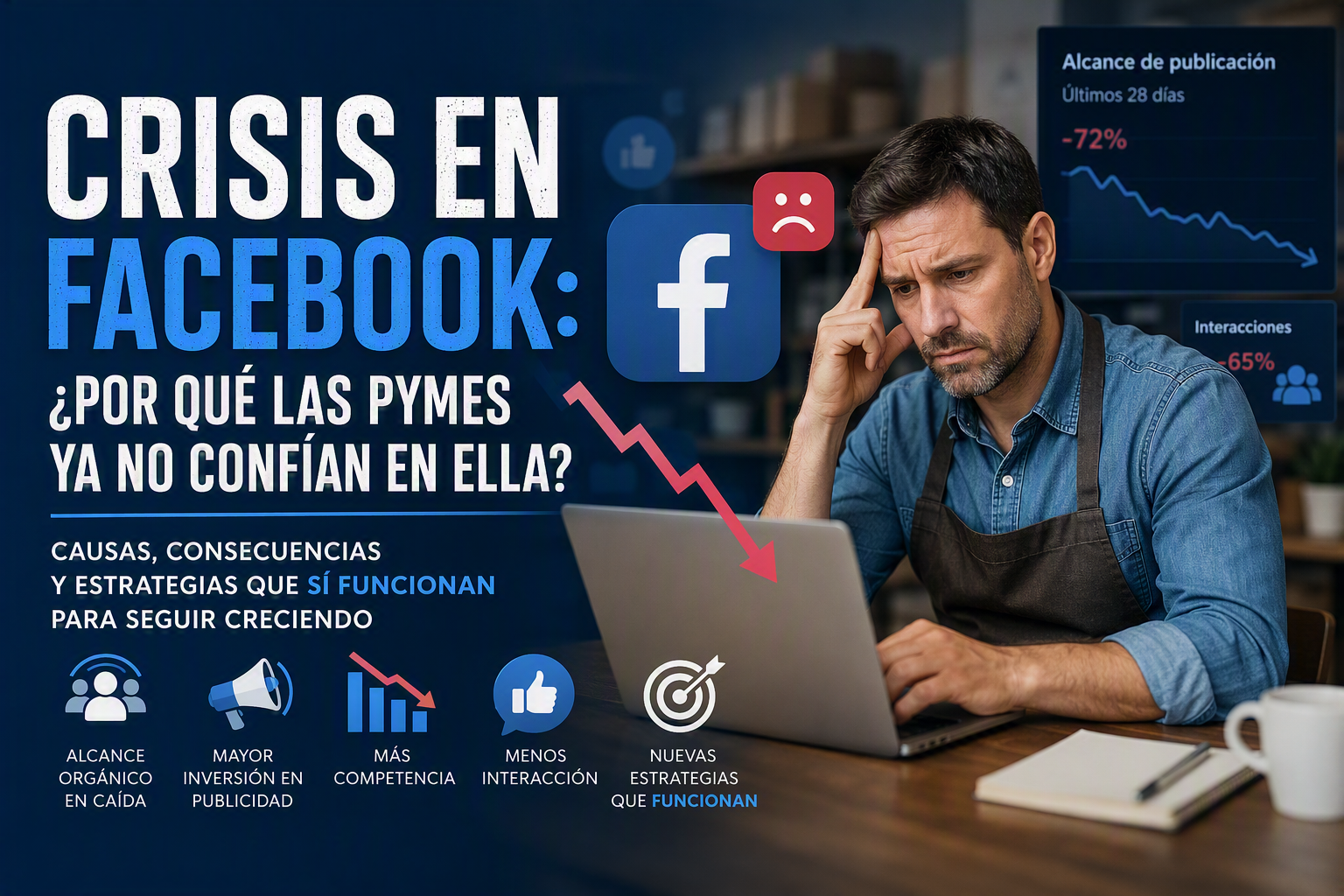
Over time, the landscape transformed radically. Algorithms began to prioritise paid content and limit the visibility of organic posts.
Currently, the organic reach of a business page on Facebook can be below 5%, meaning a post without promotion barely reaches a small fraction of followers.
Factors that caused this change:
- Increased content competition.
- More restrictive algorithms.
- Saturation of promotional posts.
- Constant changes in platform features.
Why Facebook reduced organic reach
The reduction in organic reach was not an accident. From Facebook's perspective, the goal was to improve the user experience by avoiding an excess of promotional content in the feed.
As millions of businesses began to post constantly, the volume of posts far exceeded the amount of content a user could consume daily. Facebook had to decide what to show and what to hide.
Algorithms began to prioritise factors such as:
- Meaningful interactions.
- Viewing time.
- Content relevance.
- Previous relationship between users.
- Formats favoured by the platform.
As a result, business pages lost visibility compared to posts from family, friends, and groups. This change forced many companies to supplement their organic efforts with advertising campaigns.
From a business perspective, many entrepreneurs interpreted this decision as a strategy to force advertising investment. Regardless of the reasons, the truth is that the social media management model has changed forever.
The most frequent errors of SMEs on Facebook
The loss of results is not always related to algorithm changes. In numerous cases, difficulties stem from strategic errors that limit the platform's potential.
One of the most common mistakes is using Facebook solely as a product showcase. Users access social networks to be entertained, informed, or connect with others, not to receive constant advertising.
Another frequent failing is the absence of content planning. Many businesses post irregularly, without defined objectives or metrics to evaluate performance.
It is also common to ignore the data available in Meta Business Suite. Analytical tools allow us to identify which content generates the most interaction, which produces conversions, and which audience segments respond best.
Businesses that achieve the best results usually combine informative, educational, promotional, and testimonial content within a coherent plan.
Recent Facebook Updates Affecting SMEs
Facebook makes frequent modifications to improve the user experience and adapt to new demands. Some of the most recent include:
1. Fight against fake news
The platform has implemented stricter systems to detect and limit the spread of misleading content, which helps protect brand reputation.
2. Filters to avoid spoilers
A new feature allows you to temporarily block posts about series, films, or sporting events to avoid unwanted previews.
3. Customisation of the navigation bar
Previously, all users in a country saw the same icons in the app. Now, the bar adapts to each person based on the functions they use most: groups, Marketplace, profile, pages, etc.
For SMEs, this means that if they manage to get customers to interact with their page frequently, they can gain direct visibility from the main screen.
Why SMEs Have Lost Trust in Facebook
Although Facebook remains useful, many SMEs have reduced their reliance due to:
- Reduced organic reach.
- Increased competition and content saturation.
- Increased advertising costs.
- Migration of users to other networks such as TikTok or Instagram Reels.
- Frequent changes on the platform that require continuous adaptation.
Is Facebook really dead for businesses?
Despite the criticism, claiming that Facebook has stopped working for businesses would be an oversimplification.
What has really disappeared is the model that allowed for great results with hardly any investment. Facebook continues to be one of the digital platforms with the largest user base and continues to offer very powerful segmentation tools.
Sectors such as catering, local commerce, training, health, real estate, or certain professional services continue to achieve positive results through well-managed campaigns.
The main difference is that Facebook must now be considered a channel within a broader strategy and not the sole point of contact with customers.
The best-positioned companies are those that use Facebook alongside Instagram, WhatsApp Business, email, Google Business Profile, and their own websites.
Social Media Digital Marketing Strategies That Work for SMEs
Despite the challenges, social media remains a key tool within a digital marketing strategy for SMEs, provided it is used intelligently.
1. Targeted advertising
Leverage micro-targeting by location, interests, and behaviour to reach specific potential customers.
2. Video content
Short formats like Reels, Stories, and Shorts generate more reach and interaction than static posts.
3. Local collaborations
Work with micro-influencers or complementary businesses to extend reach to specific audiences.
4. Message automation
Use chatbots and automatic replies to avoid missing commercial opportunities.
5. Metrics analysis
Measure results to adjust campaigns and optimise return on investment.
6. Leverage platform updates
Adapt quickly to changes like the customisable navigation bar to better position yourself against the competition.
7. Community building
Many companies focus all their efforts on selling when they should first focus on building relationships.
Building a strong digital community helps increase trust, improve reputation, and reduce reliance on advertising.
An active community interacts regularly with content, recommends the brand, and generates conversations that naturally boost reach.
To achieve this, it is advisable to respond to comments, ask questions, post engaging content, and show the human side of the company.
8. Educational content generation
Users increasingly value content that helps them solve specific problems.
An SME can position itself as a leader by sharing tips, practical guides, tutorials, FAQs, or success stories.
This type of content builds trust and makes it easier for potential customers to remember the brand when they need to buy a product or hire a service.
Companies that teach tend to sell more because they manage to differentiate themselves from competitors who only try to promote themselves.
Comparative Table: Before and Now in Social Media Management for SMEs
| Aspect | Before (2010-2015) | Now (2023-2025) | Practical example |
|---|---|---|---|
| Organic reach | 30%-50% of followers saw posts. | 2%-5% without advertising investment. | Bakery that used to reach almost all its customers now needs ads. |
| Competition | Low content saturation. | High competition, difficult to stand out. | Yoga studio that was unique in its city now competes with dozens in the area. |
| Advertising | Optional. | Mandatory for real visibility. | Shop invests €5/day to reach its neighbourhood. |
| Content type | Photos and text worked well. | Short videos and interactive content predominate. | Veterinary clinic now creates Reels with tips for pet owners. |
| Customer relationship | Messages answered manually. | Automatic responses and chatbots. | Real estate agency handles initial queries 24/7 with a bot. |
| Key platforms | Facebook as the main one. | Multi-channel strategy (Instagram, TikTok, LinkedIn, WhatsApp). | Café uses TikTok for young people and LinkedIn for business events. |
| User interface | Navigation bar the same for everyone. | Custom bar according to usage habits. | Active local group that appears as a shortcut for its members. |
What the future of social media will be for SMEs
The future points towards ever-increasing personalisation. Algorithms will continue to analyse user behaviour to show increasingly relevant content.
Artificial intelligence will also play a decisive role. Platforms will have more advanced tools to automate responses, create ads, optimise campaigns, and improve the customer experience.
Furthermore, video content will continue to gain prominence over traditional formats. Companies that develop capabilities to create useful, entertaining, and authentic videos will have a greater chance of capturing attention.
Likewise, the integration between e-commerce and social media will continue to grow. Direct purchases from social applications will become increasingly common and will shorten the journey between product discovery and conversion.
SMEs that understand these trends and adapt their strategies quickly will have a significant competitive advantage in the coming years.
Conclusion: Adapt to Win
Digital marketing for SMEs on social media is no longer an equal playing field as it was a decade ago. Today, standing out requires investment, creativity, and adaptability.
Facebook has gone from being a space of great organic reach to a competitive environment where ads, video, and constant interaction are key. However, it remains a valuable tool if integrated within a well-defined multi-channel strategy.
Recent updates, such as the custom navigation bar, are opportunities for those who know how to take advantage of them. In a constantly changing digital ecosystem, SMEs that adapt quickly not only survive, but can grow and consolidate.
Leave a comment