Introduction: when marketing stops looking only at the front
Most brands design packaging thinking only about the shelf.
- The front of the label.
- The logo.
- The colours.
- Visibility in the supermarket.
- Visual impact from a distance.
But there is an uncomfortable reality that many brands ignore: the consumer almost always turns the product.
- They touch it.
- They examine it.
- They look at it from behind.
- They read ingredients.
- They look for information.
- They analyse details.
A short while ago, Oliver Montiel from the Bold agency, a packaging expert, told me something that perfectly sums up this idea:
“Many brands design for what is seen, but the consumer really interacts with the packaging in 360 degrees.”
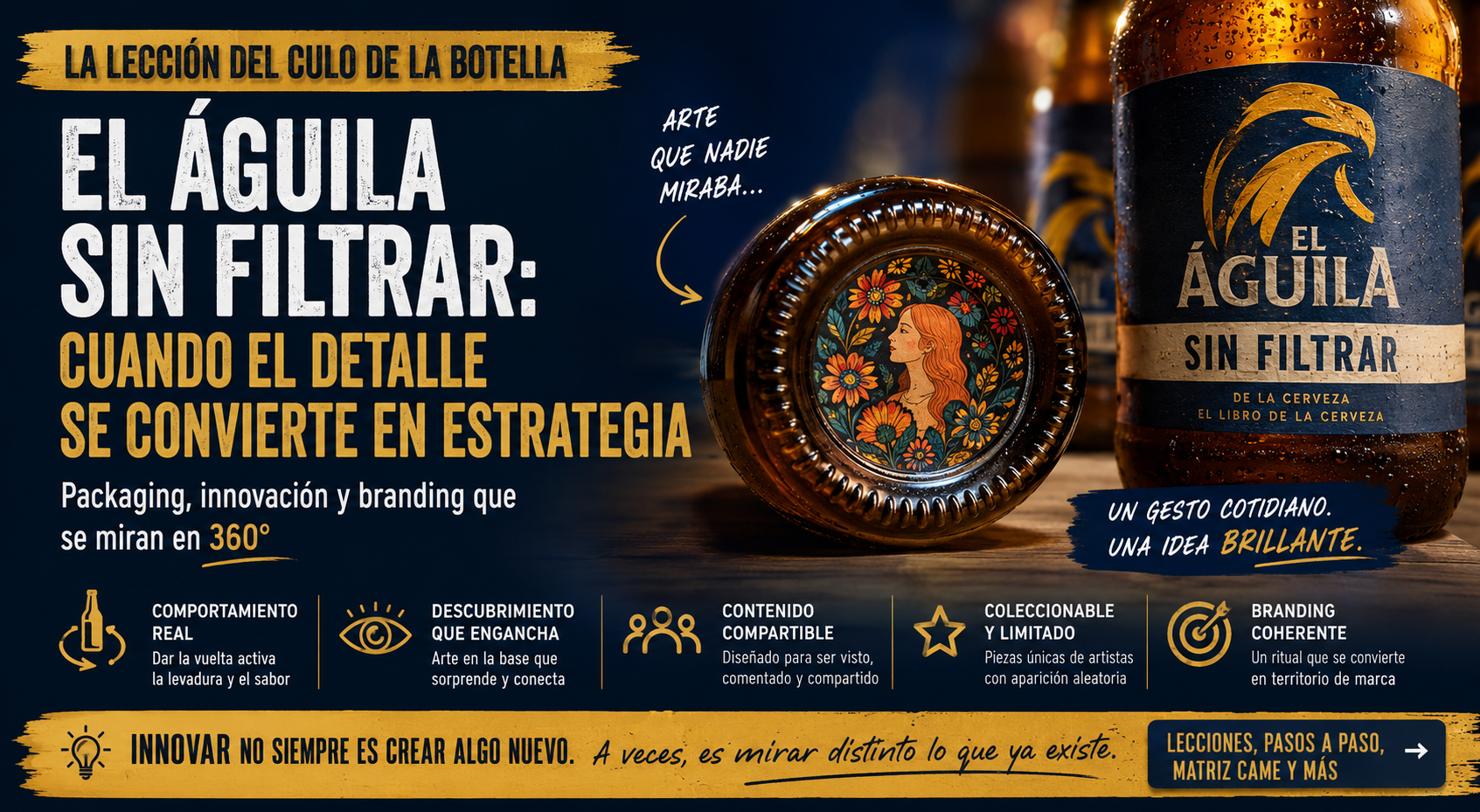
And that is precisely where the new campaign from El Águila Sin Filtrar has been brilliant.
The brand has managed to turn the bottom of the bottle into an asset for branding, storytelling, and social conversation.
Yes, the bottom of the bottle.
And that's precisely why it works so well.
The El Águila Sin Filtrar campaign: what exactly did they do
The "Limitadísimas" campaign, developed with Ogilvy, intervenes the base of El Águila Sin Filtrar bottles with designs created by contemporary artists.
The strategic key is not just the art.
The key is that the campaign stems from real consumer behaviour.
El Águila Sin Filtrar has spent years communicating a very recognisable ritual: turning the bottle upside down before consuming it to activate the yeast and enhance the flavour.
That gesture already existed.
The innovation has consisted of turning it into brand territory.
The campaign transforms a functional act into a cultural and emotional experience.
And that's where true genius lies.
Why this campaign is so important for modern marketing
1. It turns packaging into an experience
Packaging is no longer just a container.
Today it is:
- a communication medium,
- an experience,
- a narrative,
- social media content,
- a shareable object.
The best brands today understand this perfectly.
It's no longer enough to "look good".
Now the product must:
- generate conversation,
- provoke interaction,
- create surprise,
- incentivise discovery.
The Eagle achieves all of this from an area of the packaging that has historically been ignored.
2. It leverages real consumer behaviour
Many campaigns fail because they are born from advertising creativity and not from human behaviour.
Here, the opposite happens.
The campaign starts from an authentic habit:
- the consumer turns the bottle,
- looks at the base,
- interacts physically with the product.
This makes the experience feel natural and not forced.
3. It turns the product into content
One of the biggest changes in current marketing is this:
Advertising used to talk about the product.
Now the product must generate advertising itself.
Packaging becomes:
- organic content,
- social media material,
- spontaneous conversation,
- visual experience.
The consumer no longer just consumes beer.
They also consume:
- design,
- storytelling,
- discovery,
- collecting.
4. Introduce gamification and collecting
The artistic bases appear randomly.
This activates very powerful psychological mechanisms:
- surprise,
- exclusivity,
- search,
- collection,
- reward.
The purchase ceases to be solely functional.
Now there is the possibility of "finding something".
This connects perfectly with current trends:
- blind boxes,
- limited drops,
- sneaker culture,
- collecting,
- product gamification.
The big takeaway: packaging is no longer designed just to be seen
Brands have been designing packaging for the shelf for decades.
But today the consumer interacts with the product in many more contexts:
- at home,
- on social media,
- in photographs,
- in videos,
- in shared experiences,
- in social moments.
That's why design can no longer be limited to the front.
It must be conceived as a complete experience.
And here comes a fundamental lesson:
The consumer experiences packaging in 360 degrees
This implies working on:
- front,
- side,
- texture,
- opening,
- closing,
- base,
- ergonomics,
- interaction.
Each part can become:
- narrative,
- branding,
- differentiation,
- content.
The great strategic lessons from this campaign
Lesson 1: innovation doesn't always mean creating something new
El Águila didn't invent:
- a new bottle,
- a new beer,
- a new technology.
It simply redefined a forgotten part of the product.
That demonstrates something very important:
Many times, innovation consists of looking differently at something that already existed.
Lesson 2: the best campaigns are born from human behaviour
The campaign is not based on an isolated creative idea.
It is based on:
- how people hold the bottle,
- how they turn it,
- how they look at it.
The smartest brands study micro-behaviours.
Because that's where real opportunities lie.
Lesson 3: invisible details generate engagement
The internet loves unexpected discoveries.
Small hidden details generate:
- conversation,
- virality,
- interaction,
- sharing.
The base of the bottle works as an “easter egg”.
And that creates an emotional connection.
Lesson 4: the product can become an advertising medium
When the product itself generates conversation:
- the brand depends less on paid media,
- word-of-mouth increases,
- user-generated content grows,
- brand recall improves.
That has enormous value in a context where attention is increasingly expensive.
Step by step: how to apply this strategy to any brand
Step 1. Analyse how the consumer actually interacts with the product
Key questions:
- how do they open it?
- how do they hold it?
- what part do they look at?
- what gestures do they repeat?
- what moment of use is most emotional?
Huge opportunities often appear here.
Step 2. Detect underutilised areas of the product
Many brands ignore:
- bases,
- interiors,
- closures,
- secondary labels,
- textures,
- sounds,
- opening experiences.
These spaces can become branding assets.
Step 3. Introduce discoverable elements
Consumers value:
- surprises,
- hidden messages,
- personalisation,
- collectibles,
- variations.
The feeling of “discovery” generates engagement.
Step 4. Design for social media without looking designed for social media
The mistake many brands make is forcing virality.
The best shareable experiences are natural.
The Eagle doesn't say:
“take a photo”.
Simply create something worthy of a photograph.
Step 5. Turning packaging into storytelling
Design must respond to a strategic idea.
It's not about decorating.
It's about building meaning.
CAME Matrix for the El Águila Sin Filtrar campaign
| CAME | Strategic application |
|---|---|
| Correct | The traditional view of packaging as a simple front visual support |
| Face | Advertising saturation and the difficulty of capturing attention |
| Maintain | The ritual of turning the bottle as a distinctive brand asset |
| Exploit | Packaging as experience, content, and social conversation |
Synoptic table of El Águila's innovation
| Element | Applied innovation | Impact |
|---|---|---|
| Packaging | Creative use of the bottle base | Differentiation |
| Branding | Consumption ritual turned into narrative | Greater recall |
| Experience | Unexpected discovery | Emotional engagement |
| Content | Shareable packaging | Organic virality |
| Art | Collaboration with artists | Cultural value |
| Psychology | Randomness and collection | Buyback |
| Marketing | Product as a means | Reduction of advertising dependency |
| Consumer UX | Design based on real behaviour | Authenticity |
Will El Águila manage to make the gesture go viral? What would need to happen to transform the “bottom of the bottle” into a cultural behaviour
The big question isn't whether the campaign is creative.
It is.
The real question is different:
Can El Águila make looking at the bottom of the bottle a viral and cultural gesture?
Because that's where the real prize lies.
Not in the campaign.
But in transforming an everyday behaviour into a recognisable social habit.
And that is much, much harder.
Brands constantly dream of achieving it:
- that a gesture is repeated,
- that people imitate it,
- that the consumer does it even without thinking,
- that it ends up becoming part of popular culture.
Very few achieve it.
But when it happens, the brand stops depending exclusively on advertising.
Because the behaviour becomes the means.
And that's where El Águila has a huge opportunity.
The real objective isn't the packaging: it's the ritual
The best brands in the world don't just sell products.
They build rituals.
Think of historical examples:
- the lime in Corona,
- Coca-Cola's “open happiness”,
- the Oreo twist-lick-dunk,
- toasting with Estrella Galicia,
- the sound of opening a beer can,
- the “crack” of a cold Coca-Cola.
They are not just actions.
They are cultural micro-behaviours.
El Águila already had one:
turn the bottle upside down.
Now try to amplify it.
And strategically, that is very clever.
Because rituals:
- generate recall,
- increase repetition,
- build identity,
- create belonging,
- differentiate products.
What would need to happen for it to go truly viral?
1. The gesture must be extremely easy to copy
All behavioural virality has a basic rule:
Friction must be minimal
The consumer will not do something:
- complex,
- uncomfortable,
- long,
- artificial.
Turning a bottle upside down fits perfectly:
- it's simple,
- quick,
- natural,
- visual.
That is positive.
But something important is still missing:
the gesture must feel fun or satisfying.
Not just functional.
2. The gesture must be visually recognisable
Viral behaviours need:
- to be visible,
- understandable in seconds,
- recognisable even without explanation.
For example:
- uncorking a bottle,
- breaking a tablet,
- twisting a product,
- revealing something hidden.
The problem is that looking at the bottom of the bottle still lacks sufficient visual theatricality.
And therein lies the challenge.
The brand needs to turn it into:
- a moment,
- a revelation,
- a mini social experience.
3. The consumer must get an immediate reward
Viral dynamics work when the brain receives:
- surprise,
- exclusivity,
- discovery,
- social validation,
- emotional reward.
Currently the campaign offers:
- art,
- collection,
- visual surprise.
That's fine.
But to truly explode, it might need:
- ultra-rare editions,
- hidden messages,
- prizes,
- digital interaction,
- gamification,
- limited runs,
- unlockable experiences.
The more unpredictable the reward, the stronger the behaviour becomes.
It's pure behavioural psychology.
4. People must want to record it
This point is key.
Today many campaigns fail because they are interesting… but not recordable.
Modern virality needs:
- demonstration,
- video,
- reaction,
- sharing.
The critical question would be:
Does the gesture generate enough desire to show it off?
Because one thing is looking at the base of the bottle.
It's quite another to feel:
“this deserves to be uploaded to TikTok”.
And that difference changes everything.
5. It needs a recognisable social code
Great cultural brands manage to make a gesture mean something.
For example:
- “if you know, you know”,
- belonging,
- insider culture,
- shared identity.
El Águila could turn the gesture into:
- a symbol of authenticity,
- a cultural nod,
- a connoisseur's signal,
- generational ritual.
But for that, it needs massive repetition.
And above all:
that the community adopts the behaviour as its own.
Not as something imposed by advertising.
6. Content creators must adopt the gesture
Herein lies the real key.
No modern ritual scales solely through traditional media.
It needs:
- TikTok,
- Reels,
- UGC,
- creators,
- reinterpretations,
- humour,
- memeable formats.
The exact moment a campaign explodes culturally is usually when the internet stops repeating it… and starts playing with it.
When they appear:
- parodies,
- remixes,
- collections,
- rankings,
- obsessions,
- challenges,
- theories,
- comparisons.
That's where the phenomenon is born.
7. The campaign needs continuity
This is probably the biggest risk.
Many brands have a great idea…
and abandon it too quickly.
But cultural rituals need:
- repetition,
- consistency,
- evolution.
If El Águila wants to turn this into a real brand asset, it should:
- maintain the logic for years,
- create new versions,
- introduce new collaborations,
- build anticipation,
- generate a collector community.
Because cultural behaviours are not born from a campaign.
They are born from accumulation.
The great hidden potential: turning “flipping it” into brand identity
There is a gigantic opportunity here.
Because “flipping it” can become:
- philosophy,
- tone,
- storytelling,
- creative platform.
The brand could use it for:
- packaging,
- communication,
- experiences,
- collaborations,
- activations,
- retail,
- events.
Not just flipping the bottle.
Flipping the conventional.
And when a physical gesture becomes a strategic idea…
the brand gains depth.
Can it become a historic branding case?
Yes.
But it still depends on something fundamental:
that people adopt the gesture without feeling they are obeying advertising.
That is the critical point.
Brands cannot impose cultural rituals.
They can only design conditions for them to occur.
And when they work, they usually share something:
- simplicity,
- reward,
- identity,
- repetition,
- social visibility.
El Águila has several ingredients.
But it still needs to turn curiosity into mass behaviour.
The difference between a good campaign and a cultural phenomenon
Right now, El Águila has a very good campaign.
But to transform into a cultural phenomenon it needs something more difficult:
for the consumer to make the gesture their own.
That:
- they repeat it,
- they teach it,
- they recommend it,
- they expect it,
- they look for it,
- they turn it into a habit.
Because the real success would not be selling more beer.
It would be getting millions of people, when picking up a bottle, to automatically do something they didn't do before.
And if that happens…
The bottom of the bottle would stop being packaging.
It would become culture.
What brands can learn from this campaign
The El Águila campaign demonstrates something essential:
The best ideas were often right in front of us
Or underneath.
In this case, literally under the bottle.
It wasn't necessary:
- more technology,
- more budget,
- more spectacle.
It was necessary to observe better.
To understand:
- how the consumer interacts,
- which gestures they repeat,
- which details the industry ignores.
That's where the big opportunities appear.
Conclusion: the future of branding will be experiential or it will not be
For years, marketing was obsessed with interrupting.
Now the smartest brands are looking to:
- surprise,
- accompany,
- integrate into the experience,
- generate discovery.
El Águila has achieved something very difficult:
Turning an invisible part of the packaging into cultural conversation.
And that demonstrates a huge truth about contemporary branding:
Brands no longer just compete for attention.
They compete for observation.
Because when a brand manages to get the consumer to look where nobody normally looks… it has achieved something very valuable.
It has achieved curiosity.
And curiosity remains one of marketing's most powerful assets.
Leave a comment