Understanding the Instagram Algorithm in 2026: What Every Creator, Brand, and Marketer Needs to Know
Instagram has evolved dramatically since its launch in 2010. What began as a simple photo-sharing platform has become one of the world’s most influential digital ecosystems, shaping consumer behavior, brand visibility, creator economies, and even cultural trends.
Yet one question continues to dominate conversations among marketers, entrepreneurs, influencers, and businesses:
How does the Instagram Feed actually work?
Many people still talk about «the Instagram algorithm» as if it were a mysterious machine hidden behind a curtain, deciding who succeeds and who disappears. The reality is far more complex—and far more interesting.
Instagram does not rely on a single algorithm. Instead, it uses a collection of machine-learning systems designed to personalize every user’s experience. Each person sees a unique Instagram based on their interests, behaviors, relationships, and interactions.
Understanding how these systems work is no longer optional. Whether you are a content creator, small business owner, retailer, marketing professional, consultant, or corporate brand, your visibility depends on understanding the signals Instagram values.
This article explores how the Instagram Feed works, how the platform ranks content, what factors influence reach, and how you can adapt your strategy to thrive in an increasingly competitive environment.
The Evolution of Instagram’s Feed
When Instagram first launched, posts appeared in strict chronological order.
The newest content appeared at the top, and older content gradually moved down the feed. Visibility depended almost entirely on timing.
As Instagram’s user base expanded into the hundreds of millions, a new challenge emerged.
Users simply could not see all the content being published.
According to Instagram, people were missing a significant percentage of posts from friends, family, creators, and brands they cared about because the volume of content exceeded their ability to consume it.
To solve this problem, Instagram introduced algorithmic ranking.
The objective was not to show everything.
The objective was to show what each user was most likely to find valuable.
This shift fundamentally changed social media marketing.
Success was no longer determined solely by publishing frequency. Instead, content quality, relevance, engagement, and audience relationships became the primary drivers of visibility.
There Is No Single Instagram Algorithm
One of the most common misconceptions is that Instagram uses one universal algorithm.
In reality, Instagram operates multiple ranking systems across different areas of the platform:
- Feed
- Stories
- Reels
- Explore
- Search
- Suggested Content
Each area serves a different purpose.
As a result, each ranking system evaluates different signals and priorities.
For example:
A Reel may reach millions of people who have never heard of your brand.
A Story, however, is primarily shown to people who already have a relationship with you.
Understanding this distinction is critical because strategies that work in Reels may fail completely in Stories, and vice versa.
How the Feed Ranking System Works
The Instagram Feed remains one of the most important environments for businesses and creators.
The Feed is where users discover updates from accounts they follow and interact with regularly.
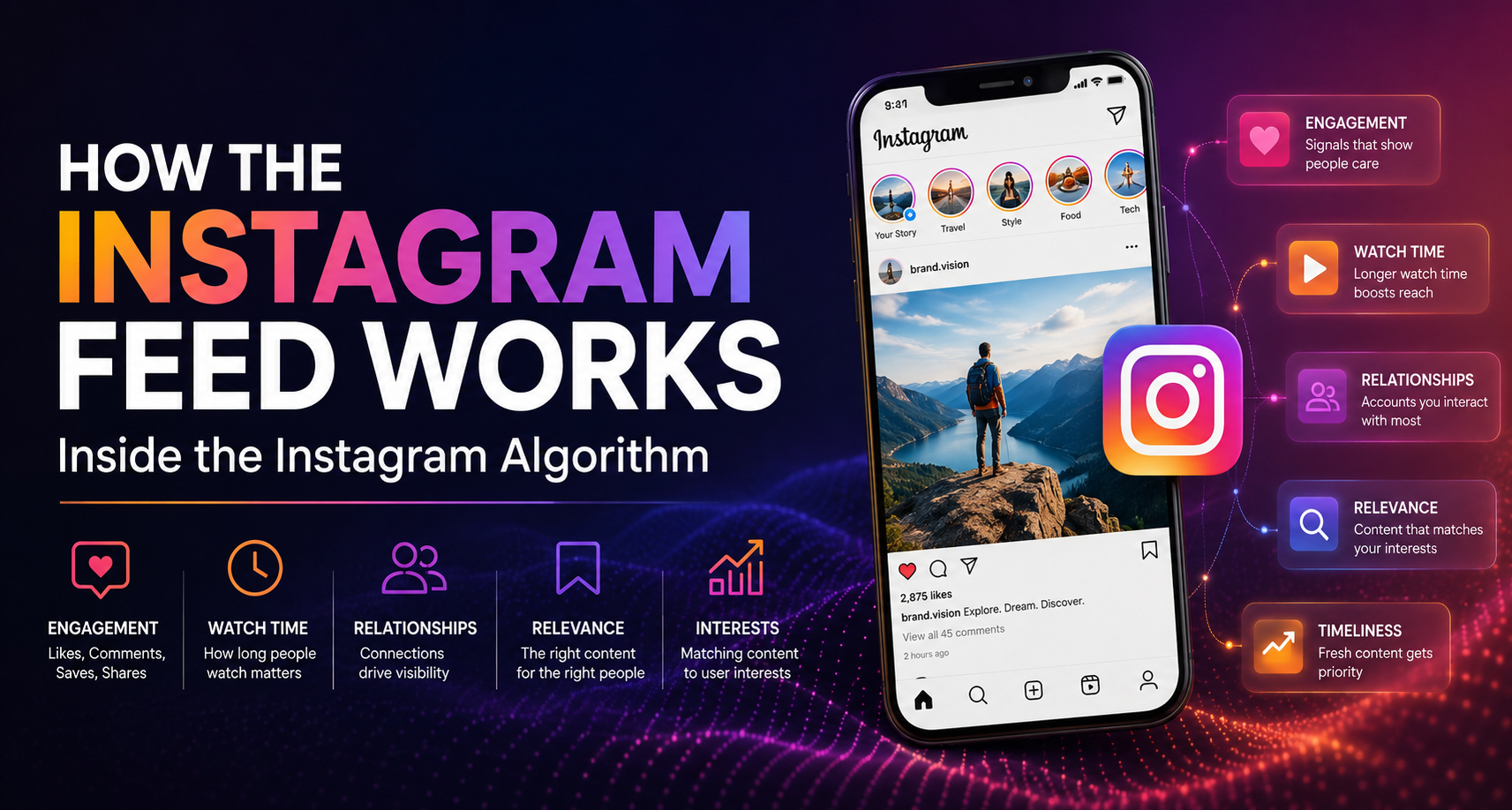
Instagram evaluates thousands of signals before deciding what appears at the top of a user’s Feed.
These signals can be grouped into several categories.
User Activity
Instagram studies how users behave on the platform.
The system analyzes:
- Posts liked
- Content shared
- Accounts followed
- Videos watched
- Topics explored
- Comments written
- Time spent viewing content
Every interaction helps Instagram build a profile of user interests.
If someone regularly engages with marketing content, Instagram will prioritize similar content.
If another user consistently watches travel videos, travel-related posts will appear more frequently.
The platform learns continuously from behavior.
Information About the Post
Instagram also evaluates the content itself.
Important factors include:
- Publication date
- Engagement velocity
- Number of likes
- Number of comments
- Number of shares
- Number of saves
- Watch time
- Content format
Posts that generate meaningful engagement shortly after publication often receive greater visibility.
This is because Instagram interprets strong early engagement as a sign of relevance and quality.
Relationship Signals
Relationships matter enormously.
Instagram tries to identify which accounts are most important to each user.
Signals include:
- Direct messages exchanged
- Comment interactions
- Story engagement
- Profile visits
- Shared interests
- Historical engagement patterns
If users consistently interact with a particular account, Instagram assumes they want to see more content from that account.
This is why community building often outperforms pure audience growth.
Ten thousand highly engaged followers can generate better results than one hundred thousand passive followers.
Creator Credibility
Instagram increasingly evaluates creator quality.
Factors may include:
- Consistent publishing
- Original content creation
- Authentic engagement
- Community interaction
- Compliance with platform guidelines
Accounts that repeatedly publish spammy, misleading, or low-quality content may experience reduced visibility.
The Importance of Engagement
Engagement remains one of the strongest ranking signals.
However, not all engagement carries the same value.
Instagram prioritizes actions that indicate deeper interest.
Saves
Saves are often considered one of the most powerful signals.
When users save content, Instagram interprets this as evidence that the content has long-term value.
Educational posts, tutorials, frameworks, checklists, and industry insights often generate high save rates.
Shares
Shares represent another strong signal.
When someone sends your content to another person, Instagram sees that action as a recommendation.
Shared content frequently experiences increased distribution.
Comments
Meaningful comments provide evidence of active participation.
A thoughtful discussion generally contributes more value than generic comments such as:
- Nice post
- Great
- Amazing
- Love this
The platform increasingly focuses on authentic interaction rather than superficial engagement.
Watch Time
For videos and Reels, watch time is crucial.
Instagram wants users to remain on the platform.
Content that holds attention supports that objective.
Long viewing sessions signal quality and relevance.
Why Reels Dominate Instagram Growth
Over the past few years, Reels have become Instagram’s most powerful discovery engine.
The reason is simple.
Feed content primarily reaches existing followers.
Reels are designed to reach people who do not yet know you.
Instagram aggressively promotes engaging video content because it competes directly with platforms such as:
- TikTok
- YouTube
- Snapchat
The platform rewards Reels that:
- Capture attention quickly
- Maintain viewer retention
- Generate shares
- Encourage rewatches
- Inspire comments
Creators who understand these principles often achieve exponential audience growth.
The First Three Seconds Matter
Modern social media is a battle for attention.
Instagram measures whether users stop scrolling.
The first few seconds determine success or failure.
Effective hooks often include:
- Surprising statistics
- Unexpected insights
- Contrarian viewpoints
- Strong visual movement
- Clear audience targeting
For example:
«Most businesses are using Instagram completely wrong.»
This statement creates curiosity and encourages viewers to continue watching.
Without a compelling hook, even excellent content may fail.
Why Saves and Shares Matter More Than Likes
Many marketers remain obsessed with likes.
The algorithm is not.
Likes are relatively low-effort interactions.
Saves and shares demonstrate stronger user intent.
Think about the difference.
A like takes a fraction of a second.
A save indicates future relevance.
A share suggests advocacy.
Consequently, modern content strategies should prioritize usefulness rather than popularity.
Ask yourself:
«Would someone want to keep this content for future reference?»
If the answer is yes, your save rate will likely improve.
The Rise of Interest-Based Distribution
Social media is increasingly becoming interest-based rather than follower-based.
Historically, visibility depended on audience size.
Today, relevance often matters more than follower count.
A small creator producing highly relevant content can outperform much larger competitors.
Instagram’s machine-learning systems focus on matching content with interested audiences.
This democratizes opportunity.
It also increases competition.
The winners are not necessarily the biggest accounts.
They are often the most relevant accounts.
Content Originality and AI
Instagram has placed increasing emphasis on original content.
Reposting content from other creators may limit distribution.
The platform wants to reward creators who contribute unique value.
At the same time, artificial intelligence is transforming content creation.
AI tools can help with:
- Research
- Scripting
- Caption writing
- Content planning
- Image generation
- Video editing
However, relying entirely on AI-generated content can be risky.
Audiences increasingly value authenticity, expertise, and human perspective.
The most successful creators use AI as an amplifier rather than a replacement.
Technology supports creativity.
It does not replace it.
Common Instagram Algorithm Myths
Myth 1: Instagram Hates Business Accounts
False.
Instagram benefits when businesses create engaging content.
The platform does not penalize business profiles simply because they are commercial.
Poor performance is usually related to content quality, audience fit, or engagement issues.
Myth 2: Hashtags Are Dead
False.
Hashtags are less important than they once were, but they still provide contextual information.
They help Instagram understand content topics.
Hashtags should support content, not define strategy.
Myth 3: Posting More Guarantees More Reach
False.
Publishing ten mediocre posts rarely outperforms publishing three exceptional posts.
Quality remains more important than quantity.
Myth 4: Shadowbans Explain Every Drop in Reach
False.
Most reach declines result from:
- Audience fatigue
- Increased competition
- Content saturation
- Reduced engagement
- Algorithmic adaptation
Blaming shadowbans often prevents meaningful analysis.
The Psychology Behind Instagram’s Ranking System
Instagram’s business model depends on user attention.
The longer people remain engaged, the more valuable the platform becomes.
Therefore, the algorithm rewards content that triggers psychological drivers such as:
Curiosity
Humans naturally seek information gaps.
Content that creates curiosity often achieves higher engagement.
Social Connection
People want belonging.
Community-focused content performs well because it reinforces identity and relationships.
Emotional Impact
Emotion drives memory and sharing.
Posts that inspire, surprise, educate, or entertain often generate stronger results.
Practical Utility
Useful content encourages saves.
Educational value remains one of the most reliable growth strategies.
What Brands Can Learn from the Algorithm
The Instagram algorithm offers a broader lesson about modern marketing.
Brands frequently focus on broadcasting messages.
Algorithms reward creating value.
This distinction is fundamental.
Consumers no longer passively consume advertising.
They actively choose what deserves attention.
Successful brands therefore focus on:
- Education
- Entertainment
- Inspiration
- Problem-solving
- Community building
The algorithm merely reflects these human preferences.
The Future of Instagram’s Feed
The future of Instagram will likely be shaped by three major forces.
Artificial Intelligence
AI-driven personalization will become even more sophisticated.
Feeds will increasingly adapt to individual preferences in real time.
Creator Economy Growth
Independent creators will continue competing with traditional media brands.
Authority will depend less on institutional power and more on audience trust.
Search-Based Discovery
Instagram is gradually becoming a search engine.
Users increasingly search for:
- Products
- Services
- Recommendations
- Tutorials
- Local businesses
SEO principles are becoming more important inside social platforms.
Keywords, captions, profiles, and content context all contribute to discoverability.
Instagram SEO: The New Competitive Advantage
Many marketers still think SEO belongs exclusively to Google.
That assumption is becoming outdated.
Instagram increasingly uses semantic understanding to classify content.
Brands should optimize:
- Profile names
- Usernames
- Bios
- Captions
- Alt text
- On-screen text
- Video speech
The objective is simple.
Help Instagram understand exactly what your content is about.
The clearer the context, the easier it becomes for the platform to connect your content with interested users.
Final Thoughts
The Instagram Feed is not designed to punish creators, hide content, or favor a select few accounts.
Its primary objective is to maximize relevance for users.
Every ranking decision ultimately seeks to answer a single question:
What content is this person most likely to value right now?
Understanding this principle changes everything.
Instead of chasing algorithm hacks, successful creators and brands focus on creating content that genuinely deserves attention.
The future belongs to those who educate, inspire, entertain, and solve problems.
Algorithms will continue evolving.
Features will change.
Formats will come and go.
But one principle remains constant:
People engage with content that improves their lives.
The Instagram algorithm is simply becoming better and better at identifying exactly that.
Deja una respuesta