The Carbon Challenge Businesses Can No Longer Ignore
Climate change has evolved from being an environmental concern into a strategic business issue. Customers, investors, regulators, and employees increasingly expect organizations to demonstrate a genuine commitment to sustainability.
As companies race toward ambitious net-zero targets, one challenge remains particularly complex: how to effectively reduce and compensate for unavoidable carbon emissions.
This is where carbon removal marketplaces are emerging as a game-changing solution.
By simplifying access to high-quality carbon offsets and carbon removal projects, these platforms are transforming the way organizations participate in the fight against climate change. More importantly, they are helping businesses move from sustainability promises to measurable climate action.
But what exactly are carbon removal marketplaces, and why are they becoming increasingly relevant in today’s business landscape?
What Is a Carbon Removal Marketplace?
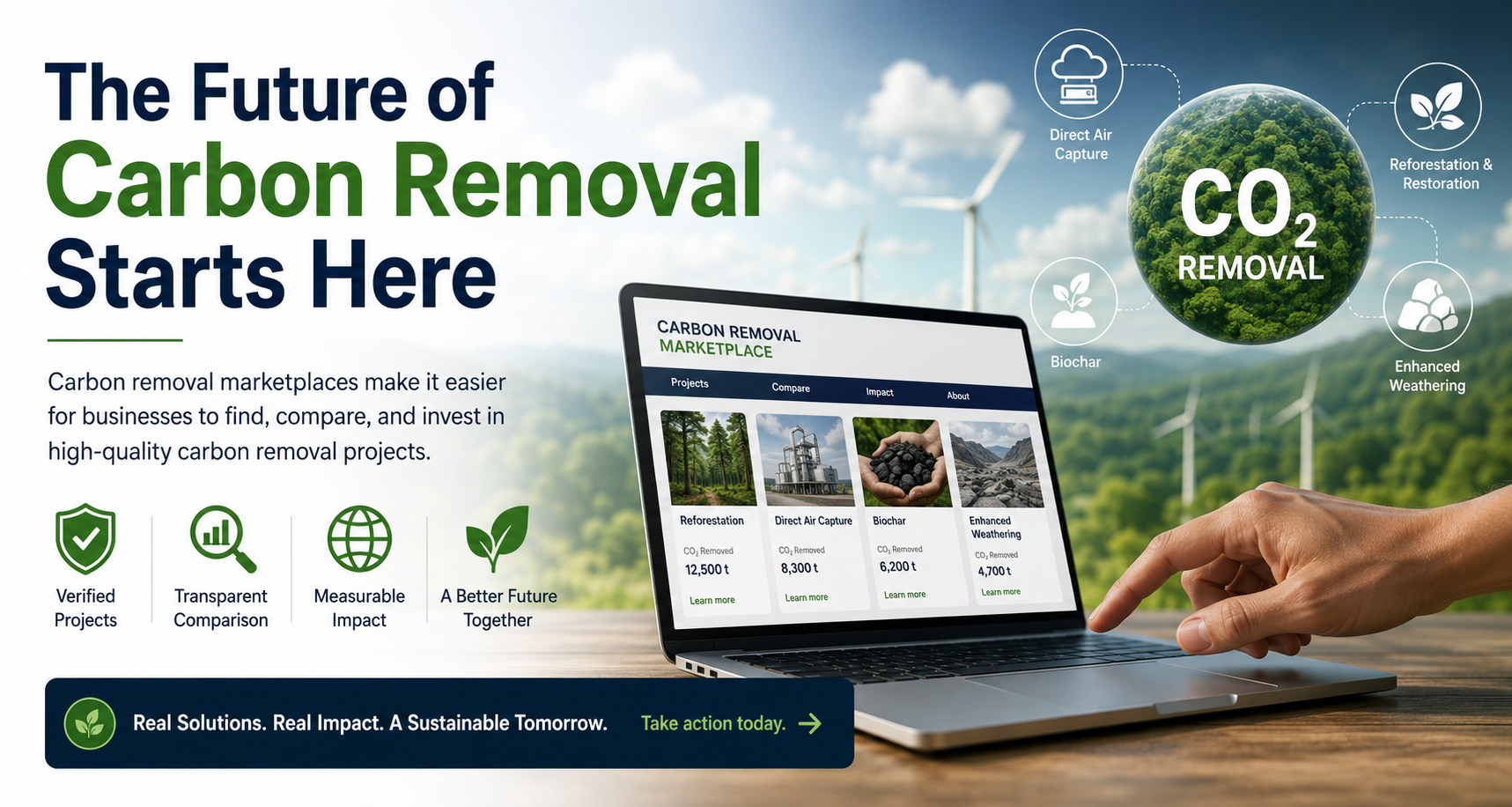
A carbon removal marketplace is a digital platform that connects organizations looking to offset their carbon emissions with verified carbon removal projects.
Unlike traditional carbon offset programs, which often focus on avoiding future emissions, carbon removal initiatives actively extract carbon dioxide already present in the atmosphere.
These marketplaces function much like modern e-commerce platforms:
- Carbon removal providers list their projects.
- Businesses compare available solutions.
- Buyers purchase verified carbon credits.
- Independent verification ensures credibility and transparency.
The result is a more efficient, scalable, and trustworthy ecosystem for climate action.
Why Traditional Carbon Offsets Are Being Questioned
For years, carbon offsets have played an important role in corporate sustainability strategies. However, the market has faced increasing scrutiny.
Several challenges have emerged:
Lack of Transparency
Many buyers struggle to understand exactly how projects operate and whether promised emissions reductions are genuinely achieved.
Verification Concerns
Not all carbon credits are created equal. Differences in methodologies and monitoring standards have generated skepticism.
Greenwashing Risks
Companies purchasing low-quality offsets risk being accused of using sustainability claims primarily for marketing purposes rather than delivering real environmental impact.
As public awareness grows, businesses need solutions that offer greater accountability and measurable outcomes.
This demand is fueling the rise of carbon removal marketplaces.
The Rise of Carbon Removal Technologies
One of the most exciting developments in sustainability is the emergence of innovative carbon removal technologies.
These include:
Direct Air Capture (DAC)
Advanced systems that physically remove carbon dioxide from the atmosphere and store it permanently underground.
Biochar
Organic waste transformed into a stable carbon-rich material capable of locking away carbon for hundreds of years.
Enhanced Weathering
Natural minerals accelerate chemical processes that permanently absorb atmospheric carbon.
Reforestation and Ecosystem Restoration
Large-scale projects designed to restore forests and natural habitats while capturing carbon naturally.
Modern marketplaces allow organizations to diversify their sustainability portfolios by investing in a combination of these solutions.
Why Carbon Removal Marketplaces Matter for Businesses
The value of these platforms extends far beyond environmental responsibility.
Easier Access to Climate Solutions
Historically, purchasing carbon credits required navigating a fragmented and complex ecosystem.
Marketplaces simplify the process, enabling organizations of all sizes to participate.
Greater Transparency
Leading platforms provide detailed information about project methodologies, impact measurements, certification standards, and long-term effectiveness.
Better Decision-Making
Businesses can compare projects based on:
- Cost
- Carbon removal capacity
- Verification standards
- Geographic location
- Social impact
- Permanence of carbon storage
This enables more strategic sustainability investments.
Stronger Brand Reputation
Consumers increasingly reward brands that demonstrate authentic environmental leadership.
Organizations that support high-quality carbon removal projects can strengthen trust and differentiate themselves in competitive markets.
The Role of Artificial Intelligence in Carbon Markets
Artificial Intelligence is rapidly becoming a critical tool in the evolution of carbon removal marketplaces.
AI helps improve:
Project Verification
Machine learning algorithms analyze satellite imagery, environmental data, and operational metrics to validate project performance.
Carbon Accounting
AI-powered platforms provide more accurate calculations of corporate emissions and offset requirements.
Risk Assessment
Advanced predictive models help identify projects with higher probabilities of long-term success.
Market Efficiency
AI enables buyers to quickly identify the most suitable projects based on sustainability goals, budget constraints, and regulatory requirements.
As climate technology continues to evolve, AI will play an increasingly important role in improving transparency and trust across carbon markets.
Practical Example: How a Mid-Sized Company Can Benefit
Imagine a manufacturing company that has reduced its operational emissions by 40% but still produces unavoidable emissions through logistics and supply chains.
Using a carbon removal marketplace, the company can:
- Calculate remaining emissions.
- Compare verified removal projects.
- Purchase certified carbon removal credits.
- Track environmental impact through transparent reporting.
- Communicate sustainability progress to stakeholders.
Instead of making vague environmental claims, the business gains measurable and auditable results.
The Future of Sustainability Is Measurable
The next generation of sustainability strategies will focus less on promises and more on proof.
Carbon removal marketplaces represent an important step toward creating a more transparent, efficient, and results-driven climate economy.
As regulations tighten and stakeholder expectations increase, businesses that embrace credible carbon removal solutions today will be better positioned for tomorrow’s marketplace.
Sustainability is no longer just a corporate responsibility initiative. It is becoming a competitive advantage.
Final Thoughts
Carbon removal marketplaces are making climate action more accessible, transparent, and scalable than ever before. By connecting businesses with verified carbon removal projects, these platforms help organizations turn sustainability commitments into measurable outcomes.
The companies that succeed in the coming decade will be those capable of combining profitability with environmental responsibility.
The question is no longer whether businesses should participate in carbon removal initiatives.
The real question is: how quickly can they start?
If your organization is building a sustainability strategy, now is the time to explore carbon removal marketplaces and evaluate how verified carbon removal projects can become part of your long-term growth, ESG, and brand positioning strategy.
Leave a comment