There are two ways to learn in sales: by design (with a method) or by trial and error (through losses, returns, angry customers, and slow months). Most of us have experienced both. The good news is that typical mistakes are repeated… and therefore they can be prevented.
In this post, you will see the 7 most frequent mistakes a salesperson makes (in both B2B and B2C), what consequences they generate, and, most importantly, what to do to avoid them with a simple system.
Key idea: in sales, it's not the most charismatic who wins, but the most predictable: the one with a process.
Mistake 1: Saying yes to everything (promising more than you can deliver)
How it looks day-to-day
- “Yes, we definitely have that…”
- “I’ll deliver it by Friday”
- “Of course it works in your case”
- “Don’t worry, we’ll include it”
Consequences (what really happens)
- Distrust: the client detects inconsistencies and the “they’re just trying to pull the wool over my eyes” alarm goes off.
- Returns and complaints: the sale turns into defensive after-sales service.
- Endless cycles: the client delays the decision because they fear making a mistake.
- Internal burnout: operations/support hate you, and rightly so.
- Bad reputation: a disappointed customer tells their story more than a satisfied one.
How to avoid it (the lesson)
- Replace “yes” with “it depends” (and validate).
- Learn to say: “I can’t guarantee that” without fear.
- Only offer what you know you can deliver.
- Clarify limits from the start: scope, timelines, conditions, exclusions.
Useful phrases
- “To be honest, that depends on X. If we confirm X, then yes.”
- “I prefer to promise less and deliver more: this is what’s included and what isn’t.”
- “I’ll tell you what I can guarantee today and what I need to check.”
Mistake 2: Disappearing after signing (abandoning follow-up)
Many salespeople behave as if the goal were the closing. In reality, the goal is a satisfied customer who repurchases and recommends.
Consequences
- Churn (cancellation) or “one-off purchase” with no repeat business.
- Referral loss: a happy client won't introduce you to anyone unless you ask.
- Slow collections / issues: if you don't lead the onboarding, everything slows down.
- More sales pressure: forces you to double your prospecting to cover churn.
How to avoid it
- Automate a post-sale follow-up plan (day 2, week 2, month 2).
- Proactive question: “How is everything going?” before there's a problem.
- Provide value even if you're not going to sell: resources, tips, case studies, optimisations.
- Close onboarding with a “defined success”: what “it works” means.
Simple follow-up template
- 48h: “Everything correct with the setup / delivery?”
- 7-10 days: “What are you finding most difficult? What's missing for the first result?”
- 30 days: “Objectives review + next steps”
- 60-90 days: “Case study + testimonial + referral”
Error 3: Only thinking about commission (prioritising your goal over the client's)
Selling with hunger is normal. Selling with anxiety is dangerous.
Consequences
- Poorly qualified clients: you close quickly, suffer later.
- Aggressive promises: you return to error 1.
- Lower average ticket: discount to close “now”.
- Salesperson reputation (not advisor): they compare you on price.
How to avoid it
- Before offering, ask: “What do you want it for?”
- If it's not for them, tell them: “I don't recommend it”.
- Measure your success by clients who achieve results, not by closures.
- Learn to say “no” to opportunities that will waste your time.
Golden rule
If the client doesn't win, you don't either (it just takes you a little longer to notice).
Error 4: Not truly listening (talking too much and asking too little)
This error is silent: you think you've done well because “you've explained everything”. But the client doesn't buy explanation; they buy clarity.
Consequences
- Generic proposals (“copy and paste”).
- Objections at the end (because you didn't resolve doubts at the beginning).
- Meetings that don't progress: lots of chat, little decision.
- The client feels like “just another one”.
How to avoid it
- Let the client speak first.
- Use open-ended questions (not interrogation, yes conversation).
- Repeat in your own words to confirm: “If I’ve understood correctly…”
- Take notes and use them in the proposal (literally).
Key questions
- “What made you look into this now?”
- “What happens if you do nothing?”
- “How are you going to decide?”
- “What would need to happen for this to be a clear ‘yes’?”
Error 5: Not preparing before a meeting (improvising)
Improvisation is noticeable. And when it’s noticeable, the price goes up (for the client) and trust goes down (for you).
Consequences
- You lose authority: you become “just another supplier”.
- You don’t control the pace: the client leads, you react.
- You get caught out by basic objections.
- You leave without a defined next step (and the deal dies slowly).
How to avoid it
- Research the client (website, LinkedIn, reviews, news, stack).
- Bring a script with questions and objectives.
- Anticipate objections and prepare examples/cases.
- Define the next step before going in.
15-minute preparation mini-script
- Who are they? What do they sell? To whom?
- What signs of need are there?
- What’s my hypothesis about their problem?
- 5 key questions + 1 proposed next step
Error 6: Relying on luck (not prospecting consistently)
When a salesperson says “this month has been strange”, it usually means: there was no system, only streaks.
Consequences
- Rollercoaster months (stress + impulsive decisions).
- Empty pipeline → discounts → bad closes.
- Dependence on a couple of accounts (high risk).
- Lack of data: you don’t know what’s working for you.
How to avoid it
- Block out daily prospecting time (minimum 45-60 min).
- Use a CRM (or a well-made spreadsheet), but record activity.
- Define metrics: contacts → meetings → proposals → closures.
- Repeat what works for 8 weeks before changing it.
Minimum Viable System
- 20 contacts/day (email + LinkedIn + call, depending on your sector)
- 5 follow-ups/day
- 2 real conversations/day
- 3 meetings/week (base target)
Error 7: Not looking after your personal brand (not existing outside your calls)
Today the client investigates you. If they find nothing, you are not “mysterious”: you are risky.
Consequences
- Fewer responses to prospecting.
- More pressure on price (“prove why you”).
- Less initial trust.
- Total dependence on campaigns or word-of-mouth.
How to avoid it
- Publish useful content 2-3 times a week (not perfect, useful).
- Ask for testimonials and turn them into evidence (screenshots, case studies).
- Position yourself: niche + problem + approach.
- Create assets: guide, checklist, mini-case studies, newsletter.
Easy content (without becoming an influencer)
- “3 mistakes I see in X”
- Short case study: problem → approach → result
- Downloadable template / checklist
- Opinion with experience: “I do this because…”
Quick checklist (to review each week)
Before selling
- Have I defined what I can and cannot promise?
- Do I have 5 key questions to uncover real needs?
- Have I minimally researched the client?
- Do I know what the desired next step is?
During the meeting
- The client speaks at least 60% of the time
- I confirm with my own words what I understood
- I identify: pain, impact, urgency, decision-makers, criteria
- I close with the next step with a date and responsible person
Afterwards
- I send a summary with agreements (in writing)
- I schedule follow-up (not “we’ll talk later”)
- Onboarding/delivery with a plan and responsible people
- 30-day review (results + expansion + testimonial)
Prospecting and pipeline
- Daily prospecting block (calendar)
- Activity log (CRM/spreadsheet)
- I have pipeline coverage (minimum 3x target)
- I don't discount out of anxiety (only for strategy)
Personal brand
- 2 useful posts/week
- 1 testimonial or mini-case study/week
- Updated profile (what I do + for whom + results)
Step-by-step: how to implement this in 7 days (without going crazy)
Day 1: Define your non-negotiables
- List: what you CANNOT promise (times, results, integrations, support).
- Write 3 honest phrases to say “it depends” without losing the sale.
Day 2: Create your discovery script (1 page)
Include:
- 5 context questions
- 5 pain/impact questions
- 3 decision questions (who, how, when)
Day 3: Standardise your meeting closing
Email/WhatsApp template:
- Summary (3 bullets)
- Suggested next step (1 concrete option)
- Suggested date/time
Day 4: Set up your after-sales follow-up
- 4 reminders (48h, 10d, 30d, 60-90d)
- One objective per contact: resolve friction, measure outcome, ask for testimonial.
Day 5: Minimum prospecting system
- Fixed daily block (60 min)
- List of 50 target accounts
- Sequence of 5 touches (no spam, value + clarity)
Day 6: Adjust your commercial proposal
- “What’s included / What’s not included” section
- Assumptions and requirements (what you need from the client)
- Defined success (how will we know it worked)
Day 7: Activate your personal brand without showing off
- Update profile (niche + problem + result)
- Publish 1 useful post (learning + tip + example)
- Ask 2 current clients for testimonials
How to adapt this system to short and long sales cycles
The difference between a fast sales cycle and a long one lies not in the principles, but in the depth and pace of each phase. In short cycles (retail, mid-ticket training, standardised services, transactional SaaS), you need agile discovery, an almost real-time proposal, friction elimination in decision-making, and very close follow-up in the first 7-15 days, because urgency rules. Here the checklist is executed in a “compact” version: fewer meetings, more clarity, quick value demonstration, and closures with an immediate next step. In long cycles (consultative B2B, bespoke projects, high-ticket solutions), the focus is on mapping decision-makers, building internal consensus, working the business case, and creating micro-commitments in each interaction. It’s not about going slower, but about advancing through milestones: diagnosis → shared vision → technical validation → economic impact → decision. In both scenarios, the key is the same: a visible process, defined next steps, and constant trust-building; it’s just that in the short cycle you compress the phases, and in the long one you multiply the validation points.
Here is the comparison table ready to be inserted below the paragraph, with a practical and action-oriented focus for the reader of comosvende.com:
Short sales cycles vs long sales cycles: what changes in your sales process
| Process element | Short sales cycle | Long sales cycle |
|---|---|---|
| Main objective | Close quickly by reducing friction | Build consensus and justify the investment |
| Usual duration | Hours – 30 days | 1 – 12 months (or more) |
| Offer type | Standardised product/service | Consultative or tailored solution |
| Discovery | Brief and direct (problem + urgency + purchasing power) | In-depth: context, impact, stakeholders, decision-making process |
| Number of decision-makers | 1–2 people | Multiple decision-makers and influencers |
| Commercial proposal | Quick, clear, and closable on the spot | Phased: diagnosis, value proposition, business case |
| Key argument | Immediate benefit and ease of implementation | ROI, strategic impact, and risk reduction |
| Proof of value | Brief demo, quick case study, guarantee | Pilot, technical test, workshops, internal validations |
| Follow-up | Very close in the first 7–15 days | Structured sequence by milestones and progress |
| Next steps | Always in the same interaction | Micro-commitments in each meeting |
| Risk of loss | Lack of urgency or excessive friction | Internal block, change of priorities, lack of consensus |
| Key metric | Conversion rate and closing speed | Phased advance and pipeline value |
| Useful tools | Online calendar, digital proposal, automations | Advanced CRM, account mapping, ROI tools |
| Salesperson's role | Decision facilitator | Consultant and buyer project manager |
| Key to success | Clarity + immediacy + simplicity | Trust + method + shared vision |
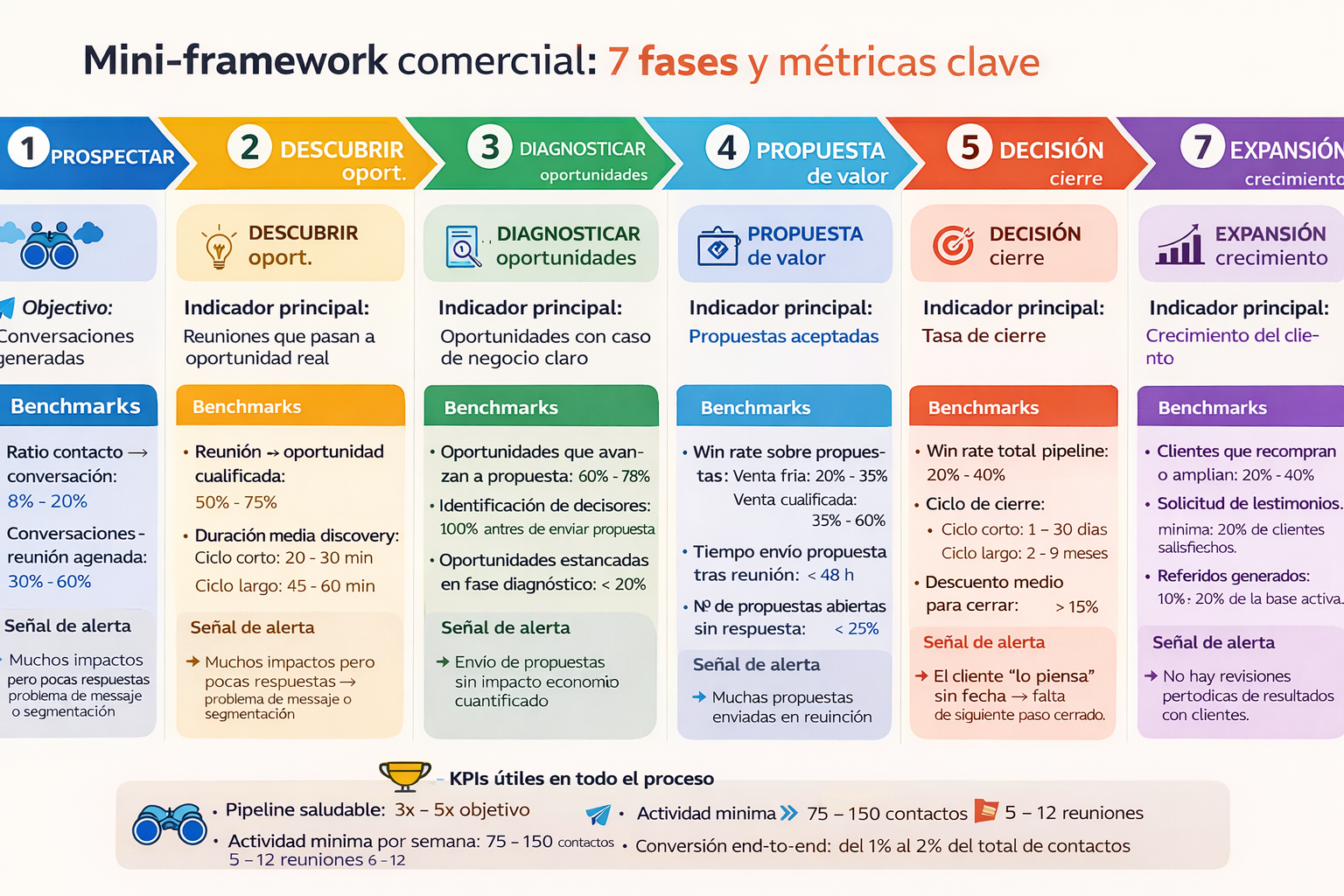
Perfect. Here is the mini-framework with benchmark metrics so that any salesperson can measure their performance phase by phase and quickly identify bottlenecks.
The ranges are designed for consultative B2B and B2C environments; you can adjust them according to average ticket and sector.
Sales mini-framework with benchmark metrics
PROSPECTAR → DESCUBRIR → DIAGNOSTICAR → PROPUESTA → DECISIÓN → ACTIVACIÓN → EXPANSIÓN1️⃣ PROSPECTING
Main indicator: Generated conversations
Benchmarks
- Contact → conversation ratio: 8% – 20%
- Conversations → scheduled meeting: 30% – 60%
- Number of new meetings/week:
- Consultative sale: 3 – 8
- Transactional sale: 8 – 20
Warning sign
➡ Many impacts but few responses → message or segmentation problem.
2️⃣ DISCOVER
Main indicator: Meetings that become a real opportunity
Benchmarks
- Meeting → qualified opportunity: 50% – 75%
- Average discovery duration:
- Short cycle: 20 – 30 min
- Long cycle: 45 – 60 min
Warning sign
➡ If you qualify less than 50%, you are prospecting poorly or talking to profiles without decision-making power.
3️⃣ DIAGNOSE
Main indicator: Opportunities with a clear business case
Benchmarks
- Opportunities advancing to proposal: 60% – 80%
- Identification of decision-makers: 100% before sending proposal
- Opportunities stuck in diagnostic phase: < 20%
Warning sign
➡ Sending proposals without quantified economic impact.
4️⃣ VALUE PROPOSITION
Key indicator: Accepted proposals
Benchmarks
- Win rate on proposals:
- Cold outreach: 20% – 35%
- Qualified outreach: 35% – 60%
- Time to send proposal after meeting: < 48 h
- Number of open proposals without response: < 25%
Warning sign
➡ Many proposals sent and few defended in a meeting.
5️⃣ DECISION
Key indicator: Close rate
Benchmarks
- Total pipeline win rate: 20% – 40%
- Closing cycle:
- Short cycle: 1 – 30 days
- Long cycle: 2 – 9 months
- Average discount to close: < 15%
Warning sign
➡ The client “thinks about it” with no deadline → lack of a closed next step.
6️⃣ ACTIVATION (ONBOARDING)
Key indicator: Time to Value
Benchmarks
- Activation after signing: < 7 days
- First tangible result:
- Services: 30 – 60 days
- SaaS: 7 – 30 days
- Active customers after 90 days: > 85%
Warning sign
➡ Onboarding delays = risk of early churn.
7️⃣ EXPANSION
Key indicator: Customer growth
Benchmarks
- Repeat/expand customers: 20% – 40%
- Testimonial requests: minimum 30% of satisfied customers
- Referrals generated: 10% – 20% of active base
- Healthy LTV/CAC: > 3
Warning sign
➡ No regular reviews of results with clients.
Global business health benchmarks
Pipeline coverage
- Total pipeline: 3x – 5x the monthly target
Minimum weekly activity (per salesperson)
- New contacts: 75 – 150
- Follow-ups: 30 – 60
- Meetings: 5 – 12
- Proposals: 2 – 6
Indicative end-to-end conversion
Out of 100 contacts:
- 15 conversations
- 8 meetings
- 5 opportunities
- 3 proposals
- 1 – 2 sales
How to interpret your metrics (quick read)
- ❌ Many meetings and few proposals → qualification problem
- ❌ Many proposals and few closures → diagnosis or value problem
- ❌ Many closures and little recurrence → expectation and onboarding problem
- ❌ Empty pipeline → lack of prospecting system
Golden rule
What is not measured cannot be improved.
And what is measured by phase tells you exactly which skill to train.
Closing
If you fix just these 7 errors, something very specific happens: friction decreases, confidence increases, and your pipeline becomes more stable. Less rollercoaster, less anxiety-driven discounts, and more customers who stay.
Leave a comment