In marketing, we have heard for years that “experience is everything”. But rarely do we see a brand capable of transforming a simple product shipment into a cultural phenomenon capable of dominating TikTok, Instagram Reels, specialised media, and spontaneous conversations on social networks.
That is exactly what Miu Miu has achieved with the launch of its fragrance Fleur de Lait.
It has not just sold a perfume.
It has sold curiosity.
It has sold play.
It has sold texture.
It has sold participation.
It has sold user-generated content.
And, above all, it has understood something fundamental in 2026:
Brands no longer compete solely for attention.
They compete to become content.
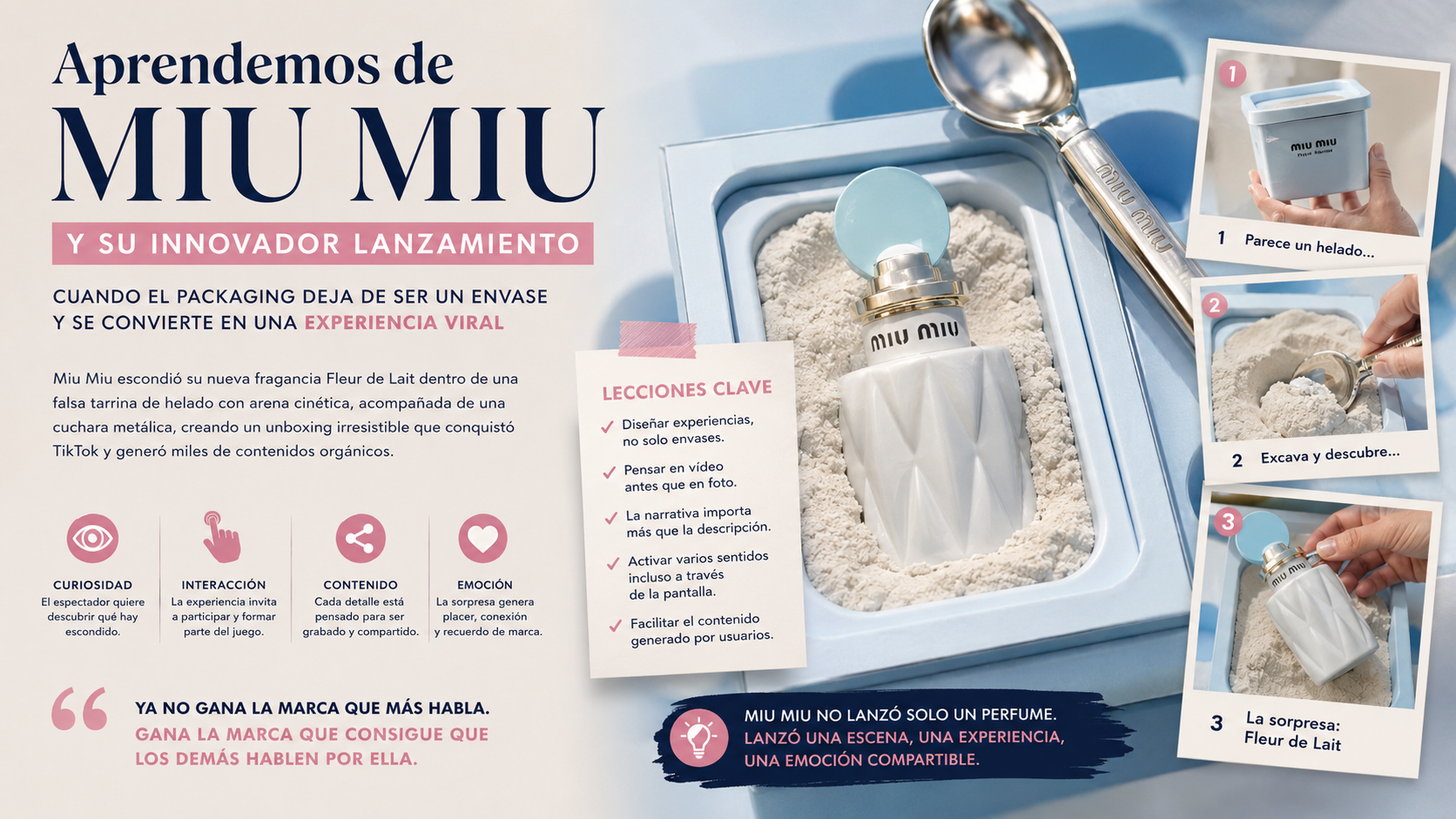
The Italian fashion house hid the perfume inside a fake ice cream tub made of kinetic sand, forcing the content creator to “dig” with a personalised metal spoon to discover the product. (Reason Why)
And therein lies the genius.
Because consumers no longer want to observe a campaign.
They want to participate in it.
The big problem with perfume marketing on social media
Perfume has always had a huge challenge in digital environments:
It cannot be smelled.
While a burger can be shown, a car can be driven by an influencer, and trainers can be tried on in front of the camera, a perfume depends on something impossible to convey through a screen.
Miu Miu understood this limitation and decided not to fight against it.
It decided to go around it.
Instead of trying to explain the olfactory notes of Fleur de Lait, the brand turned the launch into a multi-sensory experience based on universal emotional references: summer, ice cream, creamy texture, nostalgia, play, and visual pleasure. (Tapas)
This is extremely important.
Because many brands continue to communicate products based on technical characteristics, while new generations buy sensations.
Packaging no longer protects the product: it creates content
For decades, packaging had three functions:
- to protect
- to transport
- to identify
Today it has a much more important fourth function:
generating shareable content
Packaging has become a communication medium.
And that completely changes the rules.
Miu Miu didn't design a box.
It designed a scene.
Every detail was designed to be recorded:
- the metal spoon
- the texture of the fake ice cream
- the kinetic sand
- the ASMR sound
- the progressive reveal
- the final surprise
- the pastel colours
- the “premium” feel
- the manual interaction
Nothing was accidental.
Everything was designed to turn the unboxing into a spectacle. (lobemark.com)
And here lies one of the most important lessons for any brand.
Campaigns are no longer designed just for the end consumer
They are designed for the consumer’s camera.
The new consumer doesn’t buy products: they buy moments
We live in an experience economy.
But now we are entering something even deeper:
the shareable moment economy
People share things that:
- surprise
- excite
- entertain
- spark curiosity
- generate conversation
- seems exclusive
- provokes reaction
Miu Miu perfectly understood TikTok's logic:
The algorithm rewards:
- retention
- surprise
- interaction
- curiosity
- participation
That's why the format works so well.
Because the user wants to see:
- what's underneath
- what happens next
- how the influencer will react
- what the final result will be
The campaign turns a perfume into a narrative.
And that completely changes the product's viral potential.
The psychological power of curiosity
George Loewenstein, a behavioural economist, developed the so-called Information Gap Theory.
The theory explains that curiosity arises when there is a difference between what we know and what we want to know.
Miu Miu exploits exactly this psychological mechanism.
The viewer needs to discover:
- what's hidden
- what the box contains
- what's under the “ice cream”
- why everyone is sharing this video
The human brain hates information gaps.
That's why we keep watching the video until the end.
Luxury has changed: from status to experience
For years, luxury was built on:
- exclusivity
- inaccessibility
- distant sophistication
Today's successful luxury incorporates:
- playfulness
- participation
- irony
- virality
- digital aesthetics
- internet culture
Miu Miu has spent years understanding this better than many historic luxury brands.
The brand doesn't try to seem solemn.
It tries to seem culturally relevant.
And that's very different.
Sensory marketing no longer depends solely on the point of sale
Traditionally, sensory marketing was developed in physical stores:
- music
- lighting
- scents
- textures
- temperature
But social media has forced a reinterpretation of all that.
Now brands try to evoke sensations even through screens.
How?
Through:
- ASMR
- visual textures
- sounds
- slow movements
- emotional references
- physical storytelling
Miu Miu's campaign is brilliant because it translates scent into a visual and tactile experience. (newwavemagazine)
Even if you can't smell the perfume…
…you can imagine it.
And in branding, that is pure power.
The product ceases to be the protagonist
This seems contradictory.
But the smartest brands no longer place the product at the centre.
They place the experience around the product.
Apple understood this years ago.
Nike too.
Lego does it constantly.
Miu Miu applies exactly that logic.
The perfume doesn't appear immediately.
It is hidden.
This increases:
- narrative tension
- curiosity
- visual permanence
- engagement
- brand recall
The importance of "doing"
Traditional marketing was contemplative.
The consumer watched.
New marketing is participatory.
The consumer does.
Dig.
Discover.
Serve.
Break.
Try.
Assemble.
Interact.
The most successful current campaigns make the user the protagonist.
And that has a huge consequence:
the experience is remembered more
Because the brain better remembers what it participates in.
The smartest thing: the concept fits the product
Here lies one of the big differences between a viral campaign and a brilliant campaign.
Many campaigns are eye-catching.
Pero pocas tienen coherencia conceptual.
Miu Miu sí la tiene.
La fragancia contiene notas de:
- mango
- coco
- leche de coco
- flores suaves
- sensaciones cremosas y tropicales (Tapas)
Por eso el concepto helado no parece forzado.
Parece natural.
Y cuando el storytelling conecta con el producto, el consumidor percibe autenticidad.
TikTok ha cambiado el diseño de producto
Este caso demuestra algo enorme:
hoy algunos productos se diseñan pensando primero en cómo se verán en redes sociales
Esto transforma:
- packaging
- colores
- aperturas
- sounds
- textures
- mecanismos
- interaction
Las marcas empiezan a pensar:
“¿Cómo se grabará esto?”
Y eso modifica completamente el proceso creativo.
El auge del “marketing excavable”
Puede parecer exagerado, pero estamos entrando en una era donde:
- abrir
- romper
- rascar
- descubrir
- desenterrar
…genera más engagement que simplemente mostrar.
The audience needs constant stimulation.
It needs micro-rewards.
Each spoonful of the fake ice cream generates a new visual mini-reward.
That brutally increases retention.
The campaign works because it seems organic
Another key point.
The action seems created for influencers.
But it doesn't seem like traditional advertising.
And that's exactly what platforms are looking for.
The content that works best is that which:
- entertains first
- sells later
We learn something essential about the algorithm
The algorithm no longer rewards only reach.
It rewards:
- viewing time
- replays
- saves
- shares
- comments
- emotional reactions
The Miu Miu campaign activates practically all these indicators.
Because it provokes:
- surprise
- curiosity
- desire
- visual satisfaction
- conversation
Luxury also needs to play
Many brands continue to communicate luxury from:
- rigidity
- distance
- cold perfection
But new generations connect more with:
- imperfection
- spontaneity
- playfulness
- authenticity
- humour
- immersive experiences
Miu Miu perfectly understands digital cultural codes.
And that allows it to appear contemporary without losing exclusivity.
What any brand can learn from this case
You don't need to be a luxury brand to apply these ideas.
Any company can ask itself:
- Does my product generate interaction?
- Does my packaging invite participation?
- Does the consumer want to record the experience?
- Is there surprise?
- Is there a narrative?
- Can the experience be shared?
- Am I designing for social media or just for physical shelves?
Practical lessons for brands and retailers
1. Design experiences, not just packaging
Packaging should communicate even before it's opened.
2. Think video before photography
Current social media favours movement and interaction.
3. Turn the product into a story
Narrative matters more than technical description.
4. Design for the algorithm
Curiosity, surprise, and participation increase reach.
5. Engage multiple senses
Even if the consumer cannot touch the product, they can imagine it.
6. Facilitate user-generated content
The less the influencer has to “invent”, the more likely they are to post.
7. Unboxing is already part of the product
Opening something can be as important as using it.
Strategic CAME applied to the Miu Miu case
| Factor | Application |
|---|---|
| Correct | The difficulty of selling perfumes online |
| Face | Content saturation on TikTok |
| Maintain | Exclusivity and premium aesthetics |
| Exploit | Virality, ASMR, and unboxing culture |
The big conclusion
Miu Miu didn’t just launch a fragrance.
It launched:
- a scene
- an experience
- an interaction
- a piece of content
- a shareable emotion
It understood that in 2026:
- packaging communicates
- unboxing sells
- experience goes viral
- interaction creates memorability
- and user-generated content can be more valuable than a conventional campaign
Because the brand that talks the most no longer wins.
Gana la marca que consigue que los demás hablen por ella.
Y ahí Miu Miu ha dado una auténtica masterclass de marketing contemporáneo. (Reason Why)
Leave a comment