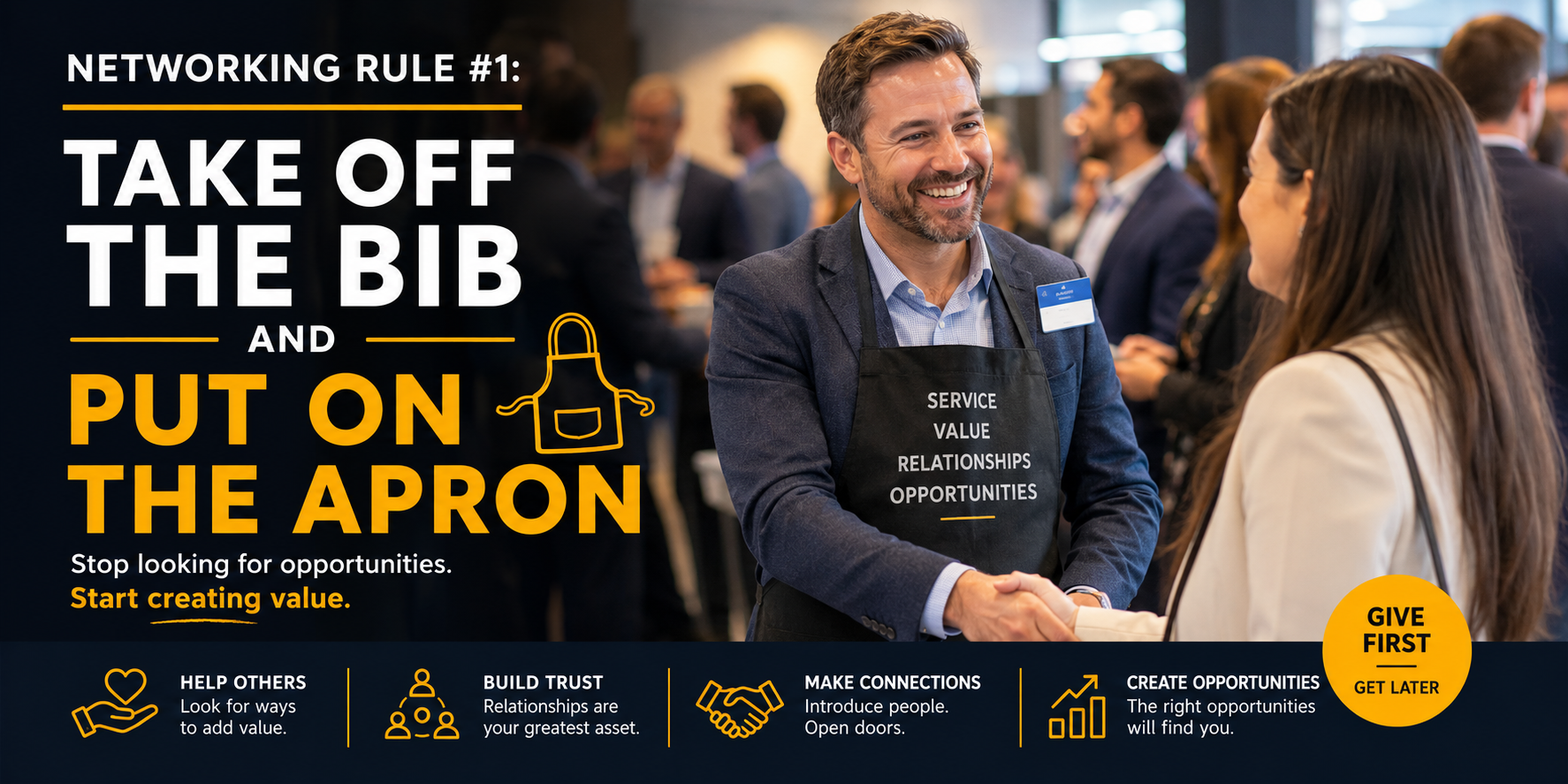
Why during Networking sessions the Best Networkers Stop Asking and Start Serving?
A Practical Guide to Building Relationships That Create Opportunities, Trust and Business Growth
For decades, networking has been presented as a simple formula: attend events, exchange business cards, connect on LinkedIn, and hope that opportunities emerge.
Yet most professionals, entrepreneurs, consultants and salespeople discover an uncomfortable truth:
Networking rarely works when everyone is trying to get something.
Walk into any conference, trade show, chamber of commerce meeting or industry event and you’ll quickly notice a recurring pattern. People introduce themselves, explain what they do, and immediately start looking for what the other person can offer them.
- Can you become a client?
- Can you introduce me to someone?
- Can you help me find a job?
- Can you invest in my startup?
- Can you recommend my company?
This approach treats networking as a transaction.
And transactions rarely create meaningful relationships.
The most successful networkers understand a fundamental principle:
Networking is not about collecting contacts. It is about creating value.
Or, as networking expert Ivan Misner famously summarized:
«Take off the bib and put on the apron.»
The bib symbolizes someone sitting at the table waiting to be fed.
The apron symbolizes someone serving others.
The difference may seem subtle, but it completely changes the outcome of your networking efforts.
The Networking Mistake Most Professionals Make
Many people attend networking events with a hidden agenda.
Even when they try to appear interested in others, their internal dialogue sounds something like this:
- How can this person help me?
- Can they become a customer?
- Can they introduce me to someone important?
- Can they give me a job?
- Can they help me grow my business?
The problem is that everyone can sense when they’re being treated as a means to an end.
Human beings are remarkably good at detecting self-interest.
When networking becomes a hunt for opportunities, conversations feel forced.
Relationships become superficial.
Trust never develops.
And eventually the connection disappears.
Ironically, the harder people chase opportunities, the fewer opportunities they receive.
Why Giving Creates More Opportunities Than Asking
Psychology offers a simple explanation.
Human relationships are built on reciprocity.
According to social psychologist Robert Cialdini, one of the most powerful principles influencing human behavior is the desire to return favors.
When someone helps us, we naturally want to help them in return.
But there’s a crucial distinction.
People respond positively when help is given genuinely.
They react negatively when help is used as manipulation.
Effective networking is not about keeping score.
It’s about creating value consistently enough that trust develops naturally.
When trust exists, opportunities emerge almost automatically.
The New Reality of Networking in 2026
The networking landscape has changed dramatically.
Today, networking no longer happens only at conferences and business breakfasts.
It happens:
- On LinkedIn
- In WhatsApp groups
- Through newsletters
- In online communities
- Via podcasts
- Through webinars
- In Slack channels
- In industry forums
- Through content creation
Every interaction becomes an opportunity to build or destroy trust.
The professionals creating the strongest networks today are not necessarily the most connected.
They are the most helpful.
They share:
- Knowledge
- Resources
- Contacts
- Ideas
- Experiences
- Solutions
Long before they ask for anything.
The Apron Mindset
Putting on the apron means entering every interaction with a different question.
Instead of asking:
«What can I get from this person?»
Ask:
«How can I help this person?»
This shift transforms networking from a sales activity into a relationship-building activity.
The most effective networkers are constantly looking for ways to:
- Introduce people who should know each other.
- Share relevant articles.
- Recommend suppliers.
- Provide insights.
- Solve problems.
- Open doors.
Many of these actions require only a few minutes.
Yet they create enormous goodwill.
Why Generosity Becomes a Competitive Advantage
In a world saturated with sales pitches, generosity stands out.
Consider two professionals.
Professional A
- Talks mostly about themselves.
- Explains their services.
- Hands out business cards.
- Requests meetings.
- Follows up asking for opportunities.
Professional B
- Listens carefully.
- Identifies challenges.
- Shares useful resources.
- Makes introductions.
- Offers practical advice.
Which one will people remember?
Which one will receive referrals?
Which one will be trusted?
The answer is obvious.
Trust is the currency of modern networking.
And generosity is one of the fastest ways to earn it.
The Hidden ROI of Helping Others
Many professionals worry that helping others takes time away from growing their own business.
The reality is often the opposite.
Helping creates assets that compound over time.
Every meaningful interaction builds:
Social Capital
People remember who helped them.
Reputation
Your name becomes associated with value.
Visibility
Others begin recommending you.
Trust
Future conversations start from a position of credibility.
Opportunity Flow
Referrals arrive naturally.
Unlike advertising, these benefits continue accumulating long after the initial interaction.
Networking Lessons from Successful Business Leaders
Many influential leaders built their careers through service-oriented networking.
Consider the philosophy of entrepreneur and author Adam Grant, whose research highlights the power of «givers.»
His studies consistently show that professionals who focus on helping others often outperform those focused exclusively on personal gain.
Why?
Because networks amplify generosity.
One helpful action can reach dozens or hundreds of people through referrals and recommendations.
A self-centered approach rarely scales.
A value-creation approach does.
How LinkedIn Rewards the Apron Mentality
LinkedIn has become one of the world’s largest networking platforms.
Yet most users still approach it incorrectly.
They:
- Send connection requests with sales pitches.
- Spam direct messages.
- Ask for meetings immediately.
- Promote products constantly.
This behavior damages credibility.
A more effective strategy involves:
Sharing Useful Content
Educate before selling.
Engaging Meaningfully
Comment thoughtfully on posts.
Supporting Others
Celebrate achievements.
Making Introductions
Connect people who can help each other.
Providing Insights
Answer questions generously.
Over time, these actions position you as a trusted expert rather than another salesperson.
The Networking Formula Used by Top Consultants
Successful consultants often follow a simple sequence.
Step 1: Give
Share ideas.
Step 2: Help
Solve small problems.
Step 3: Build Trust
Demonstrate expertise.
Step 4: Stay Visible
Maintain relationships.
Step 5: Let Opportunities Emerge
Allow business discussions to happen naturally.
Notice what is missing.
There is no aggressive selling.
No pressure.
No manipulation.
Just value creation.
Networking at Trade Shows and Industry Events
Trade shows remain one of the most powerful networking environments.
Whether attending events in marketing, retail, DIY, technology or manufacturing, the same principle applies.
Most attendees focus on collecting leads.
The best attendees focus on creating connections.
Instead of asking:
«What can you do for me?»
Ask:
- What challenges are you facing?
- What trends are you seeing?
- How can I help?
- Who should I introduce you to?
These conversations tend to be longer, more memorable and more productive.
The Power of Becoming a Connector
One of the fastest ways to build influence is becoming a connector.
A connector introduces people who can benefit from knowing each other.
Importantly, they do not always expect anything in return.
When you become known as someone who helps others connect:
- People seek your advice.
- Opportunities find you.
- Your network grows organically.
- Your reputation expands.
You become a trusted node within your professional ecosystem.
Five Practical Ways to Apply the Apron Principle Today
1. Introduce Two People Every Week
Look through your contacts.
Who should meet each other?
Make the introduction.
2. Share Valuable Content Daily
Post useful insights.
Help your audience learn.
3. Offer Help Before Being Asked
Look for opportunities to assist.
Small gestures create lasting impressions.
4. Follow Up With Value
Don’t follow up asking for something.
Follow up providing something useful.
5. Become Known for Solving Problems
People remember problem-solvers.
They forget sales pitches.
Common Networking Mistakes to Avoid
Talking Too Much About Yourself
People care more about their problems than your biography.
Treating Every Contact as a Prospect
Relationships require time.
Only Reaching Out When You Need Something
This damages trust.
Forgetting to Follow Up
Relationships fade without maintenance.
Measuring Every Interaction by Immediate ROI
Networking is a long-term investment.
Why Authenticity Matters More Than Ever
Artificial intelligence can generate messages.
Automation can schedule outreach.
CRM systems can manage contacts.
But genuine human relationships remain impossible to automate.
People still choose to work with people they trust.
Authenticity has become a differentiator.
The professionals who stand out are those who:
- Listen sincerely.
- Care genuinely.
- Help consistently.
- Deliver value repeatedly.
Technology changes.
Human nature does not.
The Long-Term Impact of Service-Based Networking
The true power of networking often appears years later.
A connection made today may become:
- A future client.
- A strategic partner.
- An investor.
- An employee.
- A mentor.
- A supplier.
- A friend.
Relationships develop over time.
The strongest professional networks are built through hundreds of small acts of generosity accumulated over many years.
That is why networking should never be viewed as a short-term tactic.
It is a long-term strategy for personal and professional growth.
Conclusion: Stop Looking for Opportunities and Start Creating Them
The most valuable lesson in networking is surprisingly simple.
Take off the bib.
Put on the apron.
Stop approaching relationships with the mindset of consumption.
Start approaching them with the mindset of contribution.
The professionals who create the greatest opportunities are rarely the ones asking for favors.
They are the ones creating value, solving problems and helping others succeed.
In a world where everyone is competing for attention, generosity becomes a powerful competitive advantage.
And the remarkable paradox of networking is this:
The moment you stop focusing on what others can do for you and start focusing on what you can do for others, opportunities begin to find you.
That is the real secret behind lasting professional relationships, sustainable business growth and meaningful networking success.
Deja un comentario