There are marketing books that start by talking about segmentation, funnels, metrics, positioning or conversion.
Others begin by promising us the definitive method to sell more.
And then there are books that take a completely different path.
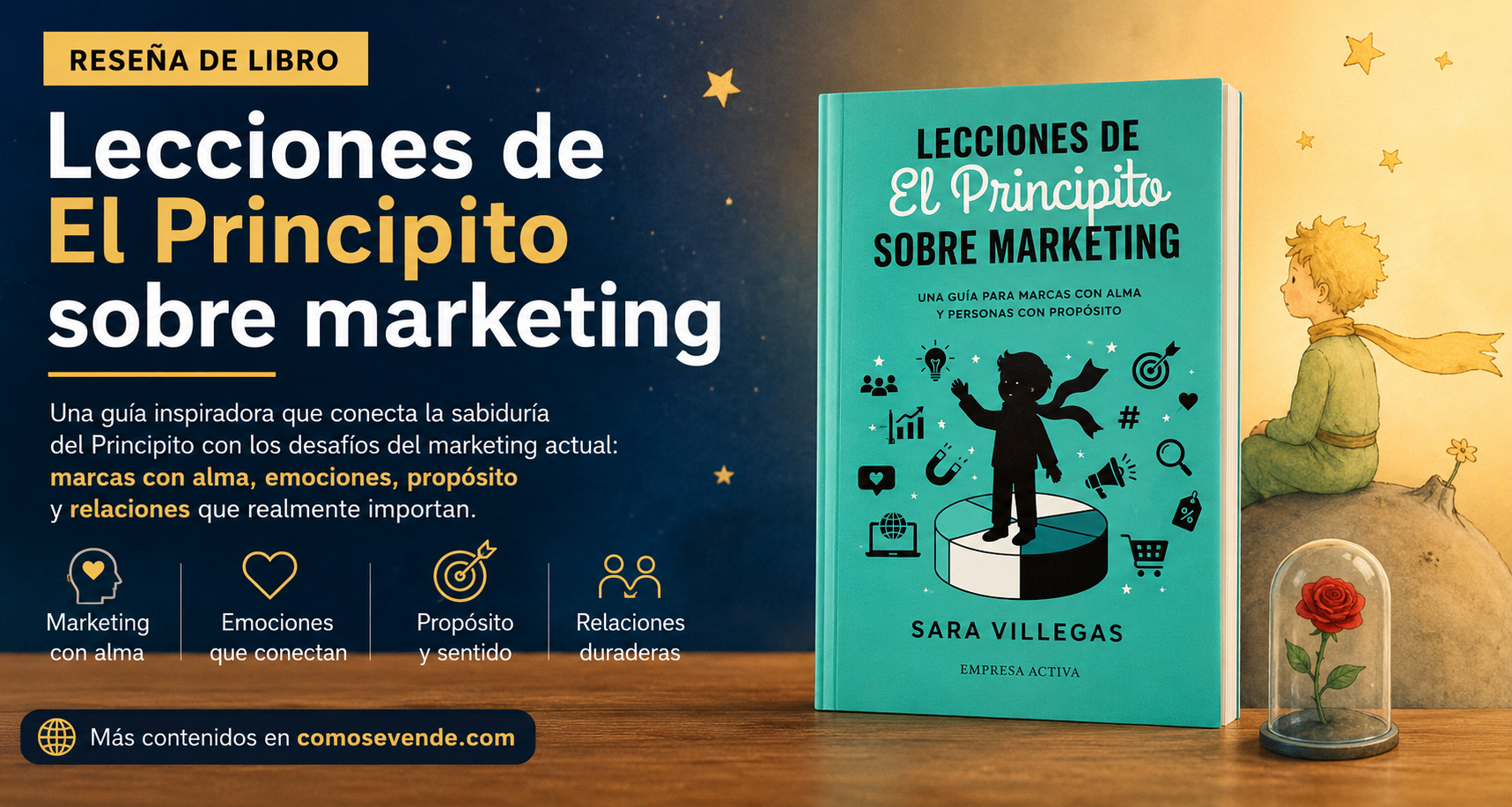
Lessons from The Little Prince on marketing, by Sara Villegas, clearly belongs to this latter category.
I read it with curiosity, initially even with some caution. Linking such a universal work as The Little Prince, by Antoine de Saint-Exupéry, with marketing could easily have ended up as a collection of pretty metaphors.
But precisely the opposite happens.
Sara Villegas achieves something much more difficult: using the characters, planets and teachings of The Little Prince as mirrors in which to observe many of the current behaviours of brands.
And she does so with surprising naturalness.
The King becomes a reflection on authoritarian marketing.
The Vain Man leads us towards the marketing of appearances.
The Businessman represents our obsession with figures.
The Lamplighter confronts us with automated marketing.
The Fox returns us to relational marketing.
The Geographer leads us towards research.
The Rose introduces care.
And finally, we return to asteroid B-612 to talk about marketing with soul.
The structure is not a simple literary device.
It is practically a map of many of the dilemmas of contemporary marketing.
That is why I consider this to be one of those books that every marketing professional should read, underline, and re-read some time later.
Because we will probably find different things in each reading.
What is Lessons from The Little Prince on marketing about
The book was published in 2026 by Empresa Activa and has 288 pages. Its author, Sara Villegas, is a specialist in marketing, communication and branding and has over twenty years of experience in companies, agencies, teaching and media.
But simply defining it as a marketing book would be an understatement.
The question it poses from the outset is much more interesting:
What makes some brands be felt while others are simply seen?
The answer runs through practically the entire book.
Marketing cannot be reduced to capturing our attention.
It must make that attention mean something.
This connects directly with a reflection I have been making for years in How to Sell: people rarely buy exclusively functional features.
Back in my article Why is it better for a brand to sell emotions than functionality? I argued precisely that the view of the consumer as an exclusively rational decision-maker is insufficient.
We buy utility, yes.
But we also buy trust, identity, recognition, belonging, memories, expectations, and emotions.
Sara Villegas' book takes this idea even further:
a brand should not limit itself to provoking emotions; it should build meaningful relationships.
1. The King: when commanding doesn't mean communicating
The first planet is particularly recognisable within many organisations.
The King represents authoritarian marketing.
It is the company that continues to think that communicating essentially consists of issuing messages:
We speak.
The consumer listens.
For decades, a good part of advertising worked like this.
Companies bought space on television, radio, newspapers, or outdoor advertising and had something that is now extraordinarily scarce: a monopoly on the conversation about their own brand.
The internet destroyed that model.
Now consumers talk to each other, compare experiences, post photos, rate products, question campaigns, and can provoke a reputational crisis from a mobile phone.
The brand no longer completely controls its narrative.
It can participate in it.
And that forces a substitution of authority for conversation.
Even a complaint can become an extraordinary opportunity to listen and build trust. It is something I recently analysed in how to turn a complaint into a viral marketing campaign, where negative criticism ends up becoming a lesson in customer experience and emotional marketing.
The King has to get off his throne.
Because communicating no longer means commanding.
It means listening.
2. The Vain Man: the dictatorship of appearing
He is probably one of the most contemporary characters from The Little Prince.
The Vain Man wants to be admired.
Translated into current marketing:
he wants followers.
He wants likes.
He wants views.
He wants impressions.
It wants engagement.
It wants virality.
The awkward question is another:
for what?
One of the biggest problems with digital marketing has been turning some intermediate metrics into final objectives.
A post can get thousands of views and change absolutely nothing in the relationship between a brand and its customers.
We can get attention without getting relevance.
We can get notoriety without gaining trust.
We can even achieve virality without achieving business.
Hence a distinction that seems fundamental to me:
liking is not the same as connecting.
In Social Media Isn't Dead: The New Marketing System for Companies Wanting to Sell in 2026, I reached a very similar conclusion: in an ecosystem saturated with content and automation, publishing more guarantees nothing.
What's different is once again the human element.
3. The Drinker: entertaining doesn't always mean connecting
We live in probably the greatest attention economy in history.
TikTok.
Instagram.
YouTube.
Shorts.
Reels.
Notifications.
Podcasts.
Newsletters.
Streaming.
AI-generated content.
Everything competes for a few seconds of our attention.
The result is paradoxical.
We've never had so many tools to communicate, and perhaps we've never produced so much noise.
Marketing can then fall into the temptation of the Drinker: constantly entertaining to avoid asking if it's really contributing anything.
Achieving attention becomes the goal.
But attention without meaning has an extremely short lifespan.
A brand should ask itself:
do I want the consumer to see me or do I want them to remember me?
It's not exactly the same thing.
4. The Businessman: when Excel replaces the customer
This is probably one of my favourite planets from the book.
The Businessman counts.
He sums.
He ranks.
He accumulates.
In contemporary marketing, we could surround him with dashboards:
CAC.
ROAS.
CTR.
CPL.
LTV.
Conversion Rate.
Engagement.
Impressions.
Reach.
They are all important.
The problem arises when we confuse measuring reality with understanding it.
A dashboard can tell us what happened.
But it doesn't always explain why it happened.
And there we need something that no Excel sheet can completely replace:
understanding people.
Data needs context.
Metrics need interpretation.
And algorithms need judgement.
5. The Lamplighter: automating without switching off humanity
Perhaps this is the chapter that gains the most importance in 2026.
We are entering an era of extraordinary automation.
Generative artificial intelligence.
Autonomous agents.
Predictive CRMs.
Algorithmic personalisation.
Chatbots.
Marketing automation.
Automatically generated content.
Technology allows us to multiply our capacity to produce, analyse and communicate.
But an uncomfortable question arises:
what happens when we also automate what made our relationship with the customer human?
In How to Master Artificial Intelligence in Marketing, I argued precisely that AI should act as a co-pilot: accelerating processes, analysing information and freeing up time for that where human judgement continues to be a differentiator.
And in Heidegger vs. Artificial Intelligence: The Hand, Technology, and the Meaning of Selling in the Algorithmic Era, I raised an even deeper question: the real risk of technology lies not only in what it can do, but in allowing it to end up determining how we understand the world.
The Lamplighter turns on and off because he has always done so.
The algorithm publishes because it is programmed to publish.
But someone should keep asking:
why?
6. The Fox: building bonds takes time
Here we find probably one of the most powerful ideas from The Little Prince applied to marketing.
Bonds take time.
And that is almost revolutionary in an economy obsessed with accelerating absolutely everything.
We want leads immediately.
Conversions immediately.
Sales immediately.
Results immediately.
But human relationships don't work like that.
Trust requires repetition.
Consistency.
Experiences.
Keeping promises.
Time.
Relationship marketing begins precisely when we stop asking ourselves:
how do I get this person to buy?
and we start asking ourselves:
what would need to happen for this person to want to continue a relationship with us?
The difference seems small.
In reality, it completely changes the strategy.
7. The Rose: caring is also marketing
One of the best ideas in the book appears when we get to the Rose.
Caring marketing.
Because acquiring a customer is relatively simple compared to getting them to continue to trust us.
Organisations often invest enormous amounts of resources in acquisition.
Advertising.
Promotions.
SEO.
SEM.
Influencers.
Lead generation.
But after acquiring the customer, paradoxically, many companies reduce their effort.
Marketing should continue after the sale.
Perhaps we could even say that true marketing begins after the first sale.
There we discover if the promise made by advertising matches the actual experience.
8. From emotional marketing to Brand 3.0
Here I find another direct bridge between the book and some ideas developed over years in How to Sell.
In Brand 3.0: the evolution of emotional marketing I explained how brands had evolved from communication focused mainly on products towards models where values, purpose, and emotions acquired ever greater importance.
The consumer ceases to be simply a buyer.
They are a person.
They have values.
Contradictions.
Aspirations.
Fears.
Identity.
Context.
Precisely therein lies one of the great successes of Sara Villegas's book.
She doesn't just talk about how to build brands.
She talks about people using brands as an excuse.
9. The essence of a brand can also be invisible
Here we inevitably find the great metaphor.
Many of a company's most important assets do not appear directly on its balance sheet.
Trust.
Reputation.
Credibility.
Recall.
Affinity.
Sense of belonging.
Culture.
Purpose.
Relationship with its customers.
We can try to measure them.
But no metric manages to capture them completely.
A brand is, to a large extent, what happens in people's minds when the company is not there to explain who it is.
That's why some companies sell products.
And others build meaning.
10. Marketing with soul in the age of artificial intelligence
There is also a reason why I consider this book particularly timely in 2026.
We are experiencing the explosion of artificial intelligence applied to marketing.
It has never been so easy to produce.
We can generate a hundred headlines in seconds.
Fifty images.
Twenty ads.
Thousands of personalised emails.
Videos.
Presentations.
Analyses.
Entire campaigns.
Precisely for this reason, a paradox arises:
when producing content tends towards zero cost, value shifts from content to meaning.
Technology can help us write.
But it cannot decide for us what is worth saying.
It can optimise a campaign.
But someone has to decide which values should not be sacrificed to improve a conversion.
It can personalise thousands of messages.
But personalisation does not necessarily mean relationship.
It can simulate empathy.
But simulating empathy and caring for a customer are not exactly the same thing either.
The more powerful the technology, the more important the question from the Little Prince becomes:
what are we doing what we do for?
A surprisingly complete cartography of marketing
One of the elements I liked most is the book's architecture.
Each planet allows us to address a different pathology or opportunity in marketing:
| Character / place | Marketing reading | Risk | Necessary evolution |
|---|---|---|---|
| King | Authoritarian marketing | Ordering instead of listening | Conversation |
| Vain | Appearance marketing | Confusing visibility with relevance | Authenticity |
| Drinker | Evasion marketing | Entertaining without contributing | Meaning |
| Businessman | Figure marketing | Confusing data with knowledge | Understanding |
| Bluffer | Automated marketing | Repetition without purpose | Human automation |
| Fox | Relationship marketing | Turning links into transactions | Trust |
| Aviator | Authenticity marketing | Making up instead of showing | Coherence |
| Gardener | Preventive marketing | Reacting too late | Anticipation |
| Astronomer | Specialisation | Looking too little | Perspective |
| Geographer | Research | Confusing maps with reality | Exploration |
| Rose | Marketing with care | Controlling instead of cultivating | Relationship |
| B-612 | Marketing with soul | Meaningless strategy | Purpose |
Viewed this way, the structure of The Little Prince ceases to be solely a literary reference.
It becomes a marketing framework.
And I find that especially original.
What I liked most about the book
I would fundamentally take away three things.
The first is the originality of the approach.
There are thousands of books explaining branding, emotional marketing, customer experience, or purpose. Using The Little Prince as a common thread allows us to observe known problems from an unexpected perspective.
The second is the ease with which Sara Villegas connects literature and marketing.
A metaphor should never become mere decoration.
A good metaphor serves to understand something complex in a different way.
And here it works.
The third is probably the most important:
the book puts people back at the centre of marketing.
In an era fascinated by artificial intelligence, automation, algorithms, and data, it is paradoxically revolutionary to remember something extremely simple:
Behind every impression there is a person.
Behind every lead there is a person.
Behind every conversion there is a person.
Behind every abandoned cart there is a person.
And behind every KPI there should also be a person.
My rating: a book to read, underline, and re-read
I finished The Little Prince on Marketing Lessons with an unusual feeling.
It is not simply a book from which to extract techniques.
It is a book to which I will probably return.
And I think that is one of the best things that can be said about a book.
Some books are for learning something.
Others are for consulting.
And some are for thinking.
This one belongs to the third category.
That is why I consider it one of those books that any marketing professional should read, underline, and re-read after some time.
Because we will surely not find exactly the same book.
We will have changed.
And perhaps that is also one of the most beautiful lessons we can take from The Little Prince.
Marketing changes.
Tools change.
Channels change.
Algorithms change.
Now we also have artificial intelligence.
But there is something that remains surprisingly stable:
we are still trying to understand other people.
Perhaps, after so many decades searching for new models, new technologies, and new formulas, we will discover that a part of the future of marketing was hidden since 1943 in the story of a little traveller who journeyed through planets asking questions.
Apparently naive questions.
But enormously difficult to answer.
And perhaps that is the main lesson I take from the book:
good marketing does not start by talking. It starts by looking, listening, and asking.
Because in marketing too, very often, what is truly important is not what we manage to measure, but what we manage to mean to someone.
Book details
Title: The Little Prince on Marketing Lessons
Author: Sara Villegas
Publisher: Empresa Activa
Year: 2026
Length: 288 pages
ISBN: 978-84-18308-31-4
Topics: Marketing, branding, communication, emotional marketing, and purpose.
Related reading on How to Sell
- Why is it better for a brand to sell emotions than functionality?
- Brand 3.0: the evolution of emotional marketing
- How to turn a complaint into a viral marketing campaign
- How to master Artificial Intelligence in marketing
- Social Media Isn't Dead: The New Marketing System for Businesses Wanting to Sell in 2026
- Heidegger vs. Artificial Intelligence: The Hand, Technique, and the Meaning of Selling in the Algorithmic Era
Leave a comment